For most of the 1990s, one Argentine peso was worth exactly one US dollar. The peg ended hyperinflation and brought stability, until it became a trap. In December 2001, the country froze bank withdrawals, violent protests erupted, the president resigned and Argentina defaulted on its debt. In Part 15 of Great Financial Crises, we look at one of the most dramatic economic collapses of modern times.
From hyperinflation to the peso-dollar peg
Argentina suffered hyperinflation in the late 1980s (see Part 7 on the debt crisis). In 1991, Economy Minister Domingo Cavallo introduced the Convertibility Plan, fixing the peso at one to one with the US dollar. The central bank had to back every peso with a dollar in reserves, effectively a currency board.
The results were impressive at first. Inflation collapsed, foreign investment returned and the economy grew strongly in the early 1990s. Many contracts, loans and bank deposits came to be held in dollars.
The trap
A fixed exchange rate means a country cannot devalue its currency to regain competitiveness or print money to fight recessions. Argentina also kept borrowing abroad to finance government deficits, particularly in the provinces.
Then a series of shocks hit:
- The Mexican crisis of 1994 (Part 11) caused a short recession and bank runs in 1995.
- The Asian and Russian crises (Parts 12 and 13) made investors wary of emerging markets.
- In January 1999, Brazil, Argentina's main trading partner, devalued its currency, making Argentine exports less competitive.
- The strong US dollar kept the peso expensive.
Argentina entered a recession in the third quarter of 1998 that lasted until 2002. As the economy shrank, tax revenues fell, debts rose relative to output and investors demanded ever-higher interest rates.
Austerity and IMF support
The government, led by President Fernando de la Rúa from late 1999, cut spending and raised taxes to show it could pay its debts, with support from IMF loan packages. But austerity deepened the recession, unemployment rose above 20% by late 2001 and public anger grew.
The corralito
As Argentines feared a devaluation, they began withdrawing their savings from banks. On 2 December 2001, the government introduced the corralito ("little corral"), limiting cash withdrawals to about 250 a week (in pesos or dollars) and restricting money transfers abroad. People could still use cards and cheques, but the economy, heavily dependent on cash, ground to a halt.
December 2001: the explosion
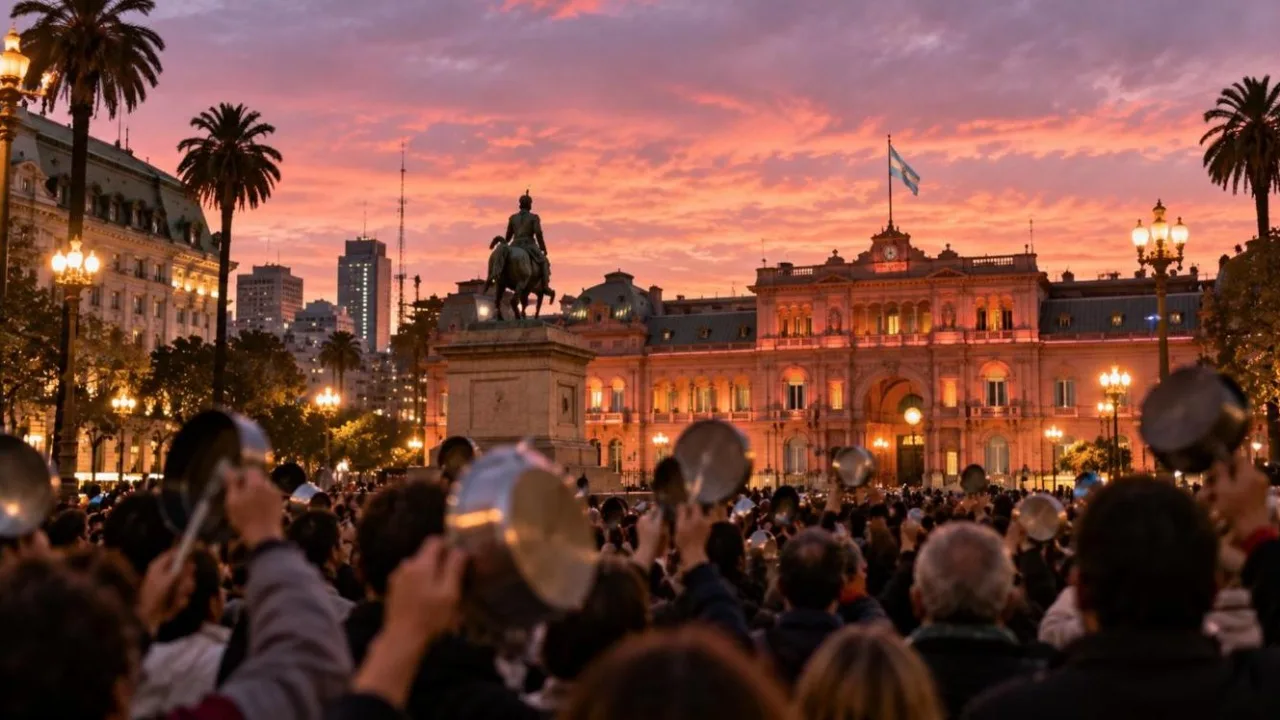
Protests and looting spread. Middle-class citizens banged pots and pans in the streets, a protest known as the cacerolazo. Violent clashes around Buenos Aires's Plaza de Mayo left people dead. On 20 to 21 December, de la Rúa resigned and famously left the presidential palace, the Casa Rosada, by helicopter.
Within about two weeks, Argentina had a succession of presidents, including a caretaker and an interim president. Interim President Adolfo Rodríguez Saá announced that Argentina would stop paying its debts, one of the largest sovereign defaults in history at the time, with figures commonly cited around $80 billion to $100 billion depending on the measure.
Devaluation
In January 2002, President Eduardo Duhalde ended convertibility. The peso was first set at 1.4 per dollar, then floated, and soon fell to nearly 4 pesos per dollar. Dollar bank deposits and loans were forcibly converted into pesos at different rates, a process called "pesification," which caused heavy losses for savers and legal battles for years.
The human cost
- The economy shrank about 28% from 1998 to 2002, and GDP fell about 11% in 2002 alone.
- Monthly inflation reached about 20% in April 2002.
- Real wages fell sharply.
- By late 2002, more than half of the population was below the poverty line.
Recovery and the long legal battle
Helped by a cheaper peso and a commodity boom, Argentina's economy rebounded strongly from 2003. The government restructured its defaulted bonds in 2005 and 2010, offering creditors steep losses, and around 92% of bondholders eventually accepted. A group of "holdout" investors sued for full payment, leading to a long legal battle in US courts that was settled in 2016.
Argentina has continued to face repeated bouts of high inflation and debt problems since, making it a frequent case study in economics.
Lessons for investors today
- Fixed exchange rates can break. A peg that brings stability can become unsustainable if the economy cannot adjust.
- Dollarised savings are not safe from government action. Governments can freeze or convert deposits in a crisis.
- Austerity in a recession can backfire. Cutting spending while the economy shrinks can deepen the downturn.
- Sovereign bonds carry real default risk, especially for countries with a history of crises.
In Part 16, we turn to the biggest crisis of the modern era: the global financial crisis of 2008.
Sources
Great Financial Crises: the full series
- Part 1: Tulip Mania (1637)
- Part 2: The Mississippi and South Sea Bubbles (1720)
- Part 3: The Panic of 1907
- Part 4: The Wall Street Crash and Great Depression
- Part 5: Weimar Hyperinflation (1923)
- Part 6: The 1970s Oil Shocks and Stagflation
- Part 7: The Latin American Debt Crisis (1982)
- Part 8: Black Monday (1987)
- Part 9: Japan's Bubble and Lost Decades
- Part 10: The Savings and Loan Crisis
- Part 11: The Mexican Peso Crisis (1994)
- Part 12: The Asian Financial Crisis (1997)
- Part 13: Russia's Default and LTCM (1998)
- Part 14: The Dot-Com Bubble (2000)
- Part 15: Argentina's Collapse (2001) (you are here)
- Part 16: The Global Financial Crisis (2008)
- Part 17: Iceland's Banking Collapse (2008)
- Part 18: The Eurozone Debt Crisis
- Part 19: The Covid Crash (2020)
- Part 20: The 2023 Banking Turmoil
This series is for education only and is not investment advice. Figures are taken from the sources listed and other commonly cited historical records, and may vary slightly between sources.