As of about 9:00 AM IST, Sunday 29 November 2026. Based on Reuters' exclusive report of Friday 27 November and follow-up reporting by the Associated Press, CBS News and The Guardian. The Air Force has not confirmed or denied the breach, and key details remain unverified.
Hackers have broken into Cloud One, the US Air Force's flagship cloud computing platform, according to people familiar with the matter who spoke to Reuters. The platform hosts applications that handle Air Force personnel, pay, logistics, maintenance and munitions data, which is why one source told the news agency: "A breach here is a big deal."
A day later, a person familiar with the incident gave the Associated Press a far calmer account, describing the intrusion as a "minor nuisance" that did not touch mission-critical or classified systems. The gap between those two versions is the story for now. Here is what has been reported, what has not, and why the incident matters well beyond one military network.
What Reuters reported
Reuters, citing three people familiar with the matter, said the intrusion was discovered within the past month or so during work to upgrade Cloud One, and that the discovery has caused disruption across the platform. The agency said it could not establish who the hackers were, the full scope of the intrusion or whether any data was stolen.
One source told Reuters the intruders exploited a software vulnerability to reach the platform's control plane, the management layer that runs the underlying cloud environment. The source likened it to a universal remote: in theory, access of that kind could let an intruder check the operational status of military aircraft or follow the movement of spare parts. Reuters stressed it was unclear whether the hackers had actually done anything of the sort, and it could not identify the specific vulnerability.
Investigators have called in US Cyber Command to assess the damage, one source said. Cyber Command did not respond to Reuters' requests for comment.
A very different account from the AP
On Saturday the Associated Press quoted a person familiar with the incident, who was not authorised to discuss it publicly, as saying hackers had infiltrated the system in early 2026, earlier than the timeline in the Reuters report suggests. According to that person, the breach was a minor nuisance, no mission-critical or classified systems were affected, and the Pentagon's cyber defenders have mitigated the threat and improved the military's cybersecurity.
The AP added that the incident is under investigation with the White House's National Security Council and Homeland Security Council. That level of attention sits awkwardly with the "minor nuisance" description, and neither account has been confirmed on the record.
Officially, the Air Force told Reuters and CBS News that it "does not comment on the security posture, vulnerabilities or operational status of specific networks and systems." In a follow-up statement to CBS News, the Defense Department said its systems "are safe, secure, and managed 24-7 by the best experts and teams in the world" and that it "will continue to maintain all mission-critical operations and applications."

What Cloud One is and why it matters
Cloud One was started in 2017 as a one-stop shop for the Air Force's IT needs. It combines services from four commercial cloud operators, Microsoft, Amazon, Oracle and Alphabet's Google, to run a wide range of applications, from personnel records and pay to logistics and maintenance, Reuters reported.
Some of those applications are operational. Reuters named the Air Force's Cloud-Based Command and Control system, which pulls together air defence radar and other data feeds from across North America, and the Theater Integrated Combat Munitions System, which tracks bombs and missiles at more than 200 Air Force locations worldwide. Two of Reuters' sources said Cloud One is among the US military's biggest cloud platforms.
That concentration is the point of a shared platform, and also its risk. Putting many applications on one managed environment makes them cheaper to run and easier to secure in a uniform way. But it also means a single weakness in the management layer can, in principle, expose a great deal at once.
The contractors involved
SAIC was Cloud One's prime contractor until this year, when Leidos took over, according to Reuters. Leidos won a $454.9 million task order in December 2025 to run, modernise and secure the multi-cloud environment, with work expected to run until October 2031, according to the Pentagon's contract announcement and trade press reports. CBS News said Leidos has been the main operator since May.
Neither company has said anything specific about the hack. SAIC did not respond to Reuters, and Leidos referred questions to the Air Force. Reuters' report that the breach came to light during upgrade work places it squarely within that modernisation programme, although nothing published so far suggests either contractor was at fault.
The practical fallout
Whatever the severity of the intrusion, the response has had visible costs. According to Reuters' sources, efforts to migrate back-office applications onto Cloud One, a long-standing military priority, have been paused. Updates to applications already running on the platform were blocked, and a fifth source said some users had their administrator rights revoked.
The freeze on updates is a particular problem. Reuters noted that it left Air Force staff unable to apply fixes just as a fresh batch of serious software vulnerabilities was being disclosed across the industry. A platform locked down for investigation is harder for attackers to move through, but it also stops defenders from patching other holes.
Part of a wider run of government breaches
The Cloud One report lands in the middle of an unusually bad stretch for US government networks. Reuters counted at least six other recently disclosed incidents, including two at the FBI, an earlier hack of Pentagon data, a leak of Department of Homeland Security personnel information, a breach affecting at least two spy agencies and a hack at the Treasury Department.
The Guardian, citing Military.com, said the Pentagon data breach involved the Defense Manpower Data Center and affected 2.76 million living people and 294,000 deceased individuals. CBS News reported that hackers reached a large FBI database used by law enforcement nationwide to look up criminal records, and that an intrusion hit an internal CIA and Office of the Director of National Intelligence network that gathers open-source intelligence. CBS also reported that White House National Cyber Director Sean Cairncross was fired last week.
Outages have added to the strain. Officials linked November's nationwide flight grounding to patches on the Federal Aviation Administration's communications network, the AP said, a disruption we covered in our report on the longest US ground stop since 9/11. The private sector has not been spared either, with the global Microsoft 365 outage and the hack of marketing vendors used by JPMorgan, Visa and Mastercard.
The AI factor
Both Reuters and the AP placed the breach against growing anxiety about AI-assisted hacking. AI models can scan large amounts of code and infrastructure for weaknesses far faster than human teams, which Reuters noted is a particular problem for cloud networks with wide attack surfaces. There is no public evidence that AI was used in the Cloud One intrusion; the concern is about the general direction of travel.
Cloud One's own leadership once struck a confident tone. In a 2023 commentary published by FedScoop, they claimed a "100% success rate" in fending off what they called a "staggering" number of attempts to break in, adding: "There is no room for error when it comes to security."
What to watch next
The key open questions are basic ones: who the intruders were, which vulnerability they used, when they first got in, and whether any data left the network. Watch for any on-the-record statement from the Air Force or Cyber Command, for congressional requests for briefings, and for signs of when the freeze on Cloud One updates and migrations is lifted. Until then, readers should treat both the alarming and the reassuring accounts as unconfirmed.
Sources
- Reuters: Hackers breach US Air Force flagship Cloud One computing platform
- Associated Press: Hackers got into the Air Force cloud computing system but critical parts not impacted
- CBS News: U.S. Air Force cloud platform breached by hackers, report says
- The Guardian: Hackers reportedly breach US air force's flagship cloud computing platform
- Washington Technology: Leidos wins $455M Air Force cloud architecture job
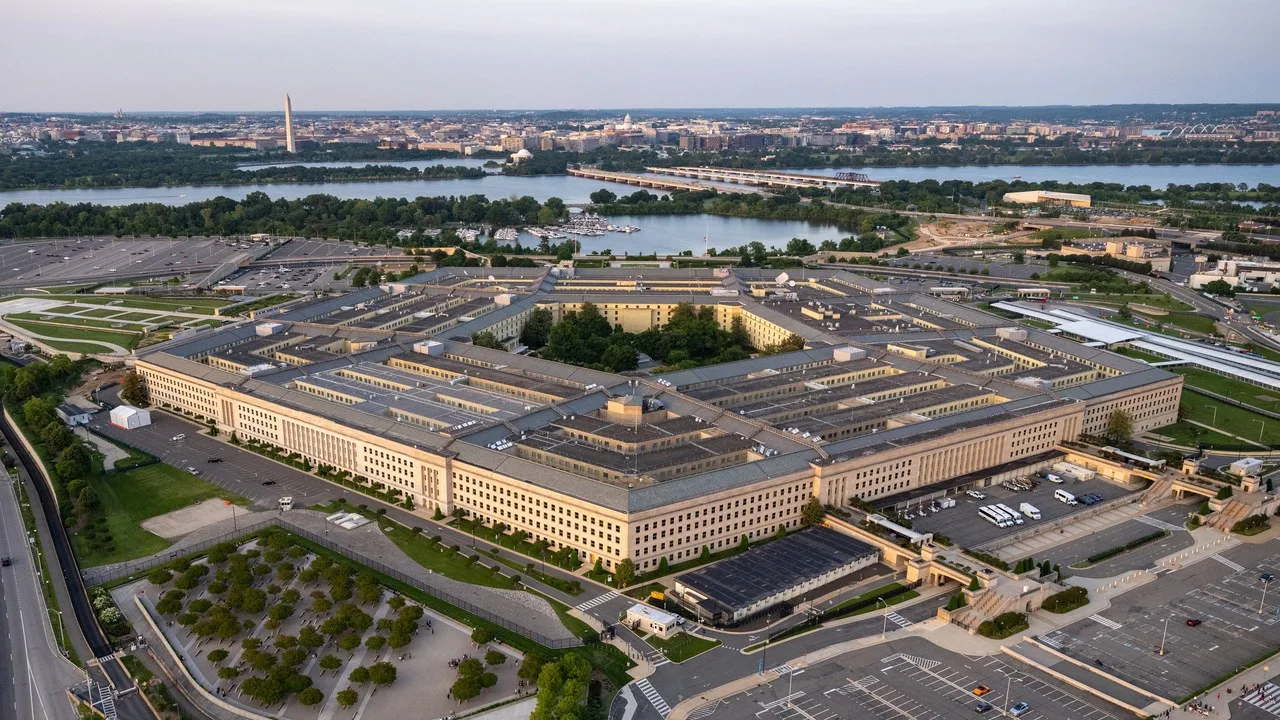
Featured image: An aerial view of the Pentagon, Washington, D.C. (May 2023, file photo), DoD photo by U.S. Air Force Staff Sgt. John Wright, public domain, via Wikimedia Commons (cropped).