As of about 9:00 AM IST, Thursday 26 November 2026. Based on the FCC's order and reporting by Reuters (via NBC News), Spaceflight Now and The Register, plus a statement from the American Astronomical Society. The FCC order was adopted and released on Wednesday 25 November (US time).
The US Federal Communications Commission has given SpaceX permission to build something that has never existed: a constellation of up to one million satellites that would work as data centres in orbit. The project, called Starmind, is designed to run artificial intelligence workloads in space, powered by near-constant sunlight, and send the results back to Earth.
The approval is a regulatory milestone, not proof that the idea works. It comes with strict deadlines, a deferred decision on how dead satellites would be disposed of, and loud objections from astronomers and rivals. Here is what the FCC actually approved, what SpaceX says it will build, and the questions that remain.
What the FCC approved
In an order adopted and released on 25 November by its Space Bureau, the FCC granted SpaceX authority to operate a non-geostationary constellation of 1,000,000 satellites in orbital shells between 500 and 1,002 kilometres up, in 30-degree and sun-synchronous inclinations. SpaceX filed its application on 30 January 2026, according to Spaceflight Now.
The licence is narrower than the headline suggests. Starmind satellites are meant to talk to each other and to the ground mainly through optical, laser-based links, which the FCC does not license as radio spectrum. What the order formally authorises is radio spectrum for backup and emergency telemetry, tracking and command in two Ka-band ranges (18.8 to 19.3 GHz down and 28.6 to 29.1 GHz up), to be used only if the optical links fail. Those operations must be on an unprotected, non-interference basis, and SpaceX must not disrupt US federal systems in the uplink band.
Explaining the decision, the FCC said the approval would let SpaceX "pioneer emergent technology that advances American leadership in space and artificial intelligence", Reuters reported. FCC Chairman Brendan Carr said that "by moving compute capacity beyond Earth, SpaceX and the many competitors working on their own orbital data centers are meeting the moment", according to Spaceflight Now.
The deadlines SpaceX must meet
The licence sets a demanding timetable. SpaceX must launch its first Starmind satellite by 25 November 2033, have 10% of the constellation, or 100,000 satellites, in orbit by November 2035, reach 50% by November 2038 and deploy the full constellation by 25 November 2040, according to the FCC, as reported by Reuters and Spaceflight Now. The company must also file reports twice a year on conjunction events, the close approaches between its satellites and other objects, The Register reported.
For scale, Reuters noted that only about 17,000 satellites are in orbit today, and Spaceflight Now counts nearly 11,200 Starlink satellites currently in orbit, citing astronomer Jonathan McDowell. Reuters also pointed out that operators sometimes ask for far more satellites than they plan to launch, to keep design flexibility, so the one-million figure should be read as a ceiling rather than a plan.
What SpaceX says it will build
SpaceX argues that space solves the biggest constraint on AI: power. "By directly harnessing near-constant solar power with little operating or maintenance costs, these satellites will achieve transformative cost and energy efficiency while significantly reducing the environmental impact associated with terrestrial data centers," the company told the FCC, according to Reuters.
According to SpaceX's website, as reported by Spaceflight Now, each satellite would have a 75-metre wingspan and a deployed height of 30 metres. At the International Astronautical Congress in October, SpaceX's senior vice president for Starlink and AI, Michael Nicholls, said each satellite might be "something like a 250 kilowatt satellite, or roughly a rack of compute in space", flying in clusters of about ten linked by roughly 10 terabits of bandwidth and connected to Starlink. Spaceflight Now also reported that SpaceX is building the spacecraft in partnership with Nvidia, will manufacture them in Bastrop, Texas, and will launch them on Starship. Speaking at an event hosted by Baron Capital, Elon Musk said he expects the first satellites to launch in the third quarter of 2027, ramping to "significant volume probably in '28 and then very large volume in '29".
The debris question the FCC left open
One of the most important parts of the order is what it did not decide. SpaceX asked for a waiver from the rule that dead satellites in low orbit must be disposed of by re-entering the atmosphere, seeking flexibility to send satellites operating above 600 kilometres into "Earth disposal orbits or heliocentric orbits" instead. The FCC deferred that request, saying SpaceX had not provided enough information to judge whether its alternative disposal methods comply with the rules. Before deploying any Starmind satellites that will not re-enter the atmosphere, SpaceX must apply to modify its licence and justify the waiver.
In practice, that means the higher shells of the constellation are not yet cleared to fly. The FCC noted that SpaceX plans to deploy satellites at lower altitudes first and test them before raising their orbits, and that their propulsion systems allow orbit-raising, station-keeping and collision-avoidance manoeuvres.
Astronomers and rivals push back
The American Astronomical Society, which petitioned the FCC in March to deny the application, said it was "disheartened and dismayed". In a statement, the AAS warned that the satellites would be larger, brighter and higher than today's broadband satellites, that their radio emissions could "imperil radio astronomy research", and that waste heat from orbiting data centres could raise the infrared background of the sky. It also criticised "the lack of formal coordination requirements" with the National Science Foundation in the licence.
The FCC rejected petitions to deny from the AAS, Viasat, Amazon Leo and others, Spaceflight Now reported, saying the limited backup use of Ka-band addresses interference concerns and that optical astronomy issues fall outside the radio-frequency scope of the order. Amazon has argued that SpaceX is unlikely to deploy all the satellites. Carr dismissed that criticism in March, saying Amazon should "focus on getting Amazon's house in order with their own launches", according to Reuters. Amazon's own constellation suffered a setback recently, as covered in our report on the Vulcan failure that destroyed 40 Amazon Leo satellites.
Does an orbital data centre make economic sense?
That remains the open question. The Register noted that the research firm Gartner has called the idea "peak insanity", and that Google, which is pursuing its own orbital computing project, believes it becomes viable only if launch costs fall to about $200 per kilogram. Google is arguably further along: it launched a test satellite in October and has hired Blue Origin to launch a larger satellite carrying the equivalent of a full data-centre rack in early 2029, according to The Register.
The bigger picture is that the AI industry is running into limits on the ground. Power, grid connections, cooling water and local opposition are slowing new data centres, and financing them has become a worry for investors, as we explained in our look at whether AI is a bubble. Moving computing into orbit swaps those problems for others: launch costs, radiation, heat that can only be shed by radiators, repairs that are nearly impossible and the need to send data back through crowded networks.
Why it matters for SpaceX and what to watch
For SpaceX, Starmind strengthens the story that it is more than a launch and broadband company. Investors are already debating how much AI ambitions should add to its value, as covered in our analysis of the $2 trillion SpaceX valuation debate. The near-term milestones are concrete: Starship's progress towards frequent, cheap flights, a modification filing on the disposal waiver, the first test satellites Musk has promised for late 2027, and whether rivals such as Google and Blue Origin win similar approvals. Until then, the FCC's decision is best seen as a permission slip for an experiment of unprecedented scale, not a guarantee that a million computers will ever circle the planet.
Sources
- FCC Space Bureau: Memorandum Opinion and Order and Authorization, SpaceX Orbital Data Center System (PDF)
- NBC News (Reuters): SpaceX gets green light to deploy 1 million satellites for data centers in space
- Spaceflight Now: FCC green lights SpaceX's plan to launch 1 million 'Starmind' data center satellites
- The Register: FCC lets Elon Musk launch a million datacenter satellites
- American Astronomical Society: Statement on FCC approval of SpaceX's orbital data center system
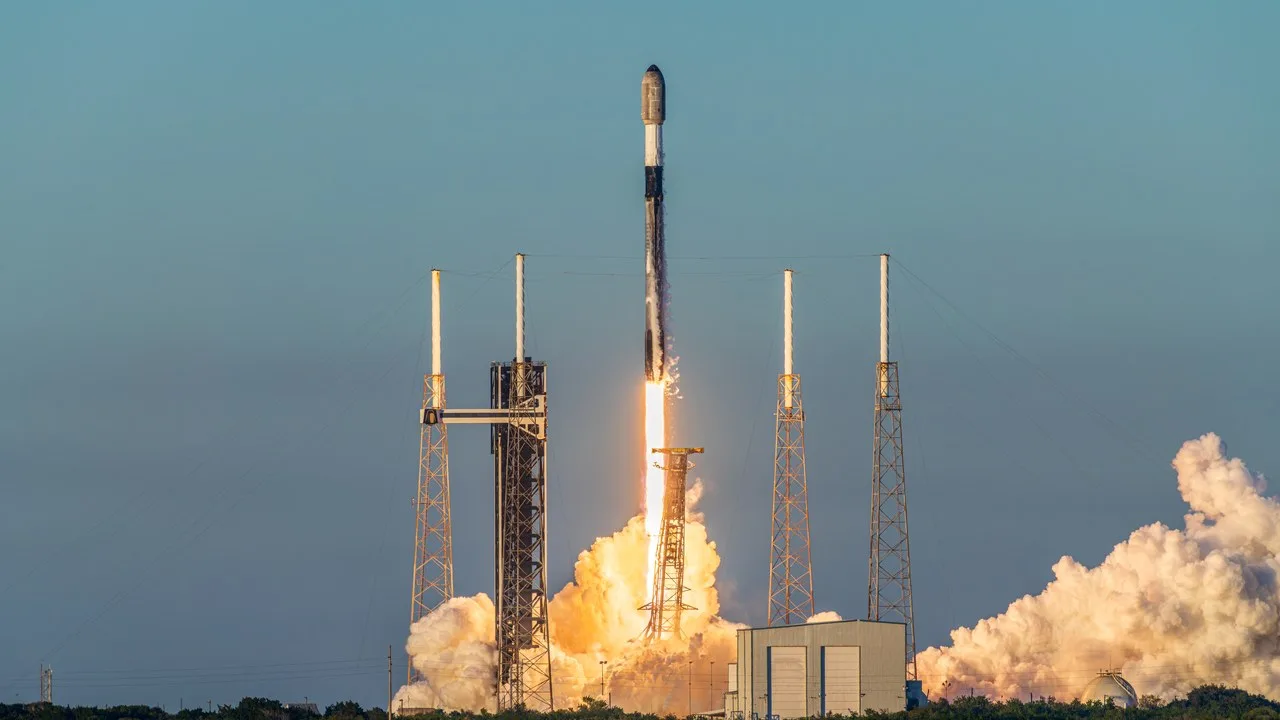
Featured image: A Falcon 9 rocket launches the Starlink 6-90 mission from Cape Canaveral Space Force Station, Florida (11 December 2025, file photo), U.S. Space Force photo by Gwendolyn Kurzen, public domain, via Wikimedia Commons (cropped).