As of about 5:00 PM IST, Saturday 14 November 2026. Based on the Federal Aviation Administration's ground-stop statement, remarks by U.S. officials on Friday night, and reporting by Reuters, the BBC, the Associated Press and Euronews.
U.S. airlines spent Saturday trying to rebuild schedules after the longest nationwide grounding of departing flights since the September 11, 2001 attacks. The Federal Aviation Administration stopped departures on Friday afternoon because of communications problems at air traffic control centres, then reopened the skies at 8:15 p.m. Eastern Time. The halt lasted more than four hours. The disruption did not end when the order was lifted.
FlightAware, cited by Euronews on Saturday morning, put cancellations of flights to or from the United States at more than 8,860 on Friday, with around 2,650 more cancelled by Saturday morning. The BBC, also citing FlightAware, said Friday's stoppage led to more than 8,500 delays as well. Transportation Secretary Sean Duffy warned that unwinding the mess would take time. "It's going to be slow," he told reporters.
How the stop unfolded
Duffy said the trouble began at 3:36 p.m. Eastern Time, when air traffic control centres saw instability in radar and communications systems. The FAA's command centre then issued a nationwide ground stop. The agency's preliminary statement said the order covered all U.S. airports "following communication issues impacting multiple Air Route Traffic Control Centers." An FAA advisory put the effective time at 20:54 UTC, or 3:54 p.m. Eastern, "due to extraordinary circumstances and for reasons of safety."
More than 3,500 aircraft were in the air when the stop began, the BBC reported. Some were diverted; others continued to their destinations. Duffy said controllers never completely lost radar or communications and were able to land thousands of aircraft safely. A limited number of flights were allowed to depart before the nationwide order was lifted at 8:15 p.m.
The official explanation, and what is still unconfirmed
Duffy blamed a legacy communications system that could not handle the load. "So this is analogue telecom. Our switches, our routers actually got overloaded with data and they went down," he said, according to the BBC. In Reuters's account, he said the overloaded equipment produced "inconsistencies in the data," and that officials shut the system down because of those inconsistencies. Mullin said the introduction of new technology into an old system had overwhelmed it, that the public was never in danger, and that there was "zero evidence" of a cyberattack or a "rogue AI system." He also ruled out a link to the global Microsoft outage that had begun on Thursday.
Investigators have not closed every door. Reuters reported that Mullin said officials had not ruled those possibilities out and were "still looking," and that the National Security Agency was working with the Department of Homeland Security. Separately, Reuters, citing two airline officials, reported that the outage appeared to involve a telecommunications network overseen by L3Harris Technologies, which handles radio frequencies used by controllers to talk to pilots. L3Harris did not comment. That account remains unconfirmed by the FAA or the company.
A failure felt far beyond U.S. terminals
Because the United States is a hub for long-haul travel, the stoppage quickly became an international business event. The BBC reported that all U.S.-bound traffic from Eurocontrol's 42 member states was suspended. Air Canada cancelled flights between the two countries, and Sydney Airport grounded U.S.-bound departures for a time.
By 11:30 p.m. on Friday, Flightradar24 told Reuters that nearly 10,000 flights had been cancelled, including more than 2,200 each at Delta Air Lines and American Airlines and 1,800 at United Airlines. Some aircraft had waited more than five hours for a gate. Those tallies do not always match FlightAware's later figures and should be read as separate snapshots. The Associated Press called it the longest nationwide ground stop in 25 years, distinguishing it from a shorter January 2023 Notice to Air Missions failure that Reuters said lasted about 90 minutes.
What the stoppage costs airlines and passengers
For the carriers, a four-hour freeze is not a four-hour problem. Crews time out, aircraft end the night in the wrong cities, and a Saturday schedule depends on Friday's fleet being in the right place. American Airlines said it was focusing on remaining flights while "positioning the airline for the strongest possible recovery in the days ahead," and prioritising international routes and smaller cities to get aircraft and crews into position. Delta and United said they were resuming operations; JetBlue said it would resume on Saturday morning. Reuters reported that shares of American, United and Delta fell between 1% and 2% in after-hours trading, with JetBlue down about 3%.
That hit sits on thin margins. A grounded aircraft earns nothing, while crew pay, fuel already boarded and hotel costs still come due — a reminder of why unit economics matter when a shock arrives. Hotels, freight shippers and small firms whose people could not get home feel it too. Businesses that already run close to the edge on cash, a risk we have described among cash-flow mistakes that sink otherwise profitable companies, have less room to absorb a spoiled week of travel.
Passengers have narrower rights than many expect. Reuters and the BBC both noted that U.S. airlines are not required to pay compensation when the cause is an air-traffic-control failure. Under the FAA Reauthorization Act of 2024, the BBC reported, passengers on cancelled or "significantly delayed" flights — three hours for domestic trips and six hours for international ones — must be offered alternative travel or a full refund if they choose not to fly, with credit-card refunds due within seven business days. There is no U.S. requirement for meal vouchers or hotels, though some airlines may offer them.
An old system, and a very large bill
Duffy used the crisis to press a case he had already been making. Earlier on Friday, before the outage, the White House and the Department of Transportation had urged Congress to approve $30.1 billion to upgrade airports and air traffic control infrastructure, Reuters reported. After the stoppage, Duffy put the price of a complete overhaul at $50 billion. "What we have is an incredibly old air traffic control system," he said. "Give us the money to fix it." He also warned that the system would "continue to fail" without that work. Ageing switches and a shortage of controllers have been documented for years. Friday was the most visible failure of that combination since 2001, and a reminder that the network has no real substitute when it stops.
What Saturday leaves unresolved
The FAA said that before clearing flights to resume it had "thoroughly tested our systems to confirm they were stable and that operations remain reliable," according to Euronews, and told travellers to check with their airlines. Duffy said the immediate problem had been fixed and that flying was safe, but that departures would resume only as crews and aircraft became available. For companies whose staff were stuck in terminals, the episode is also a reminder that work that can continue without a flight is more resilient than work that cannot. The questions now are how quickly Saturday's cancellations taper, whether the network holds under a normal traffic load, and whether investigators stay with the overloaded-equipment explanation or the unconfirmed L3Harris report changes the story.
Sources
- Federal Aviation Administration: Statement on Nationwide Ground Stop
- Reuters: US to resume flights after air traffic network failure sparks chaos
- BBC: What we know about the US ground stop and what to do if your flight is affected
- Euronews: Passengers continue to face delays and cancellations after US lifts nationwide ground stop
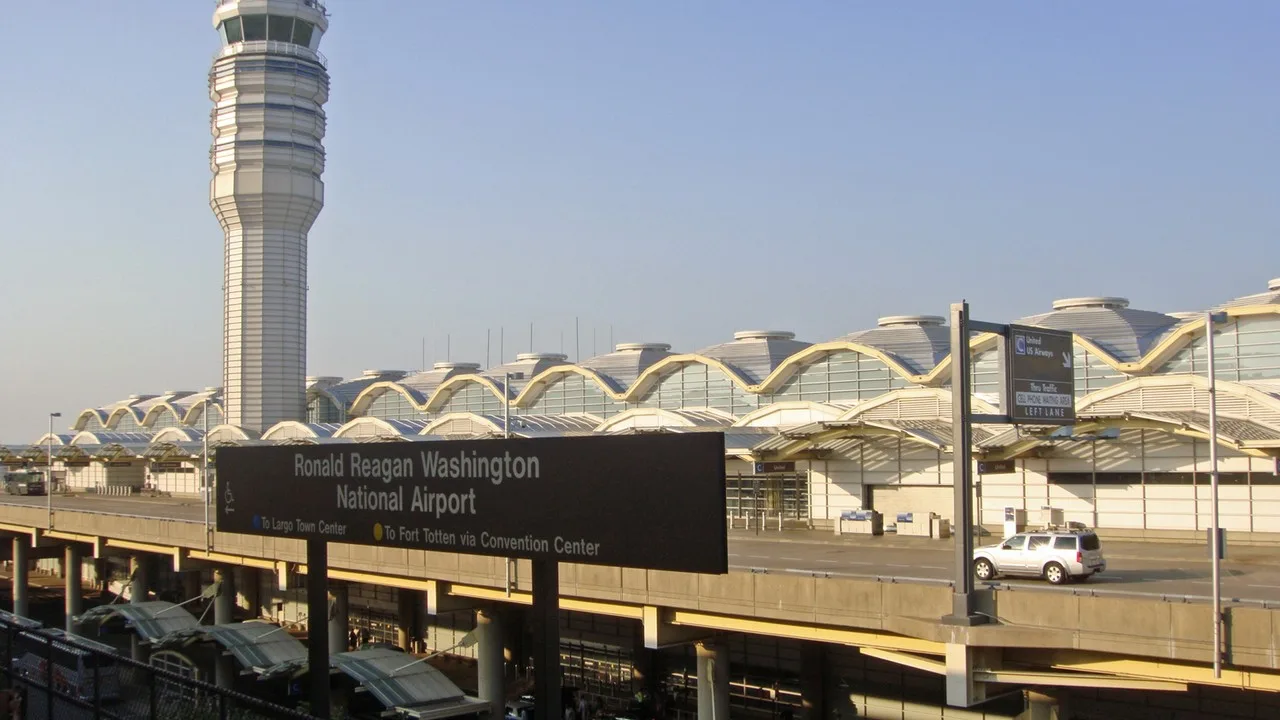
Featured image: The air traffic control tower and Terminal C at Ronald Reagan Washington National Airport, 24 July 2010, Mariordo (Mario Roberto Duran Ortiz), CC BY-SA 3.0, via Wikimedia Commons (cropped).