
As of about 8:30 AM IST, Saturday 21 November 2026. Based on market data and reporting from Reuters, CNBC, Yahoo Finance and AP. This article is for information only and is not financial advice.
The AI-led rally that carried Wall Street for most of 2026 broke down on Friday, 20 November. The S&P 500 fell 3.7 per cent to 6,910.39 and the Dow Jones Industrial Average lost 949.73 points, or 1.93 per cent, to 48,147.33. Both closed more than 10 per cent below their records, the usual definition of a market correction. The Nasdaq Composite dropped 5.28 per cent to 22,617.73, turning negative for the year.
The timing stung. Investors had hoped that Nvidia's results and Anthropic's record stock market debut this week would revive enthusiasm for artificial intelligence stocks. Instead, the selling spread from chipmakers to almost every corner of the market, and from New York to Tokyo, Seoul and Taipei.
A historic week in numbers
Friday capped one of the worst weeks for US stocks in years. According to figures compiled by Yahoo Finance, the S&P 500 fell 8.6 per cent, its worst week since the "Liberation Day" tariff sell-off in April 2025. The Dow lost 8 per cent and the Nasdaq about 10 per cent, both their worst weeks since the Covid crash of March 2020. AP reported that the S&P 500's seven-day losing streak was its longest since the start of the pandemic.
The damage beneath the surface was worse than the headline indexes suggest. CNBC said the Nasdaq-100 fell 5.6 per cent on Friday and briefly entered a bear market, meaning 20 per cent below its recent high. Yahoo Finance counted 71 of the index's 101 stocks in bear-market territory, including all 20 of its semiconductor and memory-chip names.
Chipmakers led the fall
Semiconductors were the epicentre. Reuters said the Philadelphia chip index fell 10.7 per cent on Friday and 17.1 per cent over the week. Nvidia dropped about 14 per cent to $125.53, while AMD fell more than 13 per cent and Micron almost 14 per cent, according to CNBC. Yahoo Finance said Nvidia's 23 per cent weekly fall was its worst since October 2008.
Nvidia faced a fresh blow during the session. Reuters reported, citing two people briefed on the matter, that US Securities and Exchange Commission enforcement staff are examining potential accounting issues at the company. The SEC declined to comment and Nvidia did not immediately respond. The report adds to the uncertainty surrounding the company since the exit of chief executive Jensen Huang, which we covered alongside its third-quarter results.
Anthropic slips back towards its IPO price
Anthropic, which jumped 17 per cent on its first day of trading on Thursday after a record $81 billion IPO priced at $83 a share, gave back much of that gain. Reuters said the shares fell as much as 14.5 per cent, to just above the IPO price, before ending down 9.1 per cent at $88.30.
Analysts said the contrast tells its own story. "The success of Anthropic's IPO yesterday as other AI-related stocks tumbled highlights how different parts of the AI ecosystem no longer move as one," James Reilly, senior markets economist at Capital Economics, wrote in a note cited by CNBC. "Strong AI demand and successful individual listings are no longer sufficient to sustain broader risk appetite when investors are questioning valuations, borrowing costs and the outlook for corporate profitability," Daniela Hathorn of Capital.com told Reuters.
Why investors are selling
There is no single trigger. CNBC listed several worries that have built up over recent weeks: signs that the huge spending on AI data centres is slowing, Democratic gains in the 2026 midterm elections, Huang's departure from Nvidia, and the prospect of further interest rate rises from the Federal Reserve.
"This is not just a valuation-driven correction. It's becoming broader," Massimo Santicchia, head of US equities at Procyon, told CNBC. "Right now, it's definitely risk-off." Richard Saperstein, chief investment officer at Treasury Partners, described "an AI repricing, reflecting an environment of slowing data center buildouts, reduced funding sources for AI-related projects and a slower trajectory of technology-related earnings growth."
Those concerns are not new. The Fed flagged the risks of debt-funded AI infrastructure in its latest Financial Stability Report. What changed this week is that investors stopped giving the sector the benefit of the doubt.
The Fed is not riding to the rescue
In past sell-offs, investors often expected the Fed to ease policy. This time, inflation stands in the way. Fed Governor Lisa Cook said in a speech in Chile on Friday that inflation has been above target "for more than five and a half years" and that "waiting longer to implement rate increases risks getting behind the curve," CNBC reported. Markets strongly expect a quarter-point rate rise at the Fed's 8–9 December meeting.
There was one encouraging sign. The University of Michigan's survey showed one-year inflation expectations falling to 3.7 per cent in November, the lowest reading since March, CNBC said. Bond markets also rallied: Reuters reported that the 10-year Treasury yield fell about 10 basis points to 4.948 per cent, its largest one-day drop since 22 October, as investors sought safety.
A global, cross-asset rout
The selling was worldwide. Japan's Nikkei 225 fell 5.06 per cent and South Korea's Kospi 5.21 per cent on Friday. Reuters said Taiwan's market fell 17 per cent over the week, its biggest weekly drop since 1990, and MSCI's global stock index lost 8.1 per cent, its largest weekly fall since early 2020. Europe's STOXX 600 fell 2 per cent.
Traditional hedges did not all hold up. Spot gold fell 2.81 per cent to $3,520.09 an ounce, a 14-month low, Reuters said. Bitcoin dropped below $60,000 for the first time since July. Oil went the other way, with Brent rising to $92.61 a barrel on worries about the US-Israeli war with Iran. The VIX, Wall Street's "fear gauge", closed at its highest level since April 2025. In stocks, consumer staples was the only S&P 500 sector to finish higher, with Walmart, Costco, Johnson & Johnson and Procter & Gamble all gaining.
What to watch next
Strategists are divided on whether the worst is over. BTIG's Jonathan Krinsky told CNBC that market breadth and technical signals do not yet look like those seen at durable bottoms, noting that Apple is only about 3 per cent below its 2026 high. Capital Economics expects the S&P 500 to fall to 6,500 by the end of next year. Next week brings the Thanksgiving holiday and thinner trading in the US, followed by the run-up to the Fed's December decision.
For long-term investors, corrections of 10 per cent or more are a normal, if painful, part of markets. Our explainer on rebalancing your portfolio covers how to keep risk in line with your plan rather than reacting to daily headlines.
Disclaimer: This article is for general information and news purposes only. It is not financial, investment or tax advice, and it is not a recommendation to buy or sell any security. Markets are volatile; consult a qualified, licensed adviser before making investment decisions.
Sources
- Reuters: Tech leads global stocks rout, Treasury yields fall
- Reuters: Nvidia's accounting is a focus of US SEC investigation, sources say
- CNBC: S&P 500 and Dow close in correction; Nasdaq erases 2026 gain as AI rout picks up steam
- Yahoo Finance: Dow and S&P 500 enter correction, Nasdaq sinks 5% to erase 2026 gains as AI trade melts down
- AP: S&P 500 sinks 3.7% and the Nasdaq composite goes negative for the year
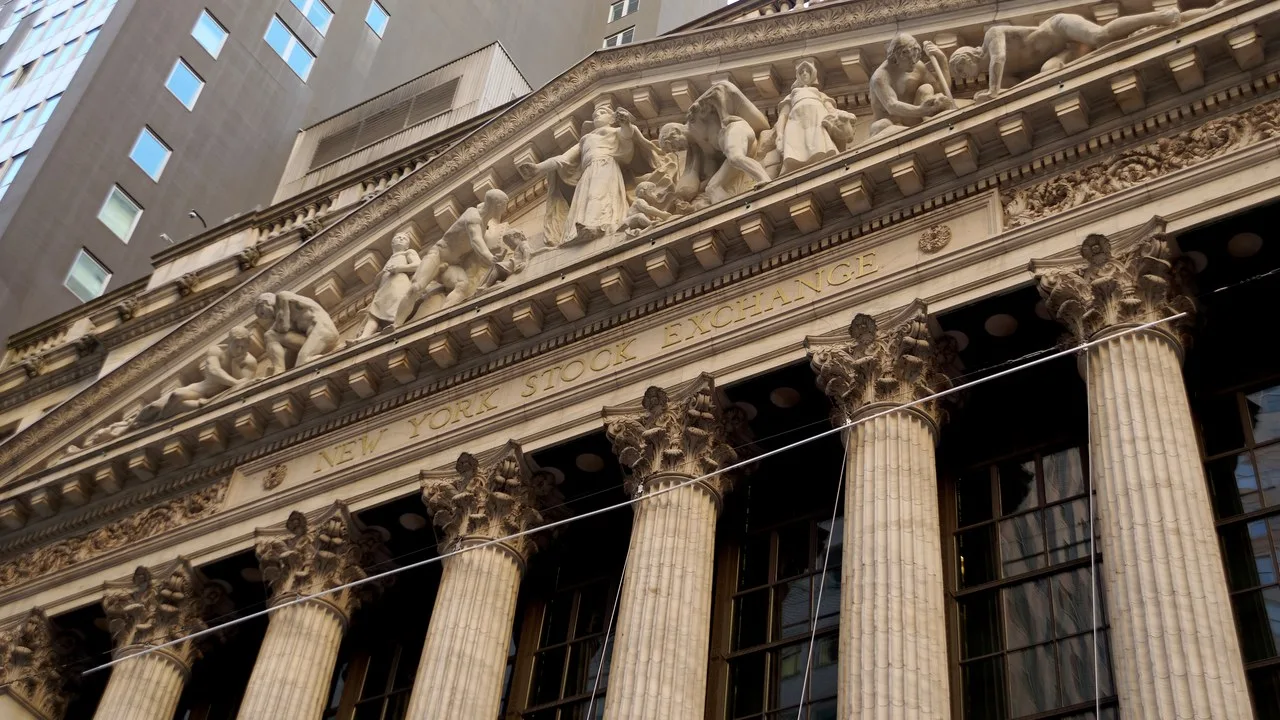
Featured image: The New York Stock Exchange's Broad Street facade, New York (2 October 2023, file photo), Jakub Hałun, CC BY 4.0, via Wikimedia Commons (cropped).