As of about 8:30 AM IST, Sunday 15 November 2026. Based on the Federal Reserve's November 2026 Financial Stability Report, released on Friday, 13 November, and reporting by Reuters and Yahoo Finance.
Artificial intelligence has become the risk that U.S. financial-market professionals worry about most, and the Federal Reserve is now looking closely at how the AI build-out is being paid for. In its twice-yearly Financial Stability Report, published on Friday, the Fed said debt issued to fund data centres and other advanced computing infrastructure had climbed above $680 billion so far in 2026. It also estimated that large technology firms carry roughly $3 trillion in leases, guarantees and other commitments linked to the build-out that do not appear as ordinary debt on their balance sheets.
The report does not say a crisis is coming. It does say that the way the AI boom is financed has become more complicated and more interconnected, and that losses in a downturn could reach further than the headline debt figures suggest.
AI jumps to the top of the risk list
As part of the report, staff at the Federal Reserve Bank of New York surveyed 23 contacts at broker-dealers, banks, investment funds and advisory firms in September and October. AI was the most frequently cited risk to the financial system. Reuters reported that 87% of respondents named it, up from 50% in the spring survey. The Fed stresses that the survey reflects the views of respondents, not of the Fed itself.
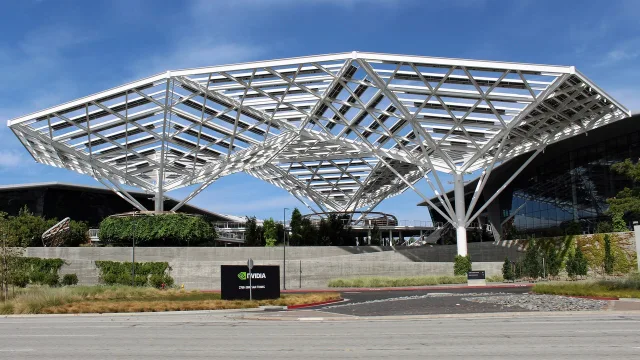
Respondents pointed to three AI-related worries: high stock valuations that could fall if earnings disappoint, cyberattacks by state actors or damage caused by frontier AI models, and complex forms of AI-related financing. The other most-cited risks were a correction in risk assets (52%), higher long-term interest rates (48%), and cyberattacks and fiscal debt sustainability (43% each), according to Reuters. Reuters also noted that the survey was completed before this week's turmoil at Nvidia, whose chief executive Jensen Huang stepped down on Thursday.
The scale of the borrowing
A special box in the report, "Leverage in the Data Center Buildout," sets out the numbers. Debt issuance tied to advanced computing rose to more than $680 billion by October 2026, about five times the $130 billion issued in all of 2023. Investment-grade technology companies issued most of it. Advanced computing now accounts for about 31% of non-financial investment-grade corporate debt issuance, up from less than 6% in 2023. Outstanding public debt related to advanced computing is estimated at more than $1.1 trillion.
The type of borrowing is changing too. The Fed says financing has moved from mostly corporate bonds towards a mix of public and private debt, structured credit and project finance. Because a large share of deals happen in private credit markets, the Fed says the exact size of AI-related debt is harder to measure. We looked at these warning signs earlier this year in Is AI a bubble? Debt, data centres and warning signs.
The $3 trillion that is not on the balance sheet
The most striking finding is about obligations that are not counted as debt. Across Amazon, Alphabet, Broadcom, Meta Platforms, Microsoft, Nvidia and Oracle, the Fed estimates that leases that have been signed but not yet started exceed $1 trillion in undiscounted value. Other commitments, such as take-or-pay contracts and residual value guarantees, exceed $2 trillion. These figures are undiscounted and so are not directly comparable with balance-sheet debt, the Fed notes, but together they come to about $3 trillion and have grown faster than debt itself.
The Fed explains how this works. A hyperscaler signs a long-term lease for data centre capacity with a third-party developer, and the developer uses that lease to borrow money to build the facility. Chip designers sometimes guarantee the future value of the graphics processors used as collateral when smaller AI companies buy them. The large firms often add equity investments on top, creating what the Fed calls a "circular financing" dynamic.
Why the Fed thinks this matters
The Fed draws two conclusions. On the one hand, the biggest technology firms have strong credit ratings and may absorb losses in a downturn, which would shield the rest of the financial system. On the other hand, their economic exposure "may be substantially larger than suggested by their on-balance-sheet liabilities." In other words, an AI slowdown could hit the strongest companies harder than investors expect from reading their debt figures.
The risk also spreads beyond technology firms. Many of these deals use special purpose entities that issue senior and subordinated debt. The riskier slices are held by high-yield bond funds, life insurers, business development companies and other private debt vehicles. The largest U.S. bank holding companies have close to $1 trillion of exposure to big tech firms, data centre developers, AI-related special purpose entities, private credit vehicles and utilities, the report says. Those exposures are tested in the Fed's annual stress test. "The complex interlinkages among firms engaged in the data center buildout, public credit markets, private lenders, and special purpose financing vehicles create vulnerabilities that necessitate close monitoring," the report says.
A comparison with the 1990s telecom boom
The Fed compared five hyperscalers — Amazon, Alphabet, Meta, Microsoft and Oracle — with the telecom industry's broadband investment cycle that began in 1995. Measured against the size of the economy, capital spending in the two cycles has tracked closely. But AI investment has been accelerating, and the Fed says the current cycle "may surpass that of the 1990s telecom cycle relatively soon." Until this year, the hyperscalers' strong cash flows meant they needed less debt than telecom firms did. That buffer is now shrinking as borrowing rises.
Valuations and leverage elsewhere
The broader report also found pressure on asset prices. Stock valuations remained high, "partly driven by market enthusiasm for super intelligence (SI)," the term used in the report. The equity risk premium stayed low. Treasury yields rose markedly over the past six months, and spreads on high-yield bonds widened moderately.
Hedge fund leverage reached its highest level since the data began in 2013, concentrated in a small number of large funds. Leverage at the largest life insurers remained historically high. Banks were described as sound and resilient, with capital near historic highs, but still carrying sizeable fair-value losses on fixed-rate assets that are sensitive to long-term interest rates. For investors, this combination of high valuations, rising yields and leverage is one reason rebalancing a portfolio on a set plan tends to work better than reacting to headlines.
What to watch next
The coming week will test these concerns. Nvidia reports quarterly results on Tuesday, its first under interim chief executive Colette Kress, and Anthropic is expected to begin trading on the Nasdaq on Thursday, CNBC reported. Minutes of the Fed's latest policy meeting are also due, as markets weigh further rate increases after recent hot inflation data, including October's 6.5% rise in producer prices. Higher rates make heavily financed projects more expensive to carry, which is exactly the pressure point the Fed has highlighted. The Fed's message is not that the AI build-out will fail. It is that if it disappoints, the losses will travel through more channels than many investors realise.
Disclaimer: This article is for general information only and is not financial or investment advice. Asset prices, interest rates and credit conditions can change quickly, and past performance does not guarantee future results. Please consult a qualified financial adviser before making any investment decisions.
Sources
- Federal Reserve Board: Financial Stability Report, November 2026 (PDF)
- Reuters, via Investing.com: AI rockets to top of worries about financial system in latest Fed survey
- Yahoo Finance: Fed says it's monitoring the data center build-out for risks to the financial system
- CNBC: Stock market next week: Outlook for Nov. 16-20, 2026
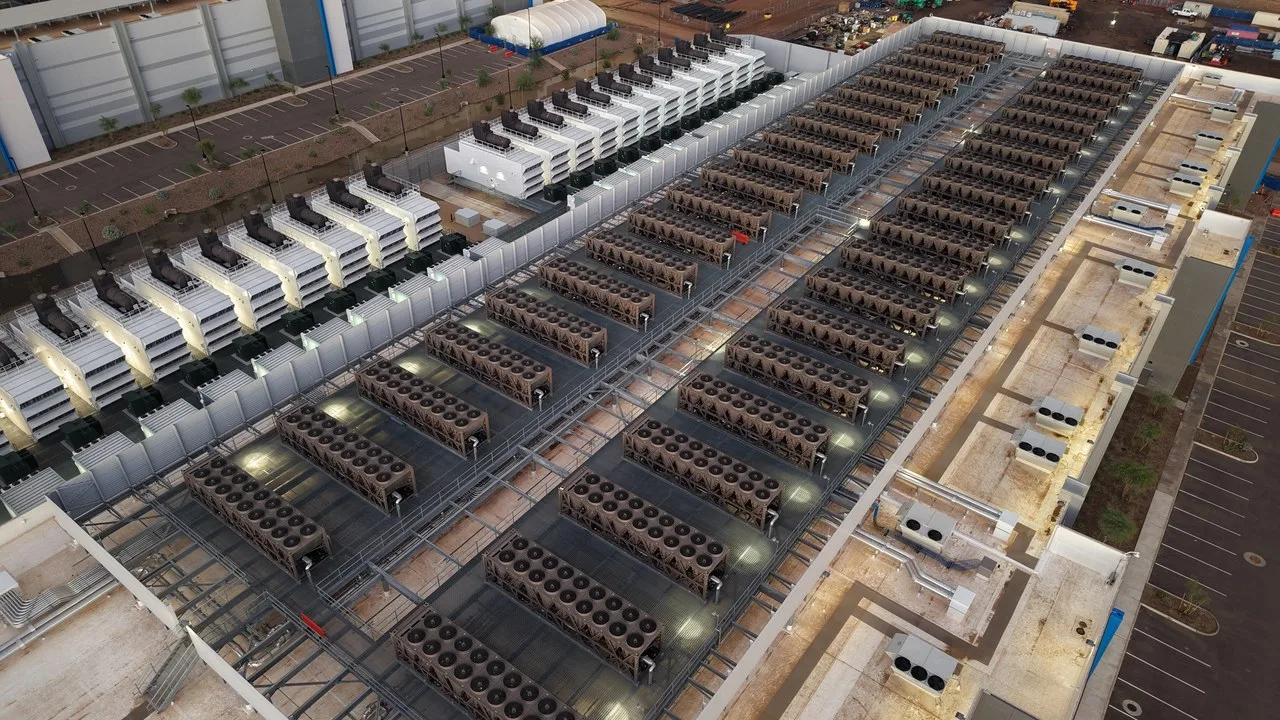
Featured image: The roof of a data centre with cooling towers and backup generators, 23 November 2025, Rsparks3, CC0 1.0, via Wikimedia Commons (cropped).