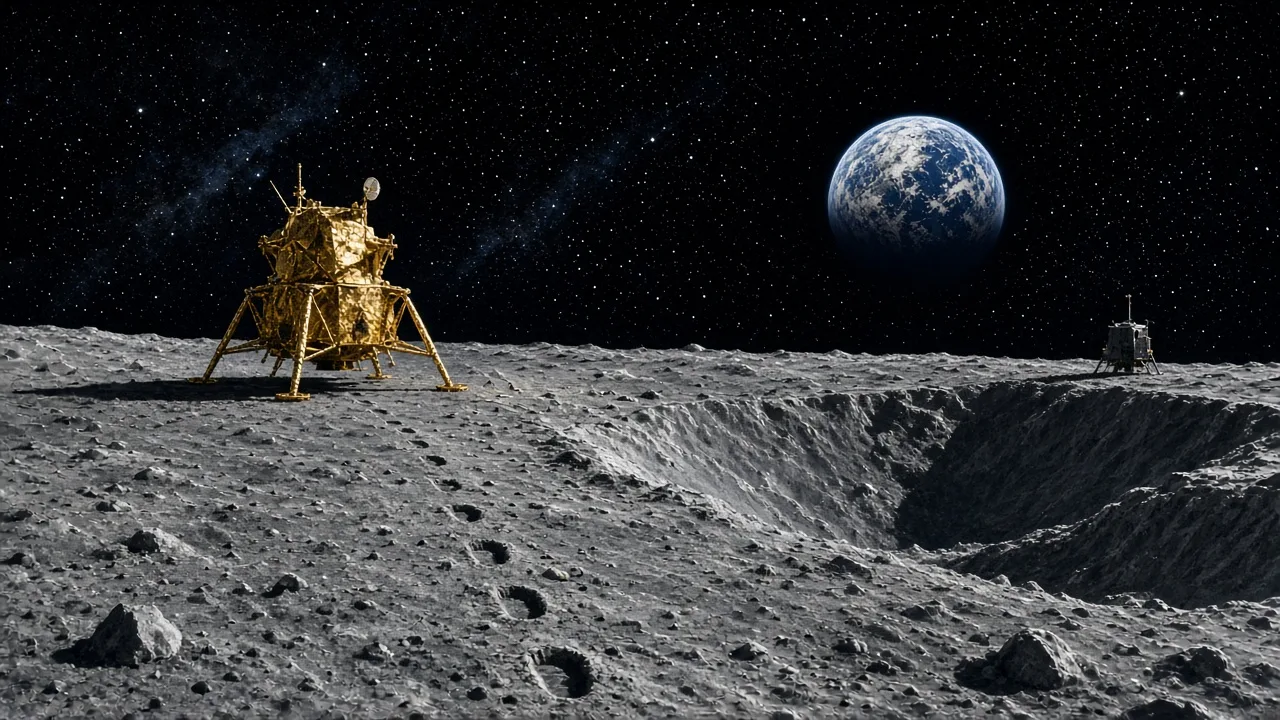
On July 20, 1969, the lunar module Eagle touched down on the Moon's Sea of Tranquility. A few hours later, Neil Armstrong climbed down the ladder and became the first human to set foot on another world. In India, that historic first step came on the morning of July 21. More than half a century later, with NASA's Artemis II crew having flown around the Moon in April 2026 and India's Chandrayaan-3 having landed near the lunar south pole in 2023, the Moon is back at the centre of a new space race. Here is how Apollo 11 happened, what it cost and why it still shapes technology and geopolitics.
The Cold War race to space
The Moon landing was born out of rivalry. In 1957, the Soviet Union launched Sputnik, the first artificial satellite, and in 1961 Yuri Gagarin became the first human in space. In the United States, these Soviet firsts were seen as a blow to national prestige and a sign of technological and military competition. In May 1961, President John F. Kennedy asked Congress to commit to landing a man on the Moon and returning him safely to Earth before the end of the decade.
Building the Apollo programme
Project Apollo was one of the largest technology projects ever undertaken in peacetime. It required new rockets, spacecraft, computers, materials and ways of managing huge, complex projects. The Saturn V rocket, the most powerful operational rocket of its time, was developed to send astronauts on their way to the Moon.
The cost was enormous. According to The Planetary Society, Project Apollo cost about $25.8 billion between 1960 and 1973, which it estimates at roughly $309 billion in 2025 dollars. Including related programmes such as Gemini and robotic lunar missions, the total US lunar effort came to around $28 billion in then-year dollars.
There were also tragedies. In January 1967, a fire during a ground test killed the three astronauts of Apollo 1, leading to major safety redesigns.
The mission: July 16-24, 1969
Apollo 11 launched from Kennedy Space Center in Florida on July 16, 1969, carrying three astronauts: Neil Armstrong, Buzz Aldrin and Michael Collins. After reaching lunar orbit, Armstrong and Aldrin moved into the lunar module Eagle, while Collins remained in orbit aboard the command module Columbia.
NASA's records show that Eagle landed at 20:17 UTC on July 20, 1969, or around 1:47 am IST on July 21. Armstrong stepped onto the surface at 02:56 UTC on July 21, which was about 8:26 am IST. His words, "That's one small step for man, one giant leap for mankind", are among the most famous ever spoken. Aldrin joined him shortly afterwards.
The two astronauts spent around two and a half hours outside on the surface, collecting rock and soil samples, setting up experiments and planting a US flag. They then rejoined Collins in lunar orbit, and the crew splashed down safely in the Pacific Ocean on July 24, 1969.
After Apollo 11
NASA flew six more Apollo missions to the Moon. Five of them landed successfully; Apollo 13 in 1970 was forced to abort its landing after an explosion, and its crew made a dramatic safe return to Earth. In total, 12 astronauts walked on the Moon between 1969 and 1972. Apollo 17, in December 1972, was the last time humans set foot on the lunar surface.
Timeline: key moments
- October 1957: The Soviet Union launches Sputnik.
- April 1961: Yuri Gagarin becomes the first person in space.
- May 1961: President Kennedy sets the goal of a crewed Moon landing.
- January 1967: The Apollo 1 fire kills three astronauts.
- July 16, 1969: Apollo 11 launches.
- July 20, 1969 (20:17 UTC): Eagle lands on the Moon.
- July 21, 1969 (02:56 UTC, 8:26 am IST): Armstrong takes the first step.
- July 24, 1969: The crew splashes down in the Pacific.
- December 1972: Apollo 17, the last crewed landing so far.
- August 23, 2023: India's Chandrayaan-3 lands near the lunar south pole.
- April 1-10, 2026: NASA's Artemis II crew flies around the Moon and back.
Spin-offs and the technology dividend
Apollo pushed forward many technologies, including miniaturised electronics, guidance computers, materials science and project management techniques. Some popular claims about Apollo "inventing" everyday products are exaggerated, so it is more accurate to say that the programme accelerated developments in computing, electronics and engineering that fed into later industries. It also inspired a generation of scientists and engineers worldwide.
India's road to the Moon
India's space journey began in the same era. The Indian space programme took shape in the 1960s, and ISRO was founded in 1969, the year of Apollo 11. Decades later, India reached the Moon on a fraction of Apollo's budget. Chandrayaan-1 (2008) helped detect evidence of water molecules on the lunar surface, and on August 23, 2023, Chandrayaan-3's lander touched down in the Moon's south polar region, making India the first country to land near the south pole. Reuters reported the mission's cost at roughly ₹615 crore, around $75 million at the time.
Why it matters today
- A new Moon race. NASA's Artemis II flew four astronauts, including Canada's Jeremy Hansen, around the Moon in April 2026, the first crewed lunar voyage since 1972. NASA and its partners aim to return astronauts to the surface in the coming years, while China has its own plans for crewed lunar missions. Space is once again a stage for geopolitical competition.
- The economics of space have changed. Apollo was funded almost entirely by one government. Today, private companies build rockets and landers, and countries such as India have shown that frugal engineering can deliver major results.
- Big goals drive innovation. "Moonshot" has become shorthand in business for ambitious goals that force breakthroughs, a mindset that shapes everything from clean energy to AI research.
- Science still pays off. Apollo's lunar samples continue to be studied, and the search for water ice at the lunar poles could matter for future bases and missions.
- A career inspiration. For Indian students, India's growing space sector, including private start-ups, offers opportunities that would have seemed unimaginable in 1969.
Apollo 11 showed what concentrated ambition, money and engineering talent can achieve. Today's renewed Moon race shows that the questions it raised, about technology, prestige and humanity's future in space, are far from settled.