In a single year, 1917, the Russian Empire went from a centuries-old monarchy to the world's first state run by a communist party. Two revolutions, one in February and one in October, toppled Tsar Nicholas II and then brought Vladimir Lenin's Bolsheviks to power. The upheaval led to a brutal civil war, the creation of the Soviet Union and a rivalry with the capitalist West that would define much of the 20th century. It also sent ripples to India, where nationalists, writers and future planners watched the Soviet experiment closely.
A note on dates
Russia in 1917 still used the old Julian calendar, which was 13 days behind the Gregorian calendar used in most of Europe. That is why the "February Revolution" took place in March by modern reckoning and the "October Revolution" in November. Russia switched to the Gregorian calendar in early 1918. Below, dates are given in the modern style, with old-style dates in brackets where helpful.
An empire under strain
By the early 20th century, the Russian Empire was vast but troubled. Most people were poor peasants, factory workers in the cities faced harsh conditions, and many ethnic minorities resented Russian rule. A defeat by Japan in 1904-05 triggered the Revolution of 1905, which forced Nicholas II to create an elected parliament, the Duma, though he continued to limit its power.
World War I turned these strains into a crisis. Russia suffered enormous casualties, with millions killed, wounded or captured, and the economy struggled to supply both the army and the cities. Nicholas took personal command of the army in 1915, leaving the government in Petrograd (St Petersburg) to his unpopular wife, Empress Alexandra, who was influenced by the mystic Grigori Rasputin. Rasputin was murdered by nobles in December 1916, but confidence in the monarchy was already collapsing.
The February Revolution
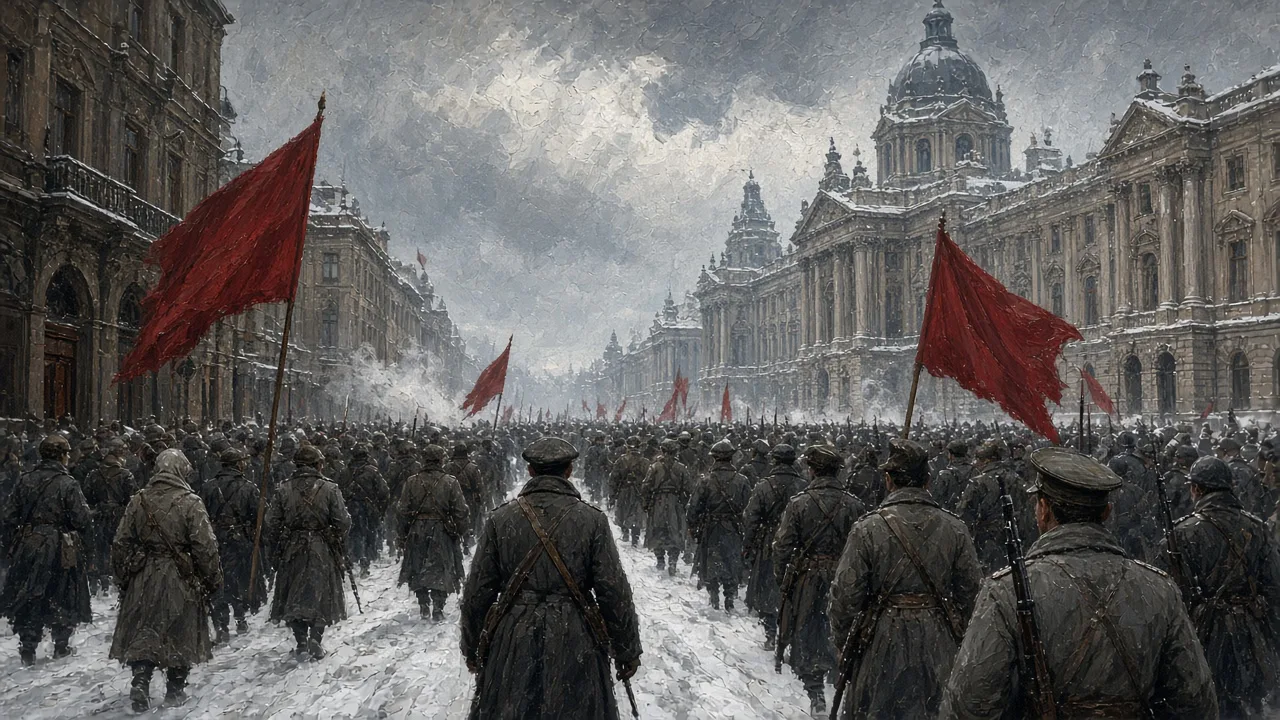
On March 8, 1917 (February 23, old style), International Women's Day, protests over bread shortages in Petrograd grew into mass strikes and demonstrations. When soldiers refused to fire on the crowds and joined them instead, the government lost control. On March 15 (March 2, old style), Nicholas II abdicated, ending more than 300 years of Romanov rule.
Power was now split between a Provisional Government, made up largely of liberal politicians, and the Petrograd Soviet, a council of workers' and soldiers' deputies. The Provisional Government decided to keep fighting the war, a fateful choice as the army disintegrated and hunger worsened.
The Bolsheviks seize power
In April 1917, Lenin, the leader of the radical Bolshevik faction, returned from exile in Switzerland, with Germany allowing his train to cross its territory in the hope he would undermine Russia's war effort. He demanded an end to the war, land for the peasants and "all power to the soviets". The Bolshevik promise of "peace, land and bread" won growing support.
On the night of November 6-7 (October 24-25, old style), the Bolsheviks, with Leon Trotsky playing a key organising role, took over key points in Petrograd and stormed the Winter Palace, home of the Provisional Government. The takeover itself involved relatively little fighting in the capital, but what followed was far bloodier.
Civil war and a new state
The Bolsheviks closed the newly elected Constituent Assembly in January 1918 after they failed to win a majority. In March 1918, they signed the Treaty of Brest-Litovsk with Germany, giving up large territories to leave the war. Opponents, known collectively as the Whites, backed at times by foreign troops, fought the Bolshevik Red Army in a civil war that lasted until about 1920 in most regions, and longer in some.
In July 1918, Nicholas II and his family were executed by Bolshevik guards in Yekaterinburg. The civil war, accompanied by political terror, famine and epidemics, killed millions of people; estimates vary widely. In December 1922, the Bolsheviks created the Union of Soviet Socialist Republics (USSR). Lenin died in January 1924, and Joseph Stalin eventually emerged as the country's dictator.
Timeline: key moments
- 1905: Revolution forces the tsar to create a parliament.
- 1914: Russia enters World War I.
- March 8, 1917 (Feb 23 OS): Bread protests begin in Petrograd.
- March 15, 1917 (March 2 OS): Nicholas II abdicates.
- April 1917: Lenin returns to Petrograd.
- November 7, 1917 (Oct 25 OS): The Bolsheviks seize power.
- March 1918: Treaty of Brest-Litovsk takes Russia out of the war.
- July 1918: The former tsar and his family are executed.
- December 1922: The USSR is formally created.
The India connection
The revolution caught the attention of Indian nationalists who were fighting their own imperial power. Some saw in it proof that an old order could be overthrown; others were wary of its violence.
- Indian communists. M.N. Roy, a Bengali revolutionary, became a prominent figure in the Communist International. A group of Indian communists formed a party in Tashkent in October 1920, although the founding date of the Communist Party of India is itself debated, with some dating it to a conference in Kanpur in 1925.
- Writers and leaders. Jawaharlal Nehru visited Moscow in 1927 for the tenth anniversary of the revolution and wrote about what he saw. Rabindranath Tagore visited the Soviet Union in 1930 and recorded his impressions in letters later published as a book.
- Planning. After independence, India adopted Five-Year Plans, beginning in 1951. The idea of state-led economic planning drew partly on the Soviet model, though India combined it with democracy and a mixed economy.
Why it matters today
- Wars can break states. The strain of World War I turned long-standing grievances into revolution.
- Food security is political. Bread shortages lit the spark in Petrograd, a reminder that prices and supply chains can topple governments.
- Revolutions rarely end where they start. A protest for bread and reform ended in one-party rule and civil war.
- The ideological legacy is long. The rivalry between communism and capitalism shaped the Cold War and influenced economic thinking worldwide, including in India.
Frequently asked questions
Why is it called the October Revolution if it happened in November?
Russia then used the Julian calendar, 13 days behind the modern Gregorian calendar. The Bolshevik seizure of power took place on October 25 by the old calendar, which was November 7 by the modern one.
Who led the Russian Revolution?
The February Revolution was a largely spontaneous popular uprising. The October Revolution was led by Vladimir Lenin's Bolshevik party, with Leon Trotsky as a key organiser.
How did the Russian Revolution influence India?
It inspired Indian communists and influenced leaders such as Nehru. After independence, India's Five-Year Plans drew partly on the Soviet idea of economic planning.