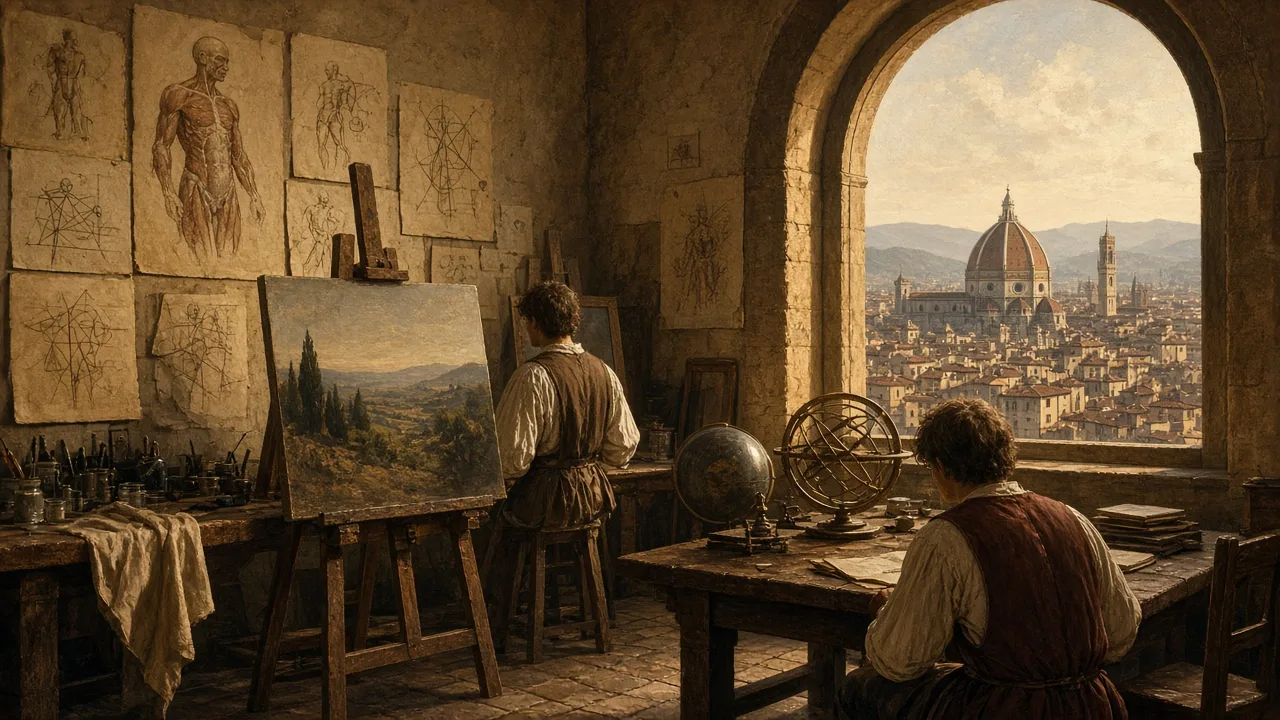
The Mona Lisa, the dome of Florence Cathedral, Michelangelo's David and the idea that the Earth orbits the Sun all belong to the same remarkable era. The Renaissance, a French word meaning "rebirth", is the name historians give to the period, roughly from the 14th to the 17th century, when European thinkers and artists looked back to ancient Greece and Rome for inspiration and, in the process, created something new. It began in the city-states of Italy and spread across Europe, changing art, education, science and the way people thought about human potential.
Why Italy, and why then?
Several forces came together in 14th-century Italy. Its cities, such as Florence, Venice and Milan, were rich from trade and banking, and they sat at the crossroads of commerce between Europe, the Islamic world and Asia. Wealthy families and merchant guilds competed for prestige by funding buildings, paintings and scholarship. The most famous patrons were the Medici of Florence, a banking family who dominated the city's politics for much of the 15th century.
Italy was also surrounded by the physical remains of ancient Rome, which made the classical past feel close. The Black Death of 1347 to 1351, which killed a large share of Europe's population, also shook old certainties and, by raising the value of labour and capital in some places, may have helped create the wealth that later paid for art. Historians still debate how far the plague shaped the Renaissance, so it is best seen as one factor among many.
Humanism: putting people at the centre
At the heart of the Renaissance was humanism, an intellectual movement that encouraged the study of classical Latin and Greek texts on grammar, rhetoric, history, poetry and moral philosophy. The Italian scholar and poet Petrarch (1304 to 1374) is often called the father of humanism for his passion for recovering ancient manuscripts.
Humanists did not reject religion, but they placed new value on human experience, individual achievement and civic life. Greek scholars and manuscripts arriving in Italy, a flow that increased around the time Constantinople fell to the Ottomans in 1453, deepened interest in Plato and other Greek writers. Many of these texts had also been preserved and studied by scholars in the Islamic world.
A revolution in art and architecture
Renaissance artists studied anatomy, perspective and light to make their work look more natural and three-dimensional. Filippo Brunelleschi designed the huge dome of Florence Cathedral, completed in the 1430s, and is credited with developing systematic linear perspective.
The High Renaissance produced some of the most famous works in art history. Leonardo da Vinci (1452 to 1519) was a painter, engineer and tireless observer of nature whose notebooks are full of studies of anatomy, machines and water. Michelangelo carved his David between 1501 and 1504 and painted the ceiling of the Sistine Chapel between 1508 and 1512. Raphael painted The School of Athens, a celebration of ancient philosophers, for the Vatican.
Printing and the spread north
The Renaissance might have stayed an Italian story without the printing press. Gutenberg's movable-type press, developed in Mainz in the 1450s, made classical texts and new ideas cheap and widely available. Humanist ideas spread north, where scholars such as Erasmus of Rotterdam and artists such as Albrecht Dürer created a Northern Renaissance with its own character.
The scientific turn
Renaissance curiosity also helped lay the foundations of modern science. In 1543, Nicolaus Copernicus published his argument that the Earth and planets orbit the Sun, and Andreas Vesalius published a landmark work of human anatomy based on dissection. In the early 1600s, Galileo Galilei used a telescope to study the Moon and Jupiter's moons. These ideas fed into the Scientific Revolution that followed.
Timeline: key moments
- 1304-1374: Life of Petrarch, often called the father of humanism.
- 1347-1351: The Black Death sweeps through Europe.
- 1430s: Brunelleschi's dome in Florence is completed.
- c. 1450s: Gutenberg's printing press begins operating in Mainz.
- 1453: Constantinople falls to the Ottomans.
- 1498: Vasco da Gama reaches Calicut in India by sea.
- 1501-1504: Michelangelo carves David.
- 1508-1512: Michelangelo paints the Sistine Chapel ceiling.
- 1543: Copernicus and Vesalius publish landmark scientific works.
The India connection
The Renaissance was not a purely European achievement. One of its most important tools came from India. The decimal place-value system with zero was developed in India, passed through scholars in the Islamic world and was popularised in Europe by Leonardo of Pisa, known as Fibonacci, in his book Liber Abaci of 1202. These "Hindu-Arabic" numerals made calculation far easier than Roman numerals and became essential for Renaissance merchants, bankers and scientists.
Trade with Asia also funded Italian prosperity, with Venice in particular growing rich on spices that often originated in India and Southeast Asia. The search for a direct sea route to that trade led Vasco da Gama to Calicut in 1498. Centuries later, the term "Bengal Renaissance" was used to describe the 19th-century flowering of social reform, literature and science in Bengal, a sign of how powerful the idea of a "rebirth" of learning had become.
Why it matters today
- Ideas travel. The Renaissance drew on Greek, Roman, Arab and Indian knowledge, a reminder that progress often comes from exchange between cultures.
- Patronage and funding shape culture. Wealthy patrons and city governments decided what got built and painted, much as investors and institutions influence culture and research today.
- Cross-disciplinary thinking pays off. Figures like Leonardo combined art, science and engineering, a model still prized in modern innovation.
- Technology accelerates change. Printing turned local ideas into a continental movement, much as the internet does now.
Frequently asked questions
When was the Renaissance?
There are no exact dates, but historians usually place the Renaissance between the 14th and 17th centuries, beginning in Italy and later spreading to the rest of Europe.
Why did the Renaissance start in Italy?
Italy had wealthy trading cities, powerful patrons such as the Medici, close contact with other cultures through trade and abundant reminders of the ancient Roman past.
What did India contribute to the Renaissance?
India's decimal number system with zero reached Europe through the Islamic world and was popularised by Fibonacci in 1202. It became a vital tool for Renaissance trade, banking and science.