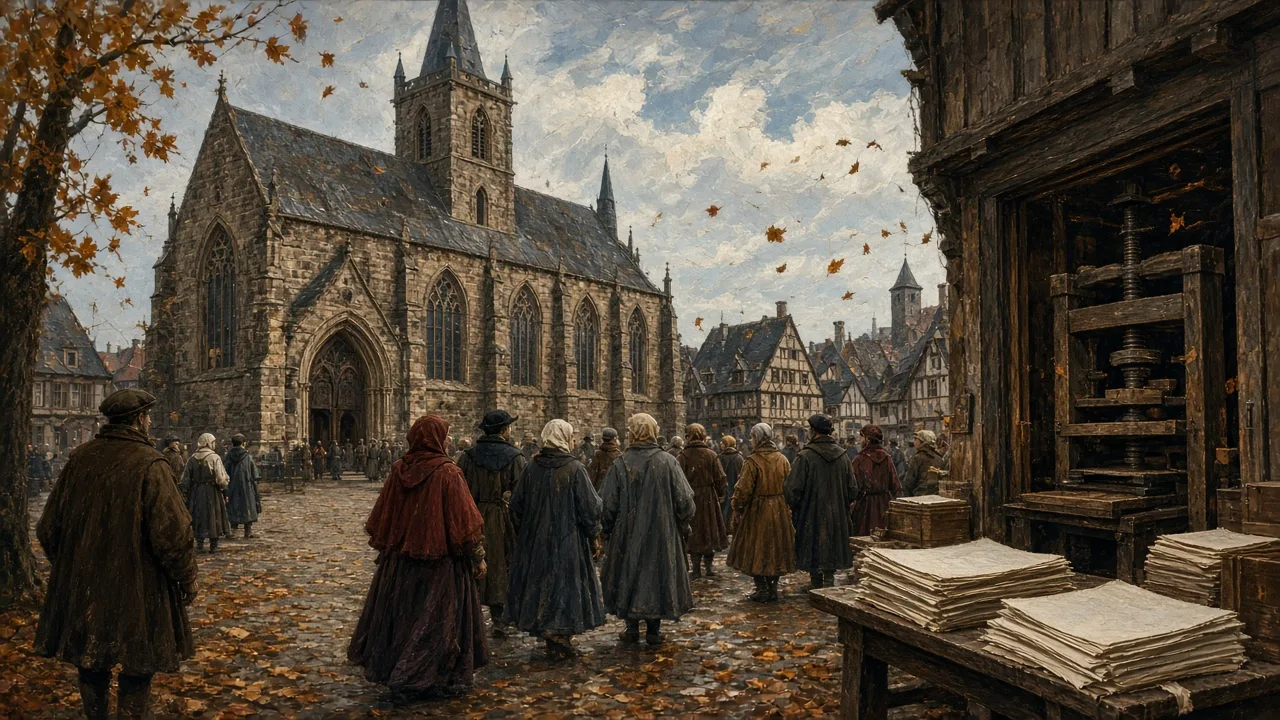
In the autumn of 1517, a little-known monk and university lecturer in the German town of Wittenberg challenged one of the most powerful institutions in Europe. Martin Luther's Ninety-five Theses, an academic list of objections to the sale of indulgences, set off a chain reaction that split Western Christianity, reshaped European politics and helped spark more than a century of religious conflict. Thanks to the new printing press, it was also one of the first great media events in history. Its effects reached as far as the Tamil coast of India.
The church before Luther
By the early 1500s, the Roman Catholic Church was the central institution of Western European life, and the papacy was deeply involved in politics and finance. Critics complained about corruption, wealthy clergy and practices such as the sale of indulgences, which were said to reduce the punishment for sins in purgatory. Calls for reform were not new. Earlier critics such as John Wycliffe in England and Jan Hus in Bohemia had attacked church abuses, and Hus was burned at the stake in 1415.
In 1517, an indulgence campaign in parts of Germany, linked to raising money for the rebuilding of St Peter's Basilica in Rome and led by the preacher Johann Tetzel, provoked Luther's protest.
October 31, 1517: the 95 Theses
Luther, a professor of theology at the University of Wittenberg, wrote his Ninety-five Theses attacking the indulgence system. October 31, 1517, the eve of All Saints' Day, is the traditional date for the start of the Reformation. The famous image of Luther nailing the theses to the door of the Castle Church is widely repeated, but historians debate whether it happened that way. What is clear is that he sent the theses to the Archbishop of Mainz, and that printers soon copied and spread them across Germany.
Luther's core ideas went beyond indulgences. He argued that salvation came through faith in God's grace rather than good works, and that Scripture, not church tradition or the pope, was the final authority. He did not initially intend to break with the Church, but the confrontation escalated quickly.
Excommunication and the Diet of Worms
In 1520, Pope Leo X threatened Luther with excommunication, and Luther publicly burned the papal document. He was excommunicated in January 1521. In April that year, he was summoned before the Holy Roman Emperor Charles V at an imperial assembly, the Diet of Worms, and refused to take back his writings. He was declared an outlaw, but a sympathetic prince, Frederick the Wise of Saxony, hid him at Wartburg Castle. There Luther translated the New Testament into German, published in 1522, making the Bible accessible to ordinary readers.
Many reformations
The movement soon spread and divided. Huldrych Zwingli led reform in Zurich. John Calvin, a French lawyer, published his Institutes of the Christian Religion in 1536 and turned Geneva into a centre of Reformed Protestantism. The name "Protestant" itself comes from the protest of reforming princes at the Diet of Speyer in 1529.
In England, Henry VIII broke with Rome largely for political and personal reasons after the pope refused to annul his marriage, and the Act of Supremacy of 1534 made the king head of the Church of England.
The Catholic Church responded with its own reform movement, often called the Counter-Reformation or Catholic Reformation. The Council of Trent (1545 to 1563) clarified doctrine and tackled abuses, and the new Jesuit order, approved in 1540, became a powerful force in education and missionary work.
Wars of religion
Religious division became tangled with politics. The Peace of Augsburg in 1555 allowed German rulers to choose Lutheranism or Catholicism for their territories. But conflict continued, culminating in the Thirty Years' War (1618 to 1648), one of the most destructive wars in European history. Death toll estimates vary widely, but the war killed millions, and some parts of Germany lost a large share of their population. The Peace of Westphalia in 1648 helped establish the idea of sovereign states managing their own affairs.
Timeline: key moments
- 1415: Jan Hus is executed for heresy.
- October 31, 1517: Traditional date of Luther's Ninety-five Theses.
- January 1521: Luther is excommunicated.
- April 1521: Luther refuses to recant at the Diet of Worms.
- 1522: Luther's German New Testament is published.
- 1529: Protest at the Diet of Speyer gives "Protestants" their name.
- 1534: England's Act of Supremacy.
- 1545-1563: The Council of Trent.
- 1555: Peace of Augsburg.
- 1618-1648: The Thirty Years' War ends with the Peace of Westphalia.
The India connection
The Reformation and the Catholic response both shaped India's encounter with Christianity and print. The Jesuit missionary Francis Xavier, a founding member of the Counter-Reformation's most energetic order, arrived in Goa in 1542.
Protestant missions came later. In 1706, two German Lutheran missionaries, Bartholomäus Ziegenbalg and Heinrich Plütschau, arrived at Tranquebar (Tharangambadi), a Danish trading post on the Tamil Nadu coast. Ziegenbalg learned Tamil and translated the New Testament, and with a printing press and Tamil type sent from Europe, the mission printed it in 1714 and 1715. King's College London describes it as the first New Testament printed in any Indian language. Mission presses like this one played a part in the growth of printing in Indian languages, a development that later helped newspapers and reform movements reach wider audiences.
Why it matters today
- New media can upend old institutions. The printing press turned a local academic dispute into a continental movement, much as social media can amplify ideas today.
- Reading in your own language is powerful. Bible translations into German, English and later Indian languages helped spread literacy and standardise languages.
- Religion and politics are hard to separate. Many rulers backed reform for reasons of power and money as much as faith.
- Pluralism was learned the hard way. The idea of coexisting faiths under one state emerged from decades of war, a lesson that still matters in diverse societies such as India.
Frequently asked questions
What were the 95 Theses?
They were a list of arguments written by Martin Luther in 1517, mainly criticising the sale of indulgences. They are traditionally seen as the start of the Protestant Reformation.
Did Luther really nail the theses to a church door?
It is the traditional story, but historians debate it. What is certain is that Luther sent the theses to church authorities and that printed copies spread rapidly.
How did the Reformation affect India?
Catholic and Protestant missionaries both came to India in its wake. Lutheran missionaries at Tranquebar printed the Tamil New Testament in 1714-1715, among the earliest printing in an Indian language.