
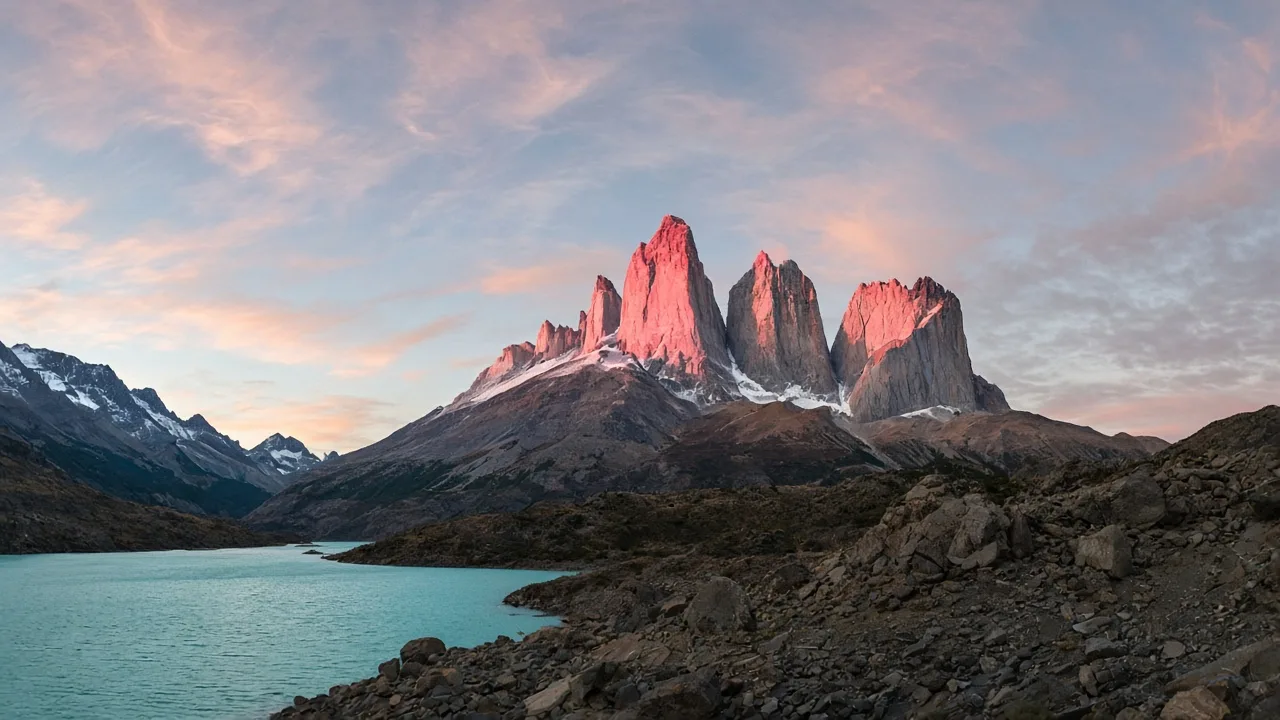
Patagonia covers the southern tip of South America across Chile and Argentina. It is a land of granite spires, ice fields, turquoise lakes and relentless wind. Its two most famous corners, Chile's Torres del Paine National Park and Argentina's Los Glaciares National Park around El Chaltén and El Calafate, are among the world's great hiking destinations, and the short southern summer coincides neatly with the northern winter.
Why go
The scenery is on an epic scale. The three granite towers of the Torres del Paine glow pink at sunrise. Mount Fitz Roy rises above El Chaltén. The Perito Moreno Glacier sheds house-sized blocks of ice into Lago Argentino. Los Glaciares National Park is a UNESCO World Heritage site, and the region rewards both multi-day trekkers and travellers who prefer day hikes and boat trips.
Best time to visit
- Summer (December to February): the longest days, which can stretch past 16 hours, and the busiest trails. Wind is often at its strongest. This is the core of a winter 2026-27 escape for northern-hemisphere travellers, and refuges and campsites book up months ahead.
- Shoulder seasons (October to November and March to April): fewer people and cooler temperatures. Late March and April bring autumn colour in the beech forests.
- Winter (May to September): cold, quiet and with limited services. Some trails and routes require guides, and many lodges close.
Patagonian weather can bring four seasons in a day at any time of year, so pack layers and waterproofs.
Top things to do
- The W Trek (Torres del Paine): a four- to five-day route linking the Base of the Towers, the French Valley and Grey Glacier. The longer "O" circuit takes about eight to ten days.
- Day hikes from El Chaltén: Laguna de los Tres beneath Fitz Roy and Laguna Torre beneath Cerro Torre. Both are free and start from town.
- Perito Moreno Glacier: walkways face the glacier near El Calafate, and boat trips and guided ice treks are available.
- Lago Grey and Grey Glacier: boat trips and kayaking in Torres del Paine.
- Puerto Natales and Punta Arenas: gateway towns with good food and lamb asado, plus penguin colonies in season.
- Ushuaia and the Beagle Channel: further south for those with extra time. It is also the main departure port for Antarctic cruises.
Where to stay by area
- Puerto Natales (Chile): the main base for Torres del Paine, with hostels, mid-range hotels and design lodges.
- Inside Torres del Paine: refugios, campsites and upscale all-inclusive lodges. You will need to book well ahead.
- El Calafate (Argentina): a convenient town for Perito Moreno, with plenty of hotels.
- El Chaltén (Argentina): a small trekking village with hostels, cabins and guesthouses.
Getting there and around
Most travellers fly to Punta Arenas or Puerto Natales in Chile via Santiago, or to El Calafate in Argentina via Buenos Aires. Buses connect Puerto Natales with El Calafate (about five to six hours including the border crossing) and El Calafate with El Chaltén (about three hours). Public buses and transfers reach the main park entrances. Renting a car gives flexibility, but distances are long, many roads are gravel, and cross-border car rentals need special paperwork.
Indicative budget
Approximate per person per day:
- Budget: about US$60 to US$100 camping or in hostels, self-catering and using buses.
- Mid-range: about US$150 to US$300 for hotels, some refugio nights with meals, and boat trips.
- Luxury: US$800 and up for all-inclusive lodges in Torres del Paine.
Park fees: for the 2026-27 season, Chile's CONAF lists foreign adult entry to Torres del Paine at CLP 32,400 for a day pass and CLP 48,500 for stays of two or more days. That is roughly US$35 to US$55, depending on the exchange rate. Buy passes in advance through CONAF's official channels. Argentina also charges foreigners an entry fee for the Perito Moreno sector of Los Glaciares, payable in pesos. Because Argentine prices change often with inflation, check the latest rate before you go.
Practical tips: entry rules, taxes and overtourism
- Entry: Chile and Argentina admit citizens of many countries visa-free for tourist stays of up to 90 days, including most of Europe, the US, Canada, Australia and New Zealand. Requirements vary for other passports, so check official consular sites before travelling.
- Bookings on the W and O: overnight stays in Torres del Paine are only allowed at designated campsites and refugios, and you must reserve them in advance. Rangers check reservations along the route.
- Fire and Leave No Trace: major wildfires in the park have been caused by visitors. Open fires are banned, and stoves may only be used in designated areas. Carry out all rubbish and stay on marked trails.
- Money: in Argentina, exchange conditions can change quickly. Cards are widely accepted, but carrying some cash helps in small towns.
- Wind: gusts can be strong enough to knock hikers off balance. Heed ranger warnings and trail closures.
FAQ
Chile or Argentina: which side is better? Ideally both. Torres del Paine suits multi-day trekking, while El Chaltén offers spectacular free day hikes, and Perito Moreno is easy to visit from El Calafate.
How long do I need? Ten to fourteen days covers Torres del Paine, El Calafate and El Chaltén at a reasonable pace.
Can I do the W Trek without a guide? Yes, independently, as long as you have booked your campsites or refugios. Guided and fully supported options are also available.


