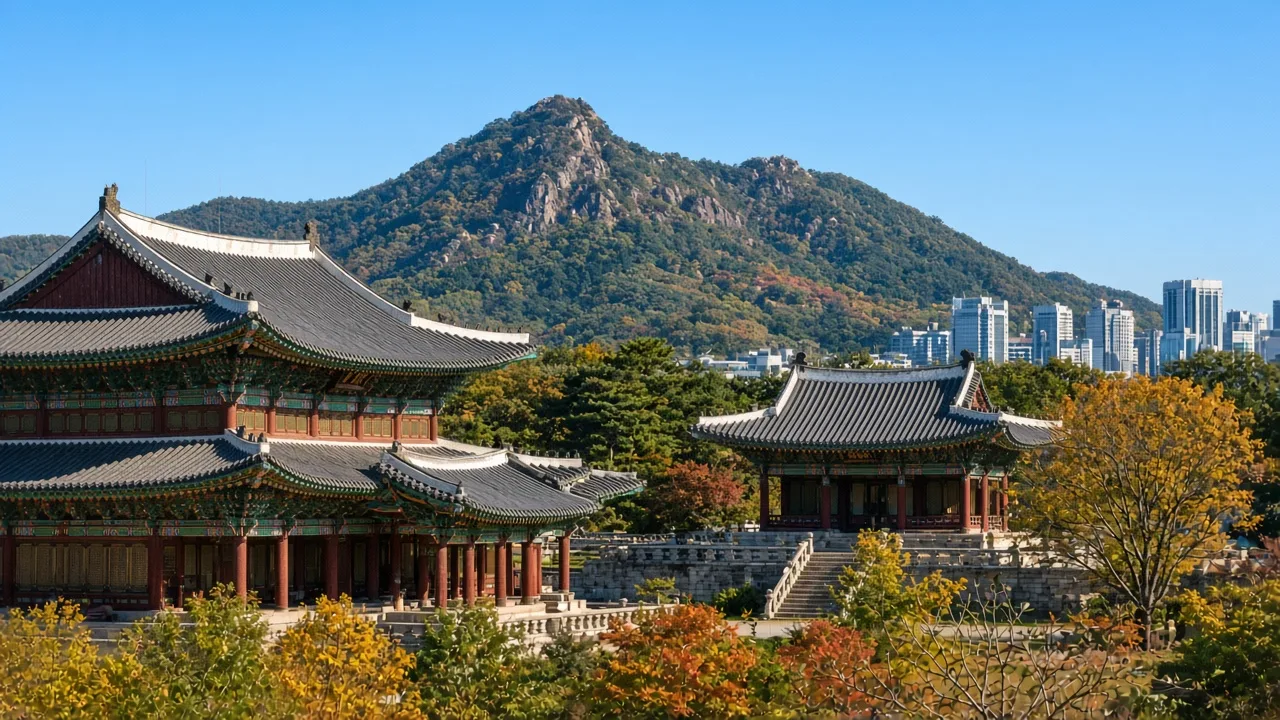
Seoul blends 600-year-old palaces with glass towers, street markets with high-tech cafés, and Buddhist temples with K-pop stages. It is one of Asia's most exciting city breaks: safe, efficient and endlessly delicious, with distinct seasons that each have their own appeal.
Why go
Seoul's appeal runs from the historic to the hyper-modern. You can wander the royal palaces of the Joseon dynasty in a rented hanbok, explore the hanok alleys of Bukchon, shop in Myeongdong and Seongsu, eat your way through Gwangjang Market, and hike the granite peaks of Bukhansan National Park without leaving the city. Changdeokgung Palace is a UNESCO World Heritage site, and the DMZ is a day trip away.
Best time to visit
- Spring (April to May): cherry blossoms in early April and mild temperatures. It is one of the busiest seasons.
- Autumn (September to November): crisp, clear days and brilliant foliage in late October and November. Many consider this the best time to visit.
- Summer (June to August): hot and humid, with the monsoon rains (jangma) in late June and July.
- Winter (December to February): cold and dry, often below freezing, with occasional snow. Winter 2026-27 means festive lights, ice rinks, ski resorts within reach, and warming bowls of tteokbokki and hotteok from street stalls. Seollal (Lunar New Year) is expected in early February 2027, when some shops close and transport is busy.
Top things to do
- Gyeongbokgung Palace: the grandest of the five Joseon palaces, with a changing of the guard ceremony. Entry is free for visitors wearing hanbok. Most palaces close one day a week, so check before you go.
- Changdeokgung and its Secret Garden: a guided tour of the garden requires a separate ticket and should be booked ahead.
- Bukchon Hanok Village: traditional houses between the palaces. Respect visiting hours and residents' privacy.
- Insadong and Ikseon-dong: tea houses, crafts and hanok cafés.
- N Seoul Tower and Namsan: a cable car or hike to the city's classic viewpoint.
- Gwangjang Market: bindaetteok (mung bean pancakes), mayak gimbap and yukhoe.
- Hongdae, Seongsu and Hannam: youth culture, indie shops, galleries and cafés.
- The DMZ: guided tours to the demilitarised zone, the Third Tunnel and observatories. Bring your passport, and note that schedules can change at short notice.
- Han River parks: picnics, bike rides and the night-time Banpo Bridge fountain show (seasonal).
Where to stay by area
- Myeongdong and Jung-gu: central, great for shopping and transport, and popular with first-timers.
- Jongno and Insadong: close to the palaces and traditional culture.
- Hongdae: young, lively and good value, with direct trains from Incheon Airport.
- Gangnam: upscale hotels, shopping and business districts south of the river.
- Itaewon and Hannam: international dining and nightlife.
Getting there and around
Incheon International Airport is one of Asia's main hubs. The AREX train reaches Seoul Station in about 45 to 60 minutes, and limousine buses serve major hotels. Gimpo Airport handles many domestic and regional flights. Seoul's subway is fast, clean and signposted in English, and a rechargeable T-money card works on buses, subways and taxis. Use Naver Map or KakaoMap rather than Google Maps for walking and transit directions in Korea. KTX high-speed trains connect Seoul with Busan in about two and a half hours.
Indicative budget
Approximate per person per day:
- Budget: about ₩60,000 to ₩100,000 (US$45 to US$75) with a guesthouse, market food and the subway.
- Mid-range: about ₩150,000 to ₩300,000 for a business hotel, restaurants and attractions.
- Luxury: ₩500,000 and up for five-star hotels and fine dining.
Palace entry fees are modest, usually a few thousand won.
Practical tips: entry rules, taxes and overtourism
- Entry: many visa-waiver nationals normally need a K-ETA (Korea Electronic Travel Authorization) before travel. Citizens of 22 countries and territories, including the US, the UK, Canada, Australia, Japan and several EU states, are temporarily exempt until December 31, 2026 (Korea time). Unless the exemption is extended, travellers from these countries arriving in 2027 should expect to need a K-ETA. Check the official K-ETA site before booking travel for winter 2026-27. Other nationalities may need a visa.
- Taxes: there is no city tourist tax. Many shops offer immediate tax refunds on eligible purchases for foreign visitors.
- Bukchon rules: in the "red zone" of Bukchon Hanok Village, tourist visits are allowed only between 10am and 5pm, and visitors may be fined for entering outside these hours. Keep noise down and do not photograph residents' homes.
- Etiquette: give priority seats on the subway to those who need them, avoid eating on trains, and do not tip, as it is not customary.
FAQ
Do I need a K-ETA to visit Seoul in 2027? If you are from a K-ETA-exempt country, the temporary exemption is currently set to expire on December 31, 2026. Check the official K-ETA website for any extension before you travel.
How many days do I need in Seoul? Four to five days covers the city at a comfortable pace. Add time for Busan, Gyeongju or Jeju.
Is Seoul good in winter? Yes, if you dress warmly. Crowds are lighter, and winter food and festive lights are highlights.