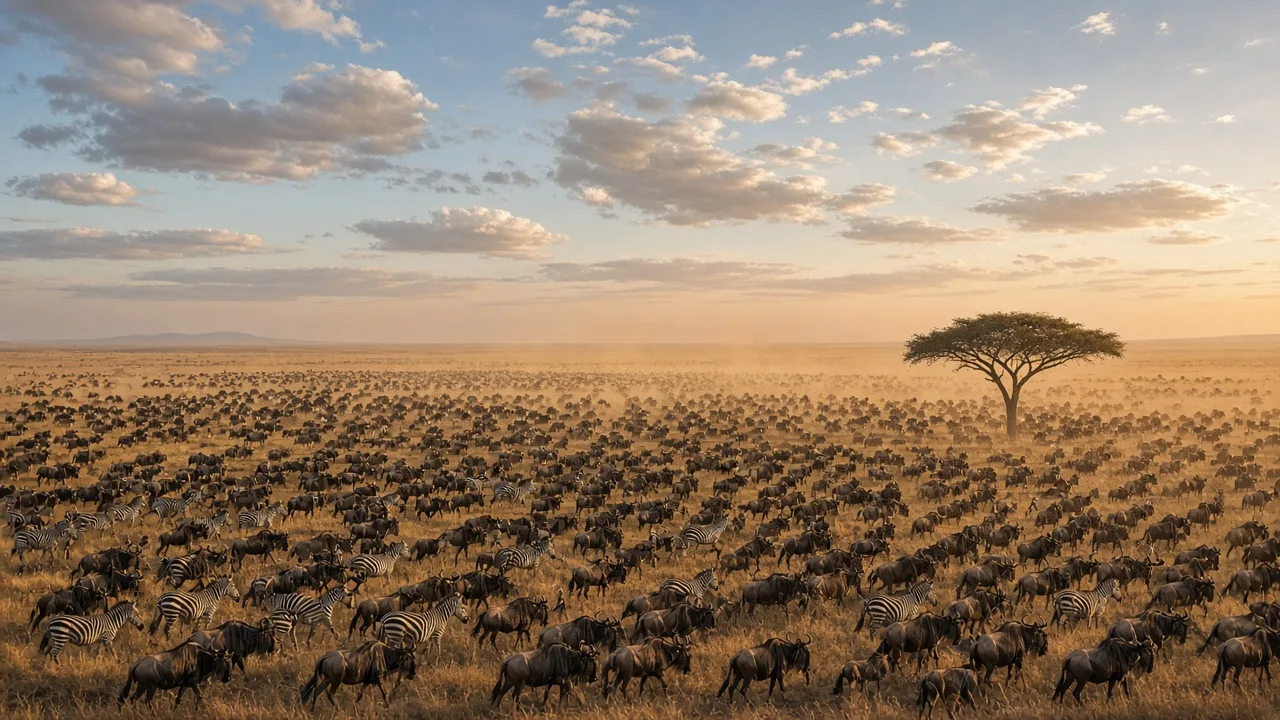
Tanzania's Serengeti National Park covers nearly 15,000 square kilometres of savannah, kopjes and riverine forest. It is the stage for one of nature's greatest spectacles: the year-round migration of more than a million wildebeest, along with hundreds of thousands of zebras and gazelles. UNESCO lists it as a World Heritage site, and it is one of the best places in Africa to see big cats.
Why go
The Serengeti offers wildlife viewing on an extraordinary scale. Lions lounge on granite kopjes, cheetahs hunt across the open plains, and leopards drape themselves over sausage trees along the Seronera River. Herds of wildebeest move constantly in search of grazing. Combine it with the Ngorongoro Crater, Tarangire and Zanzibar's beaches for a classic northern Tanzania itinerary.
Best time to visit
The migration follows the rains, so the "best" time depends on what you want to see:
- January to March: calving season in the southern Serengeti and the Ndutu area, with hundreds of thousands of calves born within a few weeks, attracting predators. This is an excellent window for a winter 2026-27 safari.
- April to May: the long rains bring lush scenery, fewer visitors and lower lodge rates, but some camps close and roads get muddy.
- June to July: the herds move north and west, with crossings of the Grumeti River in the Western Corridor.
- July to October: dramatic crossings of the Mara River in the northern Serengeti. This is peak season, with the busiest viewing points.
- November to December: the short rains, as the herds head south again.
Resident wildlife in the central Seronera area makes game viewing good at any time of year.
Top things to do
- Game drives: early-morning and late-afternoon drives in a pop-top 4x4 with a licensed guide.
- Hot-air balloon safari: a dawn flight over the plains, followed by a bush breakfast.
- Migration river crossings: patience is required, but the payoff is unforgettable.
- Walking safaris: offered by some camps in permitted zones, with an armed ranger.
- Cultural visits: Maasai villages near the Ngorongoro Conservation Area, best arranged through community-run initiatives.
- Ngorongoro Crater: a collapsed volcanic caldera with dense wildlife, including black rhino.
Where to stay by area
- Central Serengeti (Seronera): reliable year-round game viewing and many lodges and camps.
- Southern Serengeti and Ndutu: best from December to March for calving season.
- Western Corridor (Grumeti): good in June and July.
- Northern Serengeti (Kogatende and Lamai): the place to be for Mara River crossings from July to October.
- Mobile tented camps: move during the year to follow the herds.
Options range from public campsites to mid-range tented camps and ultra-luxury lodges.
Getting there and around
Most travellers fly into Kilimanjaro International Airport (JRO) near Arusha, or connect via Dar es Salaam or Nairobi. From Arusha, it is a full day's drive to the central Serengeti via the Ngorongoro Conservation Area, or about an hour by light aircraft to airstrips such as Seronera. Self-driving is possible but unusual. Most visitors book a guided safari with a licensed operator, which includes vehicle, driver-guide, park fees and accommodation.
Indicative budget
Approximate per person per day, on a shared basis:
- Budget (camping safari): about US$200 to US$300.
- Mid-range (lodges and tented camps): about US$400 to US$700.
- Luxury: US$1,000 to US$2,000 or more at top camps, plus internal flights.
Park fees are a big part of the cost. Tanzania National Parks (TANAPA) charges non-resident adults around US$70 plus VAT (roughly US$80 or more) per 24 hours in the Serengeti. Concession or camping fees for staying inside the park are extra, and fees are revised periodically. Reputable operators include them in their quotes, so check what is included.
Practical tips: entry rules, health and responsible travel
- Entry: most visitors need a visa, which many nationalities can obtain online through Tanzania's official e-visa portal before travel. Fees vary by nationality, and some visitors can get a visa on arrival. Avoid third-party sites that charge extra.
- Mandatory inbound insurance: since October 1, 2026, most foreign visitors to mainland Tanzania must hold a government-designated inbound travel insurance policy from the National Insurance Corporation (NIC), even if they already have their own cover. It is reported to cost about US$44 and is valid for up to 92 days. Visitors who arrive first in Zanzibar buy the Zanzibar equivalent instead. You can buy it online before travel or on arrival. Keep your own comprehensive travel insurance too.
- Health: malaria is present, so speak to a travel clinic about prevention. A yellow fever certificate may be required if you arrive from, or transit through, a country with yellow fever risk.
- Responsible viewing: stay in the vehicle unless your guide says otherwise, keep a respectful distance at river crossings, and avoid operators that crowd or chase animals. Night drives and off-road driving are restricted inside the national park.
- Packing: wear neutral-coloured clothing, bring layers for cold early mornings, binoculars and a dust cover for your camera. Many light aircraft have soft-bag luggage limits of around 15 kg.
- Plastic bags: Tanzania bans plastic carrier bags, so do not pack them.
FAQ
How many days do I need in the Serengeti? At least three nights, ideally split between two areas. Add the Ngorongoro Crater and Tarangire for a seven- to ten-day safari.
Can I see the Big Five in the Serengeti? Lions, leopards, elephants and buffalo are common. Rhinos are rare in the Serengeti but easier to see in the Ngorongoro Crater.
When are Mara River crossings most likely? Typically from July to October, though timings vary from year to year with the rains.