As of about 9:00 AM IST, Tuesday 24 November 2026. Based on Nvidia's announcement and reporting by Reuters and The Guardian.
Nvidia has brought back Jensen Huang as chief executive, 11 days after he resigned. In a statement on Monday 23 November, the chipmaker said its board had voted unanimously to reinstate Huang as president, CEO and director "effective immediately", after it was "satisfied with respect to Mr. Huang's candor and ability to lead NVIDIA". Wall Street cheered: Nvidia shares closed up 31.5%, adding nearly $1 trillion in market value, Reuters reported.
The decision is a sharp reversal. Less than a week earlier, board chair Harvey Jones had said Nvidia would not rehire Huang because his personal behaviour was inconsistent with the company's code of conduct, according to Reuters. It came after strong public pressure from President Donald Trump, who told CNBC: "I believe my intervention was very important to get Jensen Huang back." Lawmakers from both parties have objected, and the investigations that led to Huang's exit are still running.
What Nvidia's board said
The company said the board reached its decision after "a series of discussions and meetings" with Huang. It also said it had received input "from senior levels of the United States government" and, based on that, was "confident that Mr. Huang's reinstatement poses no national security risk." Jones called Huang "the right person to lead NVIDIA" and thanked chief financial officer Colette Kress, who served as interim CEO while keeping her CFO job. Jones stays on as board chair.
The statement did not mention the extramarital affairs that preceded Huang's resignation on 12 November. Huang has acknowledged being unfaithful to his wife and apologised, Reuters said, but has not addressed the individual relationships in detail. In his own statement, Huang said he was honoured to return and "can't wait to get back to work." Business Insider reported that he told cheering staff at headquarters he would "be a better CEO the second time around."
The investigations are not over
Nvidia stressed that the committee of independent directors examining whether Huang was the target of a foreign intelligence effort "will proceed to conclusion", and said Huang supports it. That inquiry, announced on 8 November, is being run with former acting US Attorney Joon H. Kim and the law firm Wachtell, Lipton, Rosen & Katz.
The board has also formed a separate National Security and Export Control Committee of independent directors and is creating a new Chief Compliance Officer role that will report to its governance committee. Beyond its own reviews, Nvidia faces government investigations into issues ranging from possible accounting irregularities to suspected chip smuggling, as well as a shareholder lawsuit alleging that the company and Huang concealed his relationship with Alice Huang, a Chinese businesswoman US officials suspect of spying for Beijing, according to Reuters. China has called the espionage allegations groundless. Our earlier report on the push for Huang's return and the CEO search sets out how the scandal unfolded.
Trump's role and the market reaction
Huang returned at the urging of Trump, industry figures including Elon Musk, and some investors, Reuters reported. A petition calling for his reinstatement drew more than 180,000 signatures. Trump told CNBC he had also spoken to Chinese President Xi Jinping about Huang during his visit to Shenzhen last week, and said he had urged Nvidia to keep reviewing its compliance with US export controls.
The rally lifted Nvidia back to second place among the world's most valuable companies, behind Apple, though Reuters noted the gain did not erase all the losses since Huang resigned. Shares closed at $165.05. Other AI stocks joined in: Micron, Marvell, Dell, CoreWeave and Nebius all rose more than 18%, according to Investing.com market data. That matters for a market that has been shaken by the AI sell-off, which tipped the S&P 500 and Dow into correction last week and pushed Asian governments to shore up their stock markets.
Trump's personal stake has drawn attention. Reuters estimated that Trump owns between $11 million and $55 million of Nvidia stock, based on his disclosures, meaning Monday's surge could have added as much as $17 million to his net worth. A White House spokesperson said Trump's portfolio is managed independently by third-party financial institutions and that neither he nor his family can direct its investments.
A governance test for corporate America
Governance experts say the reversal raises questions about the board's independence. "It does send a troubling message about the state of corporate governance in America," James St. Aubin of Ocean Park Asset Management told Reuters. "Certain executives are going to be held to different standards if you are perceived to be a one of one." Steve Sosnick of Interactive Brokers put it more bluntly: the episode showed that Huang "was too big to be fired."
The case is unusual because Huang has no super-voting shares, so the decision rested entirely with the board. It chose to bring him back before its own investigation was finished, relying in part on assurances from the government. For other boards, the lesson is uncomfortable: when a company depends this heavily on one founder, and the founder has powerful allies, the normal rules on conduct can bend.
Congress pushes back
US lawmakers sharply criticised the move. Senate Intelligence Committee chair Tom Cotton, a Republican, urged Congress to pass the Chip Security Act, which would require chipmakers to track the location of advanced AI processors and report suspected diversion, Reuters reported. Senator Elizabeth Warren, who is due to chair the Senate Banking Committee from January after Democrats won both chambers in the 3 November midterms, called the decision "reckless." Senate Democratic leader Chuck Schumer accused Trump of "putting his own financial interests ... before our national security." Republican Senator John Curtis asked: "Last week, the board said it didn't intend to reinstate him. I'd like to know what changed."
Huang will testify in a public hearing before the Senate Banking Committee on 3 December, the panel's chair Tim Scott said, and is still expected to sit for a closed-door interview with three House committees on 1 December.
Megaspeed blacklisted and the China risk
On the same day, the Commerce Department added Singapore-based Megaspeed, an Nvidia customer at the centre of the scandal, and affiliated companies in Thailand, Malaysia and Indonesia to its trade blacklist, according to The Guardian and the official notice. The Guardian described Alice Huang as Megaspeed's controlling shareholder; Megaspeed has said she officially left the company in August 2025 and that it complies with US export controls. The Justice Department is investigating whether Megaspeed diverted Nvidia chips to China.
The fallout reaches Nvidia's China business, which had recovered strongly. Revenue from customers headquartered in China and Hong Kong rose from $2.97 billion a year earlier to $11.05 billion in the quarter to 25 October, Reuters reported, as Nvidia sold lower-powered chips allowed under US rules. But some Chinese customers have started cancelling or delaying orders for its RTX PRO 5500 card amid fears it may not be allowed into China, Reuters said, citing people familiar with the matter; it could not establish the scale. Nvidia's record third-quarter results showed how much rides on that demand.
What to watch
The next three weeks are crowded: the House interview on 1 December, Huang's Senate testimony on 3 December, the outcome of the board's foreign-intelligence inquiry and the hiring of a chief compliance officer. A tougher Democratic-led Congress from January could also push export-control bills that raise Nvidia's compliance costs. Huang is back at the helm, but the questions that forced him out have not gone away.
Sources
- Nvidia: NVIDIA Board Reinstates Jensen Huang as President, CEO and Board Director
- Reuters: Huang returns as Nvidia CEO after Trump intervention in abrupt board reversal
- Reuters (via Investing.com): US lawmakers criticize Nvidia decision to reinstate Huang as CEO
- The Guardian: US adds Megaspeed, AI firm at center of Nvidia scandal, to trade blacklist
- Reuters: How Nvidia's billion-dollar turnaround in China is threatened by Huang's exit
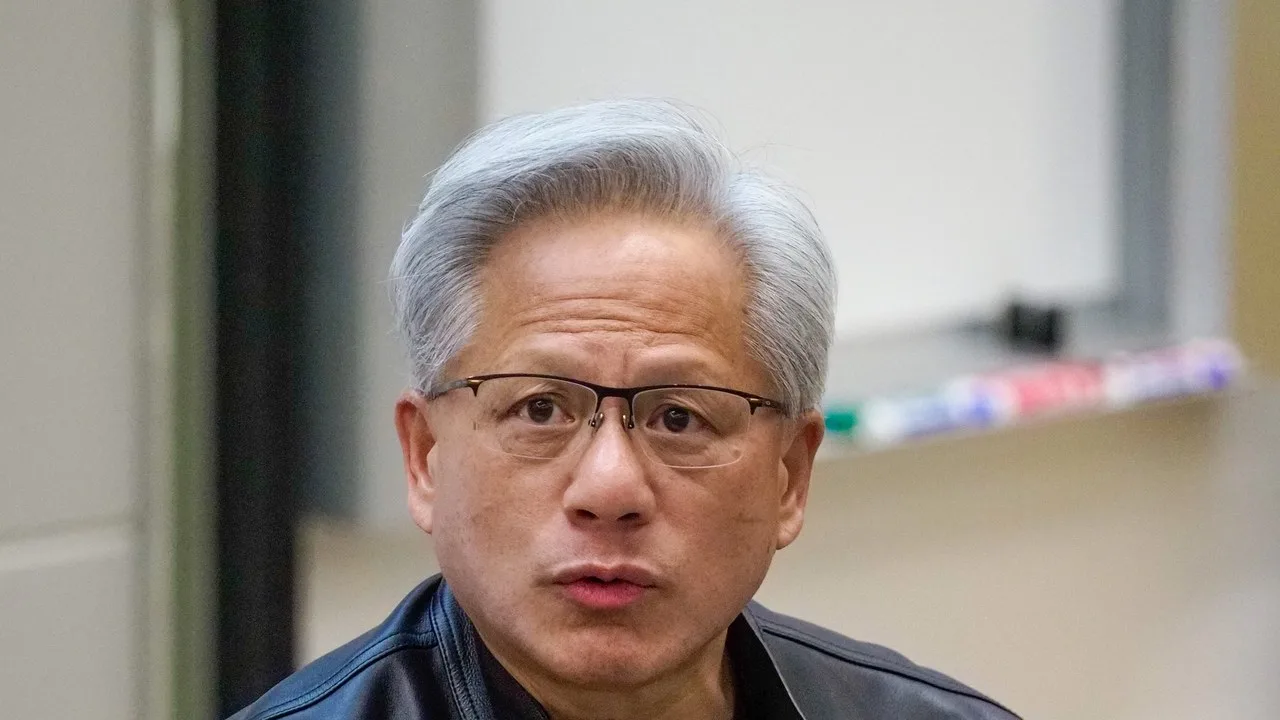
Featured image: Jensen Huang during a fireside chat in Stanford University's CS 153 course (30 April 2026, file photo), Anders Eidesvik, CC BY 4.0, via Wikimedia Commons (cropped).