As of about 8:30 AM IST, Monday 23 November 2026. Based on official statements and reporting from Xinhua, Investing.com, Yonhap, Seoul Economic Daily, CNBC and Bloomberg/Reuters reports cited by other outlets. Asian markets were still trading at the time of writing. This article is for information only and is not financial advice.
Three of Asia's biggest stock markets spent the weekend preparing for a possible "Black Monday". After Wall Street's worst week in years dragged the AI trade lower, regulators in Taiwan, South Korea and China all announced emergency steps on Saturday and Sunday to steady their markets, ranging from a blanket curb on short selling in Taipei to a ready-to-deploy stabilisation fund in Seoul and cheaper margin borrowing in Shanghai and Shenzhen.
The early verdict on Monday morning was mixed. Losses in Seoul were contained rather than reversed, while Taiwan's benchmark index swung sharply and briefly turned positive. Here is what each government did, why the region was hit so hard, and what investors should watch next.
Why Asia was in the firing line
Taiwan and South Korea are home to Taiwan Semiconductor Manufacturing, Samsung Electronics and SK Hynix, the chipmakers whose products sit at the heart of the AI boom. That made their markets two of the biggest winners of the AI rally in the first half of the year, and two of the most exposed when it unwound.
On Friday, 20 November, the S&P 500 and the Dow closed in correction territory and the Nasdaq erased its gains for 2026, as we reported in our coverage of the Wall Street correction. Investing.com noted the sell-off had been fuelled by worries about debt-funded AI infrastructure, uncertain returns on AI spending, the fallout from Jensen Huang's departure as Nvidia chief executive and the regulatory implications of the Democrats' midterm victory. Even Nvidia's strong quarterly results, which we covered in our Nvidia earnings report, failed to stop the slide.
Asia had already taken a beating before the weekend. According to figures compiled from Bloomberg data, Taiwan's Taiex fell 6.2 per cent on Friday and South Korea's Kospi 5.2 per cent. Investing.com said it was the Taiex's worst week since August 1990. Yonhap reported that the Kospi closed Friday below the psychologically important 5,000 mark, at its lowest level since 16 January, and Reuters said the index is now more than 40 per cent below its June peak after more than doubling in the first half.
Taiwan: a blanket short-selling curb
Taiwan's Financial Supervisory Commission moved first, on Saturday, saying stocks had "continued to fluctuate sharply". It announced five measures. The headline step bars short sales below the previous day's closing price for all listed stocks from Monday, 23 November, widening a narrower curb introduced on Thursday that applied only to shares already down 3.5 per cent or more. Brokers hedging their own business are exempt.
The regulator also raised the minimum margin for short sellers from 130 per cent to 150 per cent of the sale, temporarily stopped accepting applications for new put warrants, asked lenders to pause lending out shares and to recall loaned shares where contracts allow, and encouraged companies to buy back their own stock. Buybacks completed between October 2026 and March 2027 will count towards companies' 2026 ESG ratings. Bloomberg reported that Taiwan's NT$500 billion (about $15 billion) National Financial Stabilization Fund said it had started buying shares, and that the stock exchange met brokers on Sunday to discuss lowering the margin maintenance ratio from 130 per cent to 120 per cent.
South Korea: a fund held in reserve
In Seoul, Finance Minister Lee Hyoung-il, Bank of Korea Governor Shin Hyun Song and the heads of the Financial Services Commission and the Financial Supervisory Service held an emergency meeting on Sunday. According to Maeil Business Newspaper, they agreed a three-part package: preparing a stock market stabilisation fund, easing the daily limit on how many shares listed companies can buy back, and cracking down on illegal short selling.
The finance ministry said preparations would begin immediately so the fund "can be activated immediately depending on market conditions", Reuters reported. Seoul Economic Daily put its size at about 10 trillion won ($6.8 billion). The buyback easing is due to run for three months from 24 November, and regulators also said they would watch leveraged positions and margin calls closely. Seoul has often held such funds in reserve as a signal rather than spending them, and analysts quoted by CNBC-TV18 questioned whether the amount is big enough to change the mood.
China: cheaper leverage and lower fees
China's approach was different: rather than restricting sellers, it made it easier to buy. With approval from the China Securities Regulatory Commission, the Shanghai, Shenzhen and Beijing exchanges will cut the minimum margin ratio for leveraged stock purchases from 100 per cent to 80 per cent from 30 November, Xinhua reported. That reverses an increase made in January to curb excess leverage, and Xinhua said the change could theoretically bring in nearly 400 billion yuan (about $59.6 billion) of extra funds.
The Shanghai and Shenzhen exchanges also announced further fee cuts, and the Shenzhen exchange began consulting on market-maker rules for its ChiNext growth board. The exchanges said margin financing activity "has weakened significantly recently, while overall leverage is low", and Reuters reported that outstanding margin loans have fallen to about 2.2 trillion yuan from roughly 3 trillion yuan in late June.
Monday's first test
The early trade suggested the measures took the edge off the panic but did not end it. Yonhap reported that the Kospi opened 2.77 per cent lower at 4,734.90. Seoul Economic Daily noted that night futures had closed down 7 per cent and large chipmakers had been off 5 to 6 per cent in premarket trading, so the opening fall was smaller than feared. Foreign and institutional investors were net buyers at the open while retail investors sold. CNBC-TV18 reported the Kospi down about 3 per cent later in the morning.
Taiwan was more dramatic. According to BigGo Finance, the Taiex opened at 35,899.48, fell to 35,442.41, then surged to 36,655.48, a swing of more than 1,200 points, with market participants pointing to suspected buying by the stabilisation fund and the effect of the short-selling ban. In Hong Kong the Hang Seng opened about 1.3 per cent lower, while Japan was closed for a holiday. US stock futures, by contrast, rose about 2 per cent on Sunday evening, CNBC reported.
Do these measures work?
History offers a mixed record. Short-selling bans and state buying can slow a fall and stop forced selling from feeding on itself, but they rarely change the underlying reason prices are falling. Barclays argued last week, as cited by Maeil Business Newspaper, that short-selling curbs and stabilisation funds had limited effect in Taiwan because the bigger driver of the slide was retail investors unwinding trades made with borrowed money. China's move to cut margin requirements is a bet in the opposite direction: that encouraging more borrowing will bring buyers back.
Analysts say the real catalysts lie elsewhere. "A sustained return to tech likely requires clearer resolution of Nvidia-related uncertainty, evidence that AI demand remains resilient despite tighter US chip export to China, and geopolitical easing that brings oil meaningfully lower," Shawn Oh of NH Investment & Securities told CNBC-TV18.
What investors should watch this week
The week is short in the US, with markets closed on Thursday for Thanksgiving and shutting early on Friday. Wednesday brings October's personal consumption expenditures (PCE) inflation data, the Federal Reserve's preferred gauge, ahead of the Fed's 9 December meeting, where markets are pricing a high chance of another rate rise. Results from Hewlett Packard Enterprise on Monday and Dell on Tuesday will offer a read on AI-server demand. In Asia, watch whether Taiwan cuts its margin maintenance ratio and whether Seoul actually deploys its fund.
For individual investors, the lesson is familiar. Markets that rose fastest on a single theme can fall fastest when that theme cracks, and government support can soften but not erase that risk. Our guide to rebalancing your portfolio explains how to stop one sector or region from dominating your risk, and our explainer on whether AI is a bubble covers the debt and data-centre warning signs behind the sell-off.
Disclaimer: This article is for general information only and is not financial, investment or tax advice. Stock markets can fall sharply and you can lose money. Consider your own circumstances and speak to a qualified, regulated adviser before making investment decisions.
Sources
- Xinhua: China announces measures to steady stock market
- Investing.com: Asian countries take steps to aid stock markets after AI rout
- Stock Analysis (citing Bloomberg and Reuters): Taiwan bans short sales below prior close as Asia moves to prop up stocks
- Maeil Business Newspaper: Government announces set of three market stabilisation measures
- Yonhap: Seoul shares open sharply lower amid AI fears
- Seoul Economic Daily: KOSPI opens down 2.8% as emergency measures blunt sell-off
- CNBC: S&P 500 futures rebound after tech rout (live updates)
- CNBC-TV18: South Korea, China, Taiwan regulators step in to rescue stock markets
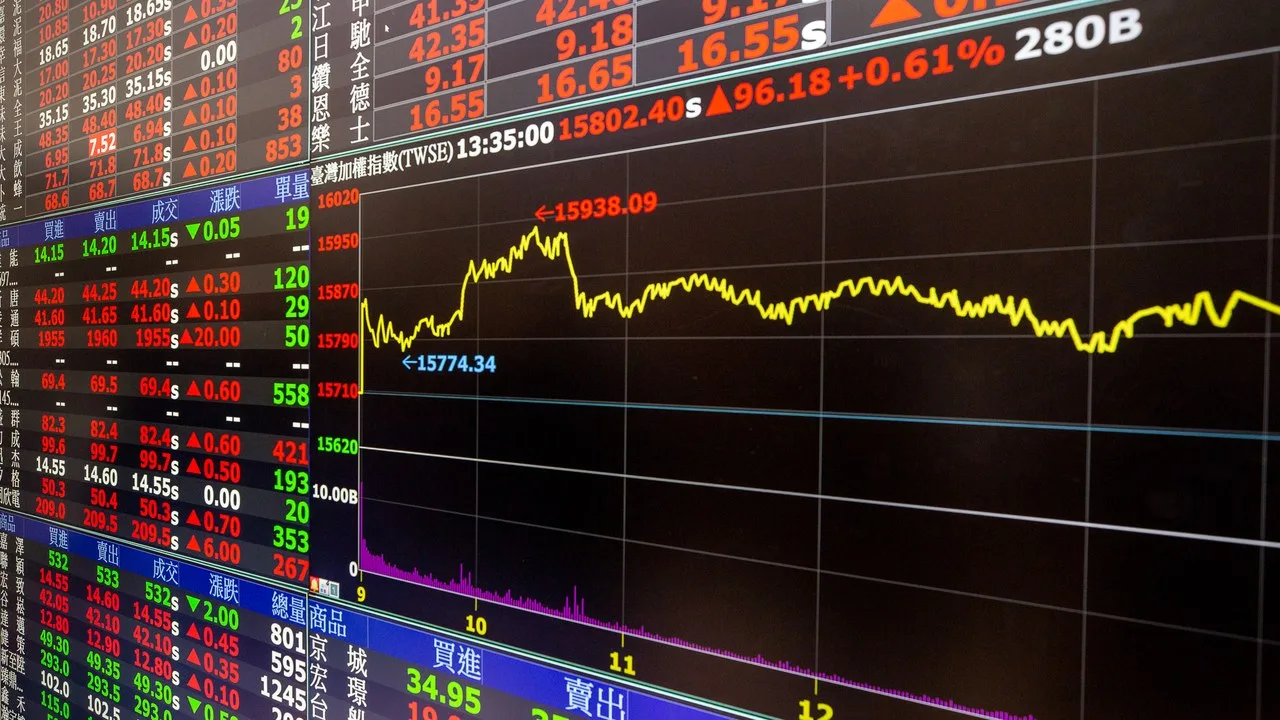
Featured image: Market data on display at the Taiwan Stock Exchange (8 February 2021, file photo), Office of the President, Republic of China (Taiwan), CC BY 2.0, via Wikimedia Commons (cropped).