
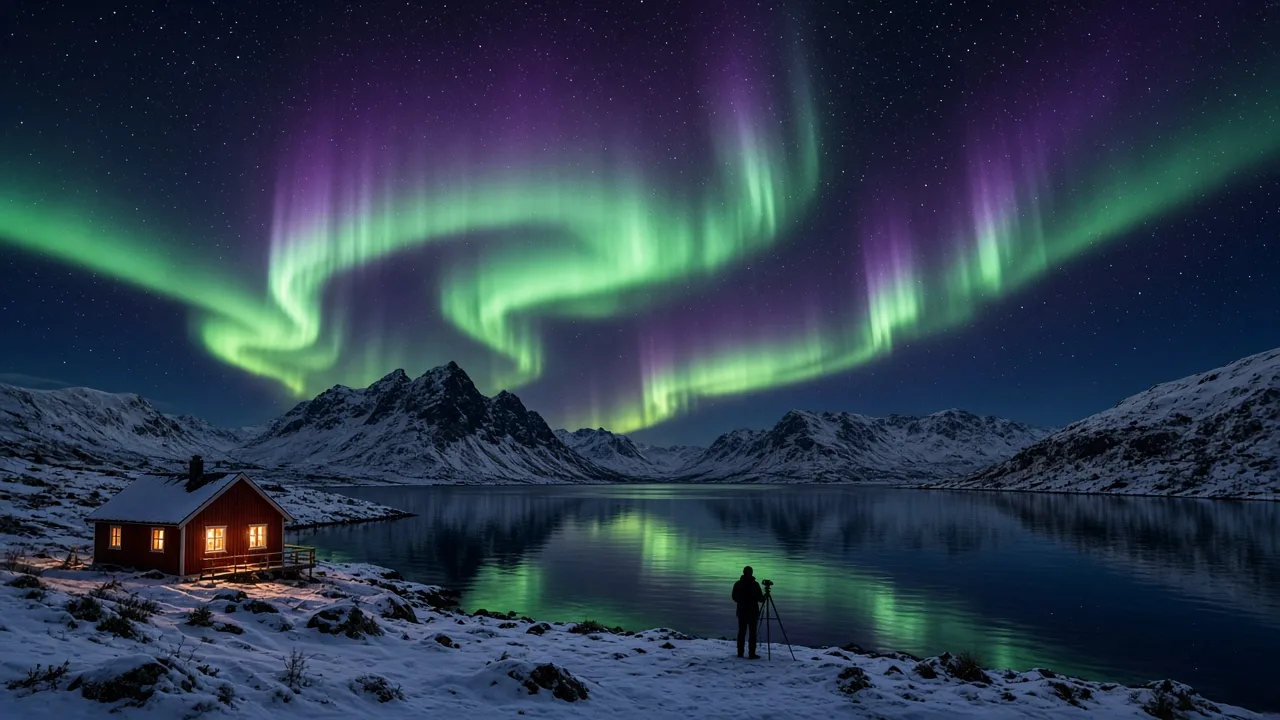
Last weekend's skies made the case for an aurora trip this winter. On Saturday 10 October, a strong geomagnetic storm pushed the northern lights far south of their usual range. In the UK, the BBC reported sightings across Wales and as far south as Devon, Hampshire and Kent. Sightings were also reported in France, Belgium and Germany, according to The Connexion.
With the long dark nights of the 2026-27 season now starting, here is what the latest solar activity means for aurora hunters, and how to give yourself the best chance of seeing the lights.
What happened on 10 October
The US National Oceanic and Atmospheric Administration's Space Weather Prediction Center (SWPC) issued a warning for a G3 (Strong) geomagnetic storm on 10 October. It said a coronal mass ejection (CME), a burst of charged particles that left the Sun on 8 October, arrived at about 14:34 UTC that day, and the storm reached G3 levels from 17:58 UTC.
According to the BBC, a key measure of geomagnetic activity reached about 600 nanotesla that evening, enough for the aurora to be visible across the whole of the UK, which is rare. When activity is around 200 nanotesla, the lights are usually visible only in the north. The Met Office said further sightings were possible across Scotland and similar geomagnetic latitudes on clear nights until Tuesday 13 October.
Is the solar maximum over?
The Sun runs on a roughly 11-year cycle of activity. In a September 2026 blog post, the Met Office said recent observations suggest the solar maximum of the current cycle occurred during 2024 and 2025, and that sunspot numbers are now trending downwards.
That does not mean the show is over. The Met Office makes three points that matter for travellers:
- Big events can still happen. Powerful flares and large CMEs can occur during the declining phase of the cycle, and historically many of the most significant events have happened after the peak.
- Coronal holes become more important. As the Sun quietens, long-lived coronal holes send out fast streams of solar wind. These cause weaker storms than major CMEs but can still produce auroras.
- Fewer sunspots means fewer chances, not none. The frequency of Earth-directed activity is falling, but the strength of any single event is not predictable from the cycle.
For travellers, the practical message is simple: low-latitude displays like 10 October will become rarer, but in the auroral zone, the band around the Arctic, the lights remain a regular sight on dark, clear nights.
Where to go
The most reliable places to see the aurora sit under or near the auroral oval:
- Northern Norway, including Tromsø and the Lofoten Islands. From 2027, Tromsø plans to add a 3% accommodation charge, subject to government approval.
- Finnish Lapland and Swedish Lapland, including Rovaniemi and the area around Abisko.
- Iceland, where you can see the lights even from near Reykjavík on strong nights, though darker countryside is better.
- Northern Canada and Alaska, such as Canada's Yukon and Northwest Territories and the area around Fairbanks.
Weather matters as much as solar activity. Cloud cover is the most common reason people miss the lights, so if your plans are flexible, look for a base where you can drive to clearer skies.
When to go
The aurora happens all year, but you need darkness to see it. In the far north, the viewing season roughly runs from late August or September to March or April. Many aurora forecasters point to the weeks around the autumn and spring equinoxes as particularly active, while midwinter brings the longest nights. Avoiding the days around a full moon also helps.
How to improve your chances
- Stay several nights. Activity varies from night to night, and one cloudy night can ruin a short trip.
- Check the forecasts. NOAA's SWPC publishes a 30-minute aurora forecast and storm alerts. National weather services and local aurora apps add cloud forecasts.
- Get away from light. Look north, away from streetlights and towns.
- Use your phone camera. As the BBC explains, our eyes see poorly in colour at night, so a faint aurora can look grey to the eye but green or pink on a camera.
- Dress for the cold. Arctic nights can be well below freezing. Layers, a hat, gloves and warm boots make waiting outside much more comfortable.
- Choose flexible tours. Many operators chase clear skies and some offer a free retry if you see nothing. Read the terms before booking.
FAQ
Is 2026-27 a good season for the northern lights? Yes, in the Arctic. Solar activity is declining after the 2024-25 maximum, but the Met Office says strong events and coronal hole storms continue in this phase.
What caused the aurora seen across the UK on 10 October 2026? A coronal mass ejection that left the Sun on 8 October triggered a G3 (Strong) geomagnetic storm, according to NOAA.
What is the best month to see the northern lights? Any dark month from about September to March in the far north. The weeks around the equinoxes are often cited as especially active.
Can I see the aurora without a camera? Yes, when it is strong. Fainter displays may show up much more clearly on a phone camera than to the naked eye.
Sources
- NOAA Space Weather Prediction Center: Strong (G3) geomagnetic storms expected, 10 October 2026
- BBC News: Northern Lights illuminate skies across the UK
- The Connexion: Northern lights seen across France (11 October 2026)
- Met Office: Does moving towards solar minimum mean less space weather?
- NOAA SWPC: Aurora 30-minute forecast
- Life in Norway: How the Nordic countries are rethinking tourist taxes


