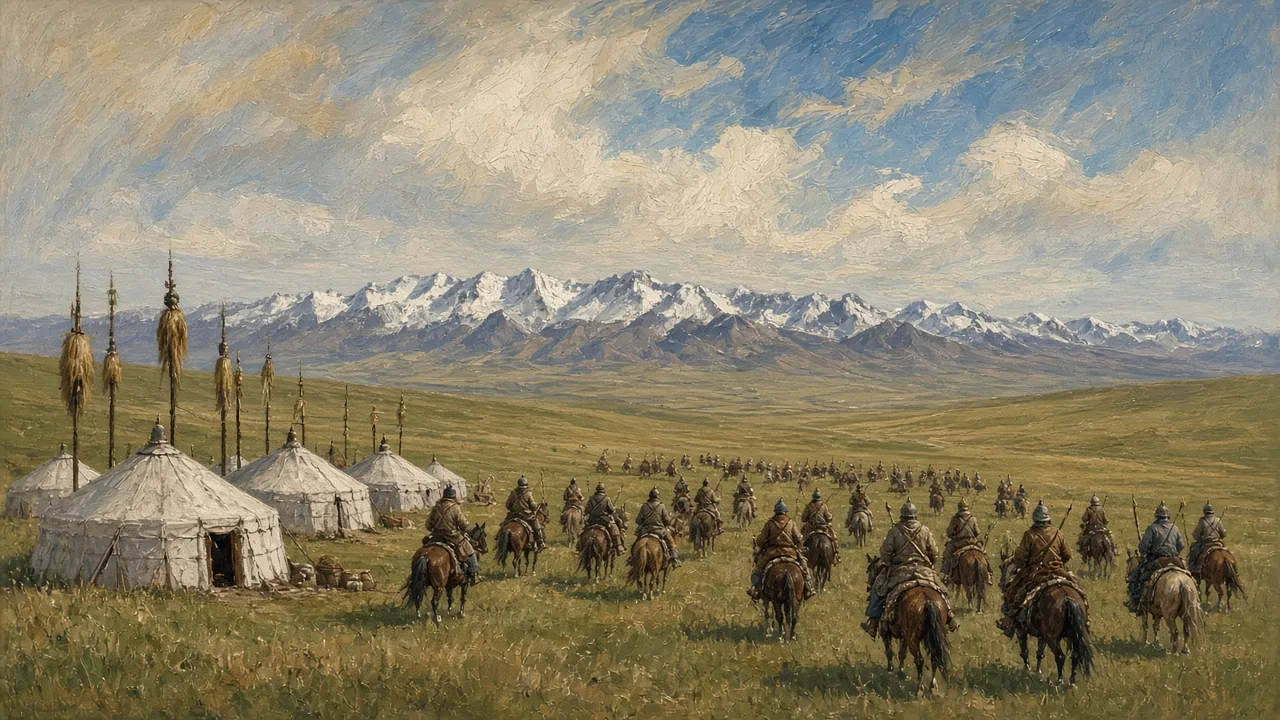
In the early 13th century, a leader from the grasslands of Mongolia united quarrelling nomadic tribes and launched a wave of conquest that reshaped Asia and shook Europe. Genghis Khan and his successors built what is often described as the largest contiguous land empire in history, stretching at its height from Korea and China to Eastern Europe and the Middle East. The Mongols were feared for their destruction, but they also connected East and West, protected trade routes and left a legacy that reached as far as India's Mughal dynasty.
From outcast to Great Khan
Genghis Khan was born with the name Temüjin, probably around 1162, though other dates such as 1155 and 1167 have been suggested. His father, a chief of the Mongol clan, was poisoned by rivals when Temüjin was about nine, and the family was abandoned by its followers. The young Temüjin grew up in poverty, was captured by enemies at one point and escaped.
Through courage, alliances and loyalty to his companions, he slowly built a following. He defeated rival tribes such as the Tatars and Kereits, and broke the power of the old aristocratic clans. In 1206, an assembly of steppe leaders, called a kurultai, proclaimed him Genghis (Chinggis) Khan, usually translated as "universal" or "oceanic" ruler.
A new kind of army and state
Genghis Khan reorganised Mongol society around his army. Soldiers were grouped in units of 10, 100, 1,000 and 10,000, and units mixed men from different tribes to weaken old loyalties. Promotion was based largely on merit and loyalty rather than birth. Every warrior was a skilled horseman and archer, and each typically had several horses, giving Mongol armies remarkable speed.
The Mongols also proved quick learners. They adopted siege engineers from China and the Islamic world, used spies and propaganda, and created a relay system of horse stations, the yam, to carry messages and officials across vast distances. Genghis Khan is also credited with a code of laws and decrees, traditionally called the Yasa, although historians debate how formal it was.
Conquest: China and Central Asia
Genghis Khan first turned on the Tangut kingdom of Xi Xia in north-western China and then the Jin dynasty of northern China. The Jin capital, Zhongdu (near modern Beijing), fell in 1215.
The next target was the Khwarazmian Empire, which ruled much of Central Asia and Iran. After a Mongol trade caravan was massacred and envoys were killed, Genghis Khan invaded in 1219. Great cities such as Bukhara, Samarkand, Merv and Nishapur were captured, and many were devastated. Medieval chroniclers recorded enormous death tolls, but historians treat these numbers with caution, as they are hard to verify and were sometimes exaggerated.
Genghis Khan died in August 1227 during a campaign against Xi Xia. The exact cause of his death and the location of his grave remain unknown.
The empire after Genghis
His sons and grandsons pushed the empire further. Under his son Ögödei, Mongol armies devastated parts of Russia, Poland and Hungary around 1240 to 1241. In 1258, his grandson Hülegü sacked Baghdad, ending the Abbasid caliphate there. In 1260, a Mamluk army from Egypt defeated the Mongols at Ain Jalut in Palestine, halting their advance in that direction. Another grandson, Kublai Khan, founded the Yuan dynasty in China in 1271 and completed the conquest of the Song dynasty in 1279, though his attempts to invade Japan failed.
By then the empire had split into four main khanates: the Yuan in China, the Ilkhanate in Iran, the Chagatai Khanate in Central Asia and the Golden Horde in the Russian steppes. During the so-called Pax Mongolica, Mongol control of the overland routes helped merchants, missionaries and diplomats such as Marco Polo travel between Europe and China. Many historians also think these same connections helped the Black Death spread in the 14th century, although the details are debated.
Timeline: key moments
- c. 1162: Temüjin is born (the exact year is uncertain).
- 1206: He is proclaimed Genghis Khan.
- 1215: The Jin capital, Zhongdu, falls.
- 1219-1221: The Mongols conquer the Khwarazmian Empire.
- 1221: Genghis Khan defeats Jalal al-Din on the Indus.
- 1227: Genghis Khan dies.
- 1241: Mongol armies win battles in Poland and Hungary.
- 1258: Baghdad is sacked.
- 1260: The Mamluks defeat the Mongols at Ain Jalut.
- 1271: Kublai Khan founds the Yuan dynasty in China.
The India connection
The Mongols arrived on India's doorstep in 1221. Genghis Khan chased the Khwarazmian prince Jalal al-Din to the Indus, where he defeated him in battle; according to the traditional account, the prince escaped by plunging his horse into the river. Mongol forces raided parts of Punjab but did not launch a full invasion of India. The Delhi Sultanate, meanwhile, became a refuge for scholars and nobles fleeing the Mongol conquest of Central Asia and Iran.
For the next century, Mongol armies from the Chagatai Khanate repeatedly raided north-western India and even reached Delhi. Sultan Alauddin Khalji repelled several major attacks around 1300, and historians often link his large standing army and strict market controls partly to this threat. The Mongol legacy returned in a different form in 1526, when Babur founded the Mughal Empire after the First Battle of Panipat. Babur was descended from Timur on his father's side and from Genghis Khan on his mother's side, and the word "Mughal" itself comes from the Persian word for Mongol.
Why it matters today
- Organisation beats size. A relatively small population built a vast empire through discipline, mobility and smart administration.
- Merit can be a strategic weapon. Promoting capable people regardless of birth helped the Mongols draw talent from across Eurasia.
- Connectivity has two sides. Open trade routes spread goods and ideas, and very likely disease as well.
- History depends on who writes it. Most records were written by the Mongols' victims, which shapes both their dark reputation and the numbers we inherit.
- Legacies travel. From Russia to China to the Mughals in India, the Mongol empire left marks on states that came long after it.
Frequently asked questions
How big was the Mongol Empire?
At its height in the late 13th century, it stretched from Korea and China to Eastern Europe and the Middle East. It is widely described as the largest contiguous land empire in history, though area estimates vary.
Did Genghis Khan invade India?
Not fully. In 1221 he defeated Jalal al-Din on the Indus and his troops raided Punjab, but he turned back. Later Mongol raids into north-western India were repelled by the Delhi Sultanate.
Were the Mughals Mongols?
Not exactly. Babur, the first Mughal emperor, was a Turco-Mongol prince descended from Timur and, through his mother, from Genghis Khan. "Mughal" comes from the Persian word for Mongol.