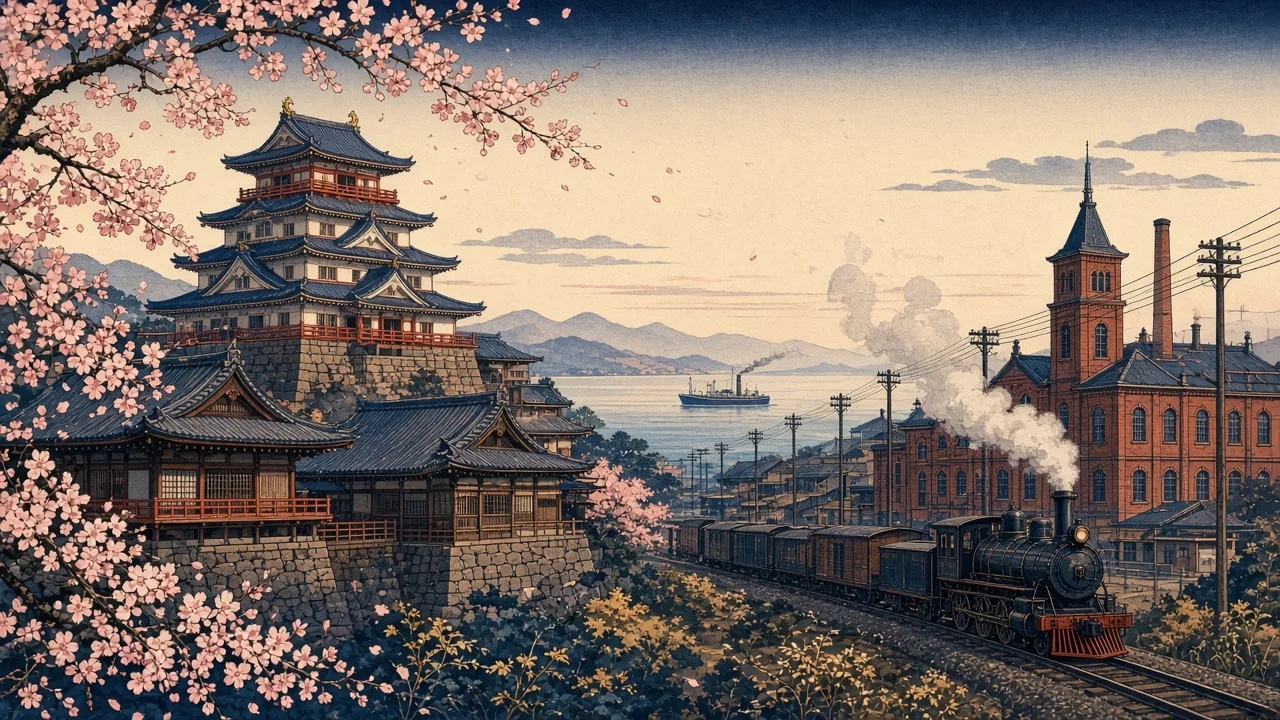
In 1853, Japan was a largely closed, feudal country ruled by a military government. Barely half a century later, it had railways, factories, a modern army and navy, a written constitution and enough military strength to defeat a European great power. The turning point was the Meiji Restoration of 1868, one of history's most remarkable examples of rapid, state-led modernisation. For Indian readers, Japan's story offers fascinating comparisons on development, technology adoption and nation-building, along with sobering lessons about where unchecked militarism can lead.
Japan before 1868: the Tokugawa world
For more than two centuries, Japan was governed by the Tokugawa shogunate, a military regime based in Edo (today's Tokyo). The emperor in Kyoto held a symbolic, religious role, while real power lay with the shogun and regional lords known as daimyo. Society was organised into rigid hereditary classes, with samurai warriors at the top. Japan also kept tight controls on foreign contact, allowing limited trade mainly through the port of Nagasaki.
The shock of the "black ships"
That isolation ended abruptly. In July 1853, US Commodore Matthew Perry arrived at Uraga, near Edo, with a squadron of warships and demanded that Japan open its ports. Japanese observers were struck by the steam-powered vessels, which came to be known as the "black ships". The following year, on March 31, 1854, Japan signed the Treaty of Kanagawa with the United States.
According to Britannica, Japan was then pushed into a series of unequal treaties with Western powers, giving foreigners special privileges, much as had happened to China. The treaties exposed the shogunate's weakness and fuelled anger among samurai, especially in the powerful southwestern domains of Satsuma and Choshu.
The Restoration of 1868
Opposition to the shogunate grew into open revolt. On January 3, 1868, Britannica notes, a group of activists in Kyoto announced the restoration of direct imperial rule under the young Emperor Meiji and the ouster of the last shogun, Tokugawa Yoshinobu. Fighting continued until the last Tokugawa forces surrendered in 1869.
In April 1868, the new government issued the Charter Oath, which committed it to deliberative assemblies, public discussion, abandoning outdated customs and seeking knowledge throughout the world. The capital was moved from Kyoto to Edo, which was renamed Tokyo, meaning "Eastern Capital".
Dismantling feudalism
The reforms that followed were sweeping. By 1871, the old feudal domains were abolished and replaced by a system of prefectures that Japan still uses. Hereditary class privileges were dismantled, the samurai lost their special status and stipends over the following years, and a national army based on conscription replaced warrior elites. The government also introduced a modern land tax to provide stable revenue, and it promoted universal education.
Learning from the world: the Iwakura Mission
In December 1871, the government sent a delegation of senior leaders abroad, led by Iwakura Tomomi and including future prime minister Ito Hirobumi. According to Japan's National Diet Library, the Iwakura Mission lasted about two years and toured the United States, Britain, France, other parts of Europe and Russia. Its aims were to prepare for revising the unequal treaties and to study foreign institutions and cultures. The treaty talks did not succeed at the time, but the mission's detailed observations of industry, government and education deeply shaped Japan's reforms.
Building an industrial economy
Under slogans often translated as "rich country, strong army", the Meiji state actively built modern industry:
- Railways. Japan's first railway, between Shimbashi in Tokyo and Yokohama, opened in 1872.
- Model factories. The Tomioka Silk Mill, Japan's first large mechanised silk-reeling factory, began operating in 1872 with imported French technology. It is now a UNESCO World Heritage Site, inscribed in 2014. Silk became one of Japan's most important exports.
- Foreign experts and overseas study. Japan hired foreign engineers and teachers and sent students abroad, then gradually replaced foreign advisers with trained Japanese specialists.
- From state to private enterprise. Many state-run enterprises were later sold to private businesses, helping give rise to large industrial and financial groups.
A constitution and a new power
In 1889, Japan promulgated the Meiji Constitution, which created a parliament (the Diet) elected on a limited franchise and a cabinet system, while preserving strong authority for the emperor and the executive. Japan's growing industrial and military strength was dramatically demonstrated in the Russo-Japanese War of 1904-05, when it defeated Russia. Japan's victory was widely noticed across Asia, including in India, where many nationalists saw it as proof that an Asian nation could match a European power.
Timeline: key moments
- July 1853: Commodore Perry's warships arrive at Uraga.
- March 31, 1854: Japan signs the Treaty of Kanagawa with the US.
- January 3, 1868: Restoration of imperial rule is announced in Kyoto.
- April 1868: The Charter Oath is issued; Edo is soon renamed Tokyo.
- 1871: Feudal domains are abolished; the Iwakura Mission departs in December.
- 1872: The first railway opens and the Tomioka Silk Mill begins operations.
- 1889: The Meiji Constitution is promulgated.
- 1904-05: Japan defeats Russia in the Russo-Japanese War.
Why it matters today
The Meiji era remains one of the most studied examples of catching up economically.
- Learning fast is a strategy. Japan systematically studied the world's best practices, adapted them and built local capability. Many developing economies, including India, follow similar ideas in technology transfer and skilling.
- Education and infrastructure first. Investments in schooling, railways and communications laid the groundwork for industry, a lesson visible in today's focus on digital public infrastructure and logistics.
- Industrial policy works, with caveats. The Meiji state seeded industries and then handed many to private firms. Debates about government support for semiconductors, electronics and other strategic sectors echo this approach.
- India-Japan ties. Japan is today a key partner for India, from the Delhi Metro to the Mumbai-Ahmedabad high-speed rail project, which uses Japanese Shinkansen technology. Japan's rail story began in the Meiji era.
- Modernisation without restraint can turn dangerous. The same drive that built Meiji Japan later fed militarism and imperial expansion in Asia in the first half of the 20th century, a cautionary reminder that economic strength needs democratic checks.
The Meiji Restoration shows how a determined society can transform itself within a generation, and why the choices made during that transformation matter for decades.