Some home remedies for skin are backed by good evidence, but many popular ones are not. The ones that work are mostly simple: petroleum jelly and thick, fragrance-free moisturisers for dry skin, colloidal oatmeal baths and cool compresses for itchy skin, and possibly aloe vera gel for minor burns. Tea tree oil has a little evidence for acne. Toothpaste on pimples, lemon or lime juice on the skin, and most DIY masks either do not work or can cause harm. If you try a home remedy, patch test it first and stop if your skin reacts.
Kitchen-cupboard skincare is popular and often passed down through families. Some of it is genuinely helpful, some is harmless but ineffective, and some can burn, irritate or stain the skin. This guide rates common remedies using evidence from the US National Institutes of Health (NIH), the American Academy of Dermatology (AAD) and systematic reviews.
Quick verdict: common home remedies for skin
| Remedy | Verdict | What the evidence says |
|---|---|---|
| Petroleum jelly | Works | Recommended by dermatologists for dry skin, lips and eczema |
| Colloidal oatmeal bath | Works | Recommended by the AAD for itchy, eczema-prone skin |
| Cool compress | Works | Simple, safe relief for itching |
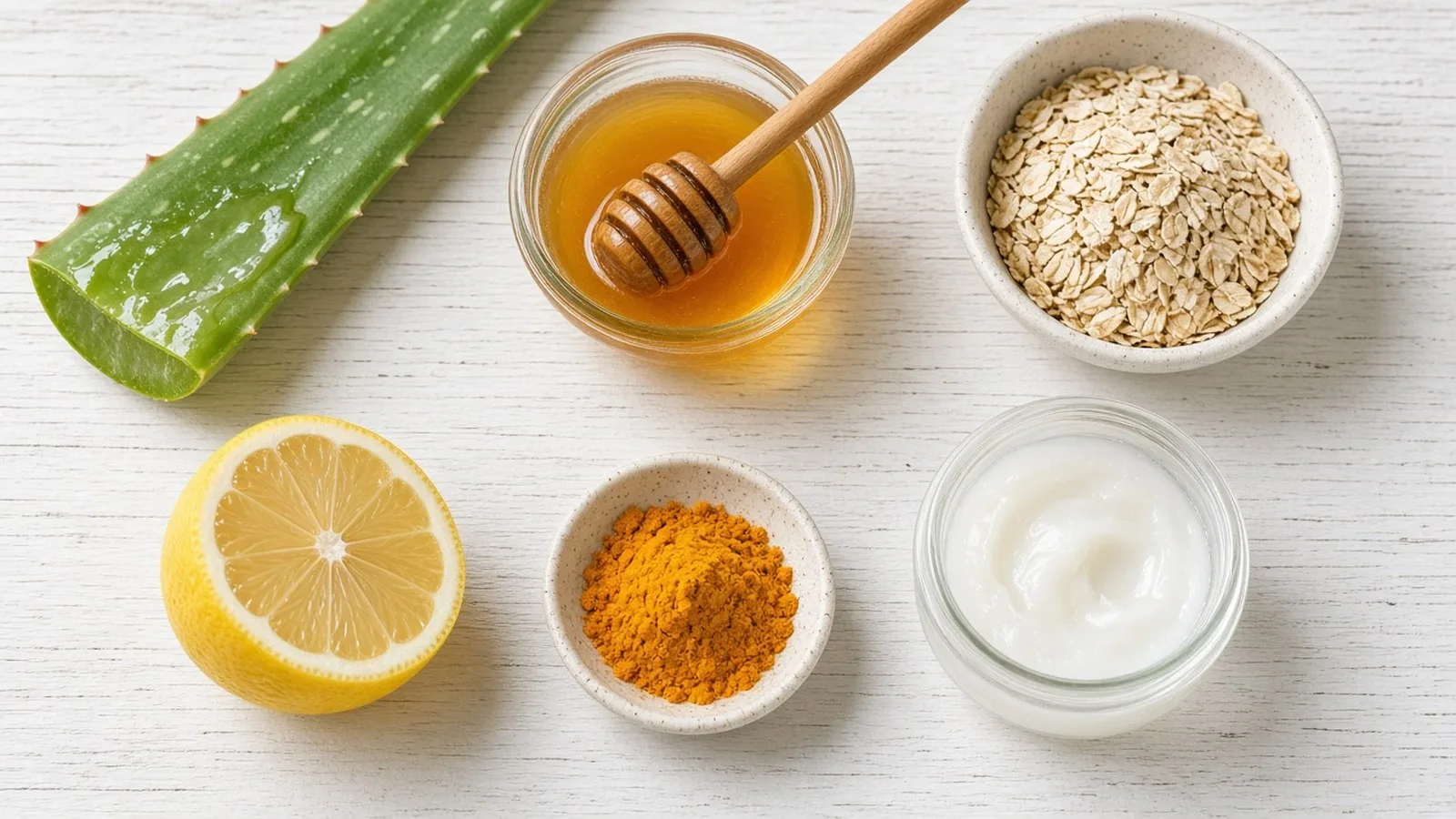
| Aloe vera gel | May help | Some evidence for minor burns; not enough for eczema |
| Honey | May help (for wounds, under medical care) | Low-quality evidence for burn and wound healing using medical-grade products |
| Tea tree oil | May help | A small amount of evidence for acne; can irritate |
| Turmeric | Unproven | Not enough evidence; can cause itching or hives and stains skin |
| Almond oil, olive oil or cocoa butter for stretch marks | Does not work | Studies found no effect on stretch marks |
| Toothpaste on pimples | Avoid | Does not treat acne and can irritate |
| Lemon or lime juice | Avoid | Can cause burns and dark marks when skin is exposed to sunlight |
Home remedies that work
Petroleum jelly and thick moisturisers for dry skin
For dry, rough skin, the most effective "remedy" is often the simplest. The AAD recommends applying a cream or ointment (rather than a lotion) within minutes of bathing while skin is still damp, and using petroleum jelly on dry, cracked lips. Ingredients that help include glycerin, hyaluronic acid, shea butter, jojoba oil, dimethicone, lanolin, mineral oil and petrolatum. Choose products labelled "fragrance-free", which the AAD notes is not the same as "unscented". Our tips for winter skin care expand on this.
Shorter, cooler showers
Changing your bathing habits costs nothing. The AAD suggests 5- to 10-minute showers or baths with warm, not hot, water and a gentle, fragrance-free cleanser. A humidifier can also help in dry weather.
Colloidal oatmeal baths and cool compresses for itching
For itchy skin, especially eczema, the AAD suggests a cool compress, or a colloidal oatmeal bath (finely ground oats that disperse in water) in lukewarm water for 10 to 15 minutes, followed by moisturiser within 3 minutes of getting out. Petroleum jelly can also be used as a simple ointment to lock in moisture.
Pimple patches
Hydrocolloid pimple patches are not exactly a kitchen remedy, but they are an easy at-home option. The AAD says they can help draw fluid out of a pimple and stop you picking at it, but they do not work on deep acne.
Remedies with some evidence (use with care)
Aloe vera
According to the NIH's National Center for Complementary and Integrative Health (NCCIH), clinical research suggests topical aloe may help burns heal faster and reduce burn pain, and two small studies suggest aloe gel combined with other treatments may improve acne. There is not enough evidence that it helps eczema. Topical aloe is generally well tolerated, though some people get burning, itching or a rash. Do not swallow aloe products meant for skin; oral aloe can cause cramps and diarrhoea, and some oral aloe leaf extracts have been linked to cases of hepatitis.
Honey
A Cochrane review found low-quality evidence that honey dressings may heal partial-thickness burns and some infected wounds after surgery faster than certain conventional treatments. These studies generally used honey as a wound dressing under medical supervision, not kitchen honey on any skin problem. Do not use honey on serious, deep or infected wounds without medical advice.
Tea tree oil
NCCIH reports a small amount of evidence that tea tree oil might help acne, but more studies are needed. Some people develop redness or irritation, which is more likely with old oil or oil that has been exposed to heat, light or air. Never swallow it, and keep it away from children and pets. If you want an acne treatment with stronger evidence, see below.
Remedies that do not work or can harm
Toothpaste on pimples
Asked whether toothpaste helps acne, a dermatologist quoted by the AAD answered: "Absolutely not!" Ingredients such as baking soda, peroxide, colours and flavours do not fight acne and can irritate the skin.
Lemon and lime juice
Citrus juice is often promoted to lighten dark spots or treat acne. Apart from being acidic and irritating, juice from limes and some other plants can react with sunlight to cause phytophotodermatitis. DermNet describes red, blistering, streaky or drip-shaped patches appearing 24 to 48 hours after exposure, which can leave dark marks lasting a long time, often more intense on darker skin. If you want to fade dark spots, our guides to melasma and niacinamide cover evidence-based options.
Turmeric on the skin
Turmeric is widely used in traditional skincare. However, NCCIH states that we do not know enough to conclude whether turmeric or curcumin is beneficial for any health purpose. Applied to the skin, curcumin can cause hives or itching, and turmeric can stain. Concentrated oral supplements have been linked to liver damage. If you enjoy a traditional turmeric ritual, patch test first and see it as a cultural practice rather than a treatment.
Oils for stretch marks
The AAD notes that almond oil, cocoa butter, olive oil and vitamin E did not prevent or fade stretch marks in studies. They can still soften dry skin.
Other DIY hacks
The AAD says there is not enough evidence that chamomile helps acne, and advises against putting tea bags on your skin. Dandruff shampoo used on the face can cause dryness.
What to use instead for acne
If you are tempted by home remedies for spots, several over-the-counter ingredients have much stronger evidence. The AAD lists:
- adapalene gel (a retinoid)
- azelaic acid
- benzoyl peroxide (starting with a 2.5% product)
- salicylic acid
Give a product 6 to 8 weeks to work before judging it. Our guide to living with acne-prone skin covers everyday habits that help.
How to try a home remedy more safely
- Patch test first. The AAD suggests applying a small amount to the inner arm once a day for 7 to 10 days before using it more widely. Stop if you notice redness, itching or swelling.
- Avoid broken, burnt or infected skin unless a health professional has advised the remedy.
- Keep it simple. One new product at a time makes it easier to spot a reaction. People with easily irritated skin may prefer a minimal routine for sensitive skin.
- "Natural" does not mean safe. Plants and essential oils are common causes of allergic and irritant reactions.
- Stay out of the sun after applying citrus or plant juices.
When to get medical help
Home care is fine for mild dryness or the occasional spot. See a doctor, pharmacist or dermatologist if:
- a rash is spreading, painful, blistering or not improving after a couple of weeks
- skin looks infected (hot, swollen, increasingly painful or oozing pus), especially with a fever
- acne is leaving scars or dark marks, or affecting your mood
- you have a burn that is large or deep, or on the face, hands, feet or genitals
For severe burns, swelling of the face, lips or throat, or difficulty breathing after using a product, call your local emergency number straight away.
Frequently asked questions
What is the best home remedy for dry skin?
Short, warm showers, a gentle cleanser and a thick, fragrance-free cream or petroleum jelly applied to damp skin are the most reliable options, according to dermatologists.
Is aloe vera good for your face?
It may help soothe minor burns and is generally well tolerated, and small studies suggest it may help acne alongside other treatments. Patch test first, as some people react to it.
Does toothpaste get rid of pimples?
No. Dermatologists advise against it because toothpaste ingredients do not treat acne and can irritate the skin. Benzoyl peroxide or salicylic acid are better choices.
Is lemon juice safe on skin?
It is best avoided. Citrus juice can irritate the skin, and lime juice in particular can cause blistering burns and dark marks when skin is exposed to sunlight.
Are natural remedies safer than skincare products?
Not necessarily. Many plants can cause allergic or irritant reactions, and home remedies are not tested for strength or purity. Evidence-based products are often gentler and more reliable.
Disclaimer: This article is for general information only and is not medical advice. Skin differs from person to person. Patch-test new products, and consult a dermatologist or doctor for persistent, painful or worsening skin problems, or before using active ingredients if you are pregnant, breastfeeding or on prescription treatment.
Sources
- American Academy of Dermatology: Dermatologists' tips for relieving dry skin
- American Academy of Dermatology: Eczema itch relief home remedies
- American Academy of Dermatology: Adult acne treatment, DIY tips
- American Academy of Dermatology: Is that DIY acne trick helpful or harmful?
- NCCIH: Aloe vera
- NCCIH: Turmeric
- NCCIH: Tea tree oil
- Jull AB et al. Honey as a topical treatment for wounds. Cochrane Database Syst Rev, 2015
- American Academy of Dermatology: Stretch marks
- DermNet: Phytophotodermatitis