At 8:15 on the morning of August 6, 1945, an American B-29 bomber dropped a single atomic bomb over the Japanese city of Hiroshima. Three days later, a second bomb struck Nagasaki. They remain the only nuclear weapons ever used in war. Within days, Japan moved to surrender, and World War II came to an end. But the bombings also opened the nuclear age, and the questions they raised about the morality of such weapons, the suffering of civilians and the risk of future nuclear war have never gone away. Today Hiroshima is a city of peace memorials, paper cranes and, since 2023, a bust of Mahatma Gandhi.
The Manhattan Project
During the war, the United States, with Britain and Canada, ran a secret programme to build an atomic bomb, known as the Manhattan Project. Scientists feared that Nazi Germany might develop such a weapon first. On July 16, 1945, the first nuclear test, code-named Trinity, was carried out in the New Mexico desert.
By then, Germany had surrendered, but the war in the Pacific continued. On July 26, 1945, the Allies issued the Potsdam Declaration, calling on Japan to surrender unconditionally or face "prompt and utter destruction". Japan's government did not accept it.
August 6: Hiroshima
The B-29 Enola Gay dropped a uranium bomb, nicknamed "Little Boy", over Hiroshima, a city with a population then estimated at roughly 300,000 or more, including soldiers and conscripted workers. The bomb exploded in the air above the city centre. The blast, intense heat and fires destroyed much of the city. Many people died instantly; many more died in the following weeks and months from burns, injuries and radiation sickness.
August 9: Nagasaki
On August 8, the Soviet Union declared war on Japan and soon invaded Japanese-held Manchuria. On August 9, the B-29 Bockscar headed for the city of Kokura, but poor visibility led the crew to turn to the secondary target, Nagasaki. At 11:02 a.m., a plutonium bomb nicknamed "Fat Man" exploded over the city. Nagasaki's hilly terrain confined some of the damage, but the destruction was still immense.
How many died?
The exact number of deaths will never be known. Population records were incomplete, many bodies were never identified, and radiation-related deaths continued for years. As the Bulletin of the Atomic Scientists explains, estimates for deaths by the end of 1945 cluster around two sets of figures: lower estimates of about 70,000 in Hiroshima and 40,000 in Nagasaki, and higher estimates of about 140,000 in Hiroshima and 70,000 in Nagasaki. Survivors, known in Japan as hibakusha, faced higher risks of cancers such as leukaemia, as well as long-term social stigma.
Surrender and debate
On August 15, 1945, Emperor Hirohito's recorded announcement accepting the Allied terms was broadcast to the Japanese people. The formal surrender was signed aboard the USS Missouri in Tokyo Bay on September 2, 1945.
Historians continue to debate whether the bombings were necessary to end the war. Supporters argue that they avoided a costly invasion of Japan. Critics argue that Japan was already close to defeat, that the Soviet declaration of war was also decisive, and that targeting cities full of civilians could not be justified. There is no consensus.
Places of memory
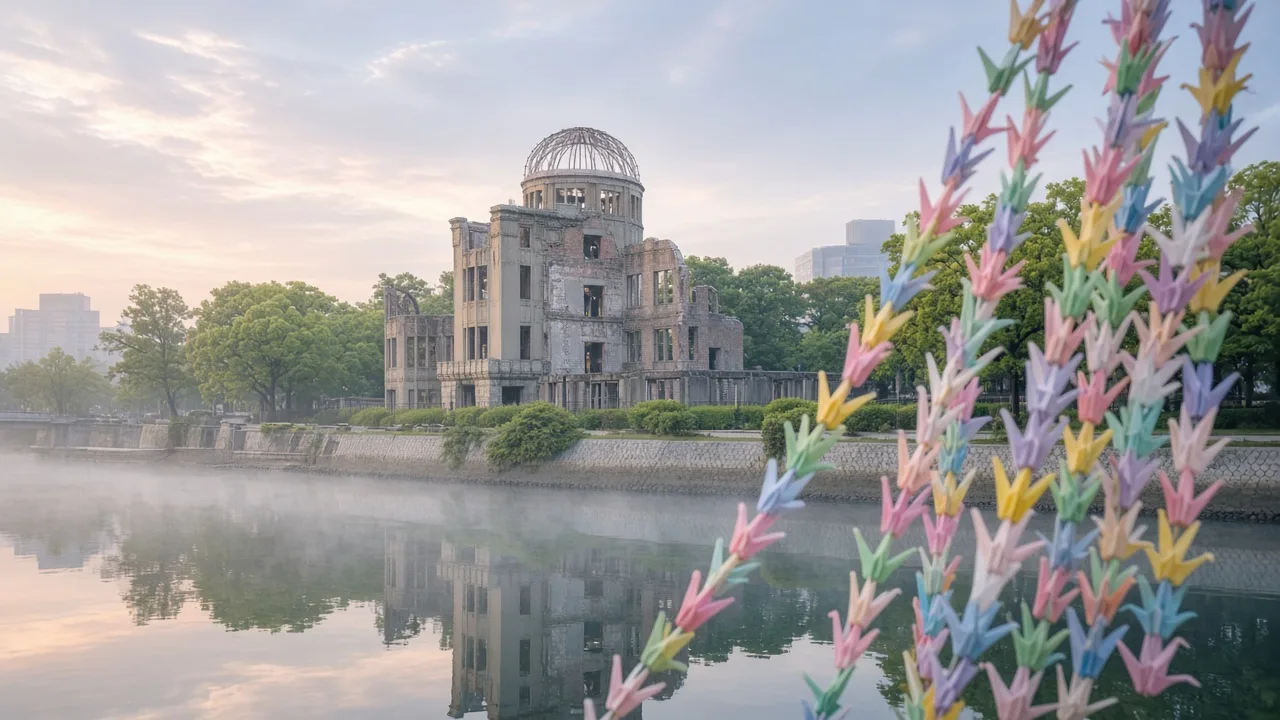
The ruined shell of the Hiroshima Prefectural Industrial Promotion Hall, close to the hypocentre, was preserved as the Genbaku Dome, or Atomic Bomb Dome. UNESCO inscribed it as the Hiroshima Peace Memorial in 1996. Nearby, the Peace Memorial Park and museum receive visitors from around the world.
Paper cranes have become a global symbol of peace through the story of Sadako Sasaki, a girl who was exposed to the bomb as a toddler and later developed leukaemia. She folded paper cranes while in hospital and died in 1955 at the age of 12. The Children's Peace Monument in Hiroshima honours her and other child victims, and visitors still leave strings of colourful cranes there. In 2024, Nihon Hidankyo, an organisation of atomic bomb survivors, was awarded the Nobel Peace Prize for its work towards a world free of nuclear weapons.
Timeline: key moments
- July 16, 1945: The Trinity test, the first nuclear explosion.
- July 26, 1945: The Potsdam Declaration calls on Japan to surrender.
- August 6, 1945: Hiroshima is bombed at 8:15 a.m.
- August 8, 1945: The Soviet Union declares war on Japan.
- August 9, 1945: Nagasaki is bombed at 11:02 a.m.
- August 15, 1945: Japan's surrender is announced.
- September 2, 1945: Japan formally surrenders.
- 1996: The Genbaku Dome is inscribed as a UNESCO World Heritage Site.
The India connection
India's response to Hiroshima has been shaped by both its peace tradition and its security needs. At the Tokyo war crimes tribunal after the war, the Indian judge Radhabinod Pal wrote a lengthy dissent, and he is remembered with respect in Japan. After independence, Prime Minister Jawaharlal Nehru became one of the early world leaders to call, in 1954, for a halt to nuclear testing.
India later developed its own nuclear weapons, conducting tests in 1974 and 1998, and adopted a doctrine of no first use. On May 20, 2023, during the G7 summit in Hiroshima, Prime Minister Narendra Modi unveiled a bust of Mahatma Gandhi near the Atomic Bomb Dome, a symbol of the shared hope for peace and non-violence.
Why it matters today
- Nuclear weapons still exist. Thousands of warheads remain in the world's arsenals, and Hiroshima is a reminder of what even a small weapon can do.
- Civilians bear the cost of war. The bombings remain central to debates about the laws of war and the protection of civilians.
- Memory builds peace. The testimony of the hibakusha has kept the human cost of nuclear weapons in public view for decades.
- Deterrence is a balancing act. India, like other nuclear powers, has to weigh security against the dangers of an arms race in its neighbourhood.
Frequently asked questions
When were Hiroshima and Nagasaki bombed?
Hiroshima was bombed on August 6, 1945, and Nagasaki on August 9, 1945. Japan announced its surrender on August 15 and formally surrendered on September 2.
How many people died in Hiroshima and Nagasaki?
Exact figures are unknown. Estimates of deaths by the end of 1945 range from about 70,000 to 140,000 in Hiroshima and about 40,000 to 70,000 in Nagasaki, with many more dying later from radiation-related illness.
Why are paper cranes linked to Hiroshima?
They are associated with Sadako Sasaki, a young survivor who folded paper cranes while ill with leukaemia. They are now a worldwide symbol of peace.
Sources
- Atomic Heritage Foundation: Bombings of Hiroshima and Nagasaki, 1945
- US Department of Energy (OSTI): The Atomic Bombing of Hiroshima
- Bulletin of the Atomic Scientists: Counting the dead at Hiroshima and Nagasaki
- UNESCO World Heritage Centre: Hiroshima Peace Memorial (Genbaku Dome)
- Prime Minister of India: PM unveils Mahatma Gandhi bust in Hiroshima