In October 1929, panic swept the New York Stock Exchange. Within a few years, the United States and much of the world had sunk into the deepest economic slump of modern times. Factories closed, banks failed, farm prices collapsed and millions of people lost their jobs and savings. The Great Depression reshaped economics, politics and the role of governments and central banks, and its shock waves reached Indian villages too. For anyone trying to understand market crashes, recessions or why central banks act the way they do today, it remains the essential case study.
The Roaring Twenties boom
The 1920s were a time of optimism in the United States. Cars, radios and telephones spread rapidly, and many ordinary people began buying shares, often with borrowed money. According to Federal Reserve History, the Dow Jones Industrial Average rose about six-fold from August 1921 to its peak of 381.17 on September 3, 1929. Investors could buy stocks "on margin", paying a fraction of the price and borrowing the rest, which pushed prices higher but made the market fragile.
Federal Reserve History notes that the economic expansion had already ended in August 1929, before the crash. In mid-October, the economist Irving Fisher famously said stock prices appeared to have reached a permanently high plateau. Days later, the market proved him spectacularly wrong.
The crash of October 1929
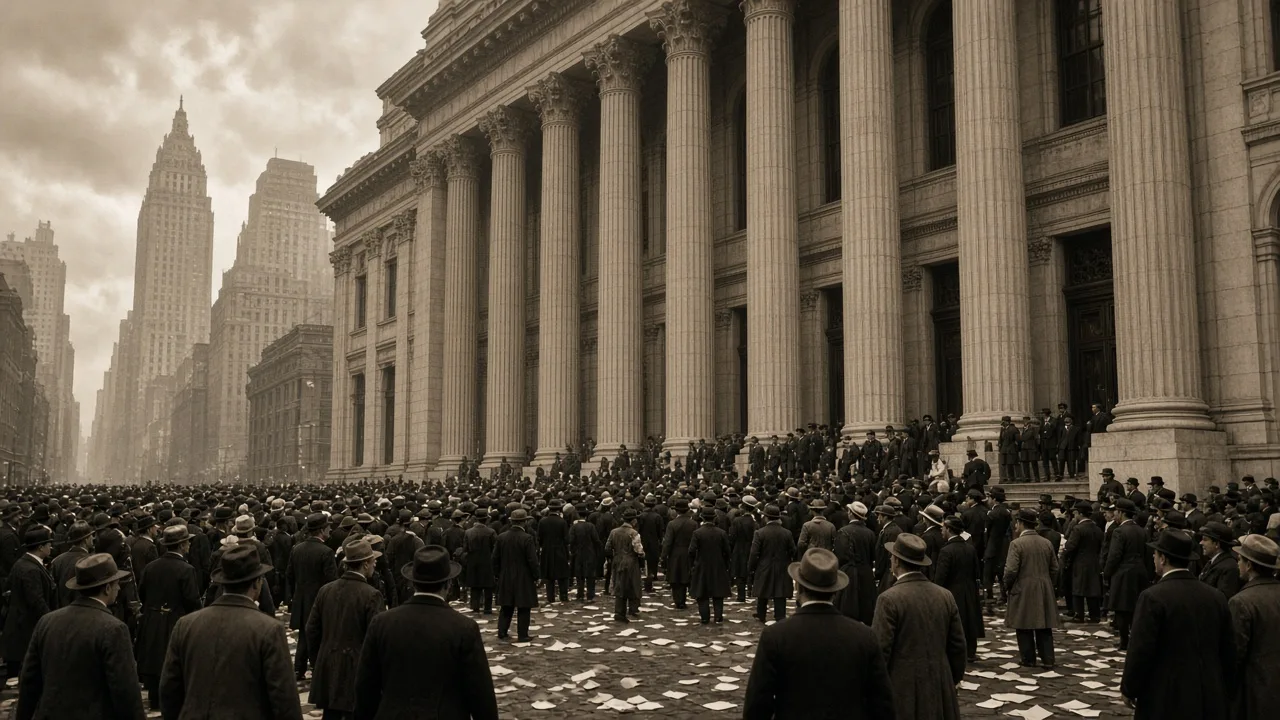
Heavy selling began on Black Thursday, October 24, 1929. On Black Monday, October 28, the Dow fell nearly 13 percent, and on Black Tuesday, October 29, it dropped nearly 12 percent more. By mid-November, the index had lost almost half its value. The slide continued, and by July 1932 the Dow stood at 41.22, about 89 percent below its peak. It did not regain its 1929 high until November 1954.
From crash to depression
A stock market crash alone does not explain a decade-long depression. What turned a downturn into a disaster was a series of further shocks and policy mistakes:
- Banking panics. Waves of bank runs swept the United States from late 1930 to early 1933. Roughly 7,000 to 9,000 banks failed or suspended operations, depending on how they are counted, wiping out savings in an era before deposit insurance.
- A shrinking money supply. Federal Reserve History notes that the money supply fell by nearly 30 percent from late 1930 to early 1933, causing prices to fall and making debts harder to repay.
- The gold standard. Countries tied to gold struggled to expand money and credit, and the crisis spread internationally through gold flows.
- Trade wars. The Smoot-Hawley Tariff of 1930 raised US import duties, and other countries retaliated. World trade shrank sharply.
According to the St Louis Fed, US real GDP fell 29 percent from 1929 to 1933, consumer prices fell 25 percent and unemployment peaked at about 25 percent in 1933.
Recovery and reform
Franklin D. Roosevelt became US president in March 1933, at the bottom of the crisis, and declared a national bank holiday. His New Deal introduced public works, financial regulation, deposit insurance through the new FDIC and social security. Britain left the gold standard in 1931 and the United States changed its gold policy in 1933, moves that many economists link to recovery. A second US recession hit in 1937-38, and full employment returned only with World War II.
Elsewhere, the Depression had grave political consequences. In Germany, mass unemployment helped the Nazi party gain support, a key step on the road to World War II.
Timeline: key moments
- September 3, 1929: The Dow peaks at 381.17.
- October 24-29, 1929: Black Thursday, Black Monday and Black Tuesday.
- June 1930: The Smoot-Hawley Tariff is signed into law.
- 1930-1933: Successive waves of US banking panics.
- September 1931: Britain leaves the gold standard.
- July 1932: The Dow hits its low of 41.22.
- March 1933: Roosevelt takes office and declares a bank holiday.
- 1937-1938: A second sharp recession in the US.
The India connection
India, then under British rule and heavily dependent on farm exports, was hit hard. As world demand collapsed, prices of crops such as wheat, rice, cotton and jute fell steeply, by some estimates roughly halving in the early 1930s. Farmers' incomes shrank, but land revenue, rents and debt repayments remained fixed in money terms, pushing many into deeper debt and some into losing their land.
Monetary policy added to the strain. The rupee was linked to sterling, and after Britain left the gold standard in 1931, large quantities of so-called "distress gold" flowed out of India as hard-pressed households sold jewellery and savings. Indian nationalists criticised the colonial government for policies that they argued served British interests first.
The economic distress fed into politics. Gandhi's Salt March of March-April 1930 and the wider Civil Disobedience Movement unfolded against this backdrop of falling prices and rural hardship. The Reserve Bank of India was established in 1935, during the Depression years, although plans for a central bank had been discussed since the 1920s.
Why it matters today
- Central banks must act in a crisis. Many economists, including former Fed chair Ben Bernanke, have argued that the Fed's failure to stop banking panics and the fall in money supply deepened the Depression. That lesson shaped responses to the 2008 financial crisis and the 2020 pandemic.
- Leverage magnifies risk. Buying shares with borrowed money fuelled the boom and worsened the bust, a warning for investors today.
- Protectionism can backfire. Retaliatory tariffs in the 1930s helped shrink world trade.
- Commodity-dependent economies are vulnerable. India's farmers suffered because their incomes depended on global prices, a concern that still drives debates on farm policy and price support.
Frequently asked questions
What caused the Great Depression?
There was no single cause. The 1929 stock crash, banking panics, a sharp fall in the money supply, the constraints of the gold standard and trade wars all combined to turn a recession into a deep depression.
How bad was unemployment in the Great Depression?
In the United States, unemployment peaked at about 25 percent in 1933. Many other countries also saw very high joblessness.
How did the Great Depression affect India?
Crop prices collapsed, hurting farmers who still had to pay fixed land revenue and debts. Large amounts of gold also flowed out of India after 1931.