This is Part 5 of Flavours of India. Earlier parts: Chettinad, Kerala, Bengal and Punjab.
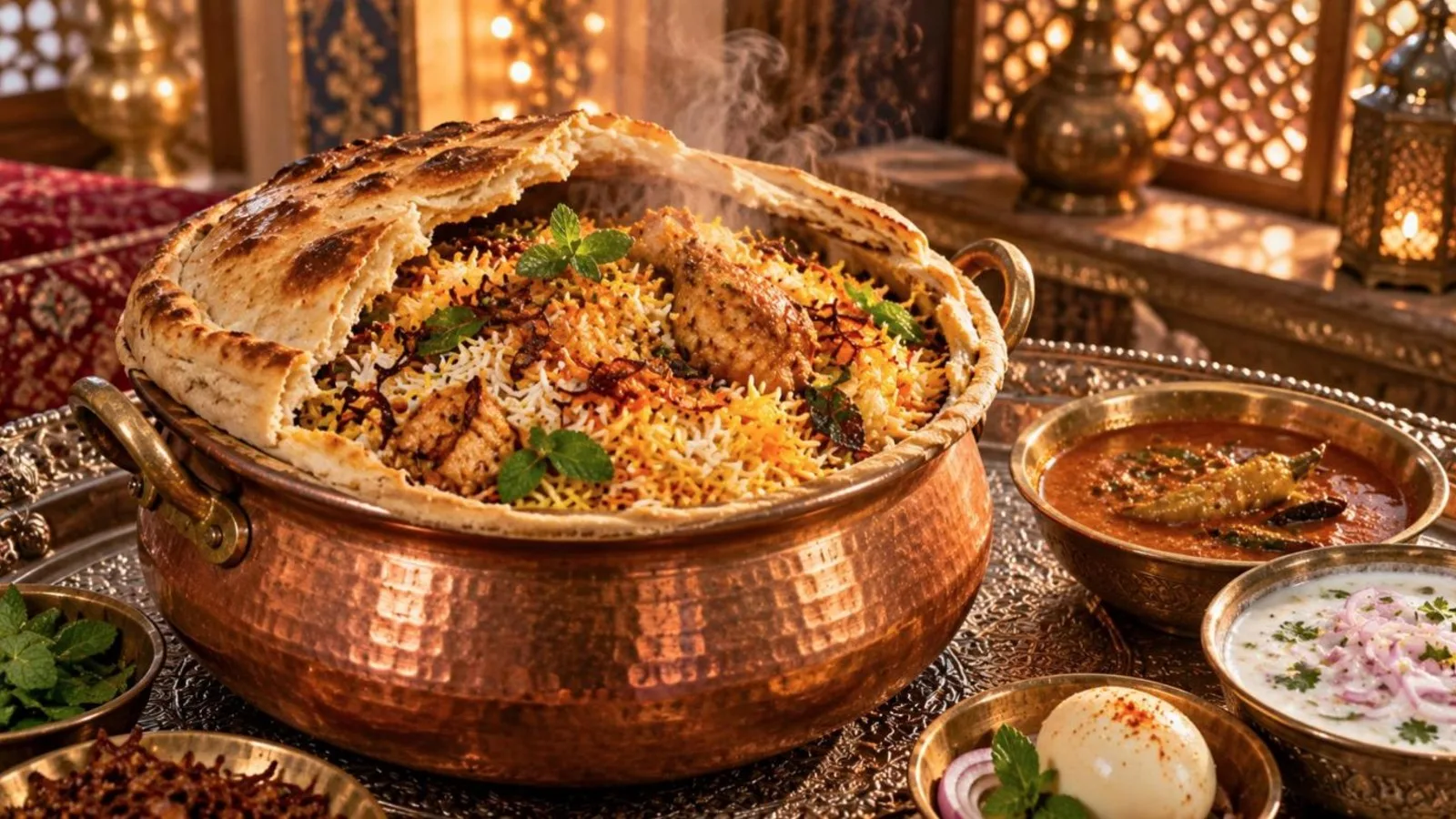
If one dish could represent India's love affair with rice, it would be biryani, and Hyderabad's version is arguably the most celebrated. It grew out of the royal kitchens of the Nizams, the Asaf Jahi rulers of Hyderabad, where Mughal and Persian techniques met the spices and flavours of the Deccan.
What makes Hyderabadi cuisine special
- Dum cooking: food is sealed in a heavy pot (often with dough) and slow-cooked in its own steam.
- Deccani flavours: green chillies, mint, tamarind and curry leaves alongside Mughal saffron, rose water and nuts.
- Famous dishes: haleem during Ramzan, mirchi ka salan, bagara baingan, double ka meetha and qubani ka meetha.
Kacchi vs pakki biryani
Hyderabadi biryani comes in two styles:
- Kacchi (raw): raw marinated meat is layered with part-cooked rice and both cook together on dum. It is considered the hallmark of Hyderabad and the more difficult technique.
- Pakki (cooked): the meat is cooked into a gravy first, then layered with rice and finished on dum.
This recipe uses the kacchi method with chicken, which cooks faster than mutton and is great for home cooks.
Hyderabadi chicken dum biryani recipe
Serves: 4-5 · Prep: 30 minutes plus at least 2 hours marinating · Cook: about 1 hour
For the marinade
- 750 g chicken, bone-in, large curry cut pieces
- 1 cup thick curd, whisked
- 1 1/2 tbsp ginger-garlic paste
- 1 1/2 tsp red chilli powder
- 1/2 tsp turmeric
- 1 tsp garam masala
- 4 green chillies, slit or crushed
- 1/2 cup each chopped mint and coriander leaves
- Juice of 1 lemon
- 1 cup fried onions (birista), crushed, plus extra for layering
- 2 tbsp ghee or oil, and salt to taste
For the rice
- 2 1/2 cups aged long-grain basmati rice, washed and soaked for 30 minutes
- 2 bay leaves, 1 star anise, 4 cloves, 4 green cardamom, 1 inch cinnamon, 1 tsp shahi jeera
- 2-3 tbsp salt (the water should taste salty like the sea)
- A few mint leaves
For layering and dum
- A pinch of saffron soaked in 1/4 cup warm milk
- 3 tbsp ghee
- Extra fried onions, mint and coriander
- 1 tsp kewra water or rose water (optional)
- Atta dough to seal the pot (or foil and a tight lid)
Method
- Marinate: mix all the marinade ingredients with the chicken. Cover and refrigerate for at least 2 hours, ideally overnight. Bring to room temperature before cooking.
- Spread the chicken: place the marinated chicken in an even layer at the bottom of a heavy, wide pot (handi or thick-bottomed vessel).
- Par-boil the rice: bring a large pot of water to a rolling boil with the whole spices, salt and mint. Add the drained rice and cook until it is about 70% done: the grain should break easily but still have a firm core, about 4-5 minutes. Drain immediately.
- Layer: spread the hot rice evenly over the chicken. Top with saffron milk, ghee, fried onions, mint, coriander and kewra water.
- Seal: cover with the lid and seal the edges with atta dough (or a layer of foil under the lid).
- Dum: cook on high heat for 5-7 minutes until you hear the moisture sizzling. Then place the pot on a hot tawa (griddle) and cook on the lowest heat for 30-35 minutes.
- Rest: turn off the heat and leave the pot sealed for 10-15 minutes.
- Serve: open the seal at the table and gently scoop from the side so each serving has rice and chicken from the bottom.
Tips for perfect biryani
- Use aged basmati for long, separate grains.
- Don't overcook the rice at the boiling stage; it will finish cooking on dum.
- Thick marinade: hung curd prevents a watery biryani.
- The tawa trick stops the bottom from burning during the long, slow dum.
- For mutton kacchi biryani, marinate overnight and increase the dum time to about 50-60 minutes, using tender meat.
How to serve
Serve with mirchi ka salan (green chillies in a peanut-sesame gravy), onion or boondi raita, and finish the meal with double ka meetha or qubani ka meetha.
Other Hyderabadi dishes to try
- Haleem: slow-cooked wheat, lentils and meat, famous during Ramzan.
- Bagara baingan: baby brinjals in a tangy peanut-sesame gravy.
- Pathar ka gosht: mutton cooked on a hot stone.
- Osmania biscuits with Irani chai
That completes the first five parts of Flavours of India. Coming next: more regional cuisines from Gujarat, Rajasthan, Kashmir and the Northeast.