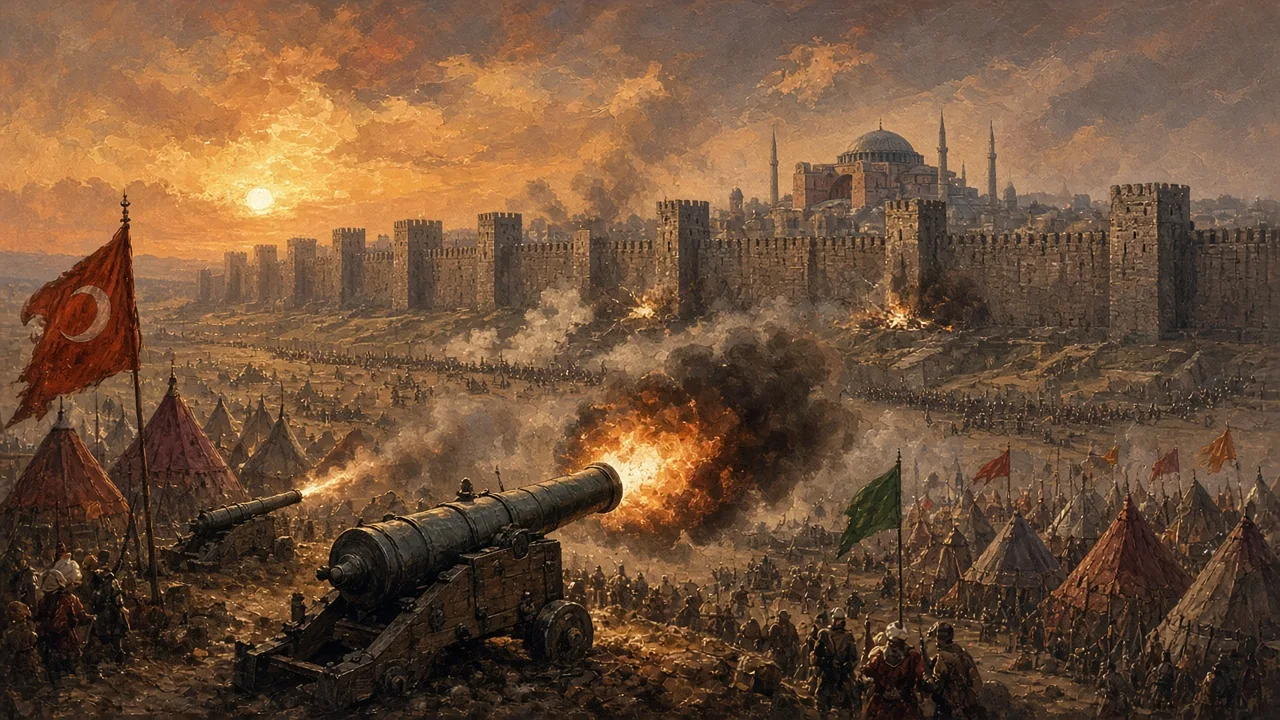
On 29 May 1453, Ottoman troops broke through the walls of Constantinople, the great Christian city on the Bosporus that had been the capital of the Eastern Roman, or Byzantine, Empire for more than a thousand years. The 21-year-old Sultan Mehmed II rode into the city and made it the capital of his rising empire. The event marked the end of the Byzantine Empire, transformed the balance of power between Europe and the Islamic world and, indirectly, helped push European sailors to look for a sea route to India.
The city at the crossroads
Constantinople was dedicated in 330 CE by Emperor Constantine I on the site of the old Greek colony of Byzantium. It sat on a triangle of land between the Sea of Marmara and the Golden Horn, controlling the strait between Europe and Asia and the passage between the Black Sea and the Mediterranean. After the Western Roman Empire collapsed in the 5th century, the eastern half lived on with Constantinople as its capital. At its height, it was one of the largest and richest cities in the world, famed for the great church of Hagia Sophia and its massive land walls.
An empire in decline
By the 15th century, Byzantium was a shadow of its former self. In 1204, the knights of the Fourth Crusade had sacked Constantinople and held it for decades, and the restored empire never fully recovered. Meanwhile, the Ottoman Turks expanded steadily across Anatolia and the Balkans, until the Byzantine state was reduced to little more than the city and a few outposts. Britannica estimates that the city's population had fallen from around 400,000 in the 12th century to perhaps 40,000 to 50,000 by the 1450s.
Mehmed II became sultan for the second time in 1451, determined to take the city his ancestors had failed to capture. In 1452, he built the fortress of Rumeli Hisarı on the European shore of the Bosporus to control shipping. He also hired a Hungarian cannon-founder, usually called Urban or Orban, to cast huge guns capable of battering the ancient walls.
The siege
Emperor Constantine XI appealed to Western Christendom for help, but little arrived. Venice and Genoa sent ships and soldiers, including some 700 Genoese under the experienced commander Giovanni Giustiniani Longo. According to an eyewitness cited by Britannica, the defenders had only around 6,000 to 7,000 trained soldiers, supported by armed civilians. Britannica puts the Ottoman land army at between 60,000 and 80,000 men, though contemporary estimates vary widely and some were far higher.
The Ottoman bombardment began in early April 1453. The defenders repaired breaches by night, and a great chain across the Golden Horn kept the Ottoman fleet out of the harbour. In one of the most famous episodes of the siege, Mehmed had dozens of smaller ships hauled overland on greased wooden tracks from the Bosporus into the Golden Horn, outflanking the chain by 22 April.
29 May 1453
After about 55 days of siege, Mehmed launched a full assault before dawn on 29 May. Two waves were thrown back. Then Giustiniani was badly wounded and carried from the walls, and confusion spread among the defenders. Elite Janissary troops broke through near the Gate of St Romanus. Constantine XI died during the fall of the city, although the exact circumstances are uncertain.
The city was plundered, as was common after a siege at the time. Mehmed then rode to Hagia Sophia, converted it into a mosque and moved his capital from Edirne to Constantinople. He repopulated the city with people of many faiths, and over time it became the heart of a vast, multi-ethnic empire. Today it is Istanbul.
Timeline: key moments
- 330 CE: Constantine I dedicates Constantinople as a new imperial capital.
- 537: The present Hagia Sophia is completed under Justinian.
- 1204: Crusaders sack Constantinople.
- 1261: The Byzantines recover the city.
- 1451: Mehmed II becomes sultan for the second time.
- 1452: The fortress of Rumeli Hisarı is built on the Bosporus.
- April 1453: The Ottoman siege and bombardment begin.
- 29 May 1453: Constantinople falls; Constantine XI dies.
- 1498: Vasco da Gama reaches Calicut by sea.
The India connection
The fall of Constantinople is often linked to Europe's search for a sea route to India. With the Ottomans controlling the eastern Mediterranean and key routes to Asia, spices and other Asian goods reached Europe through Muslim and Venetian middlemen, at high prices. Portugal, already exploring the coast of Africa, pushed on to find a way round. In May 1498, Vasco da Gama reached Calicut (Kozhikode) on the Malabar coast.
Historians caution against making the link too simple. Trade through the Middle East did not stop after 1453, and Portugal's voyages had begun decades earlier. But Ottoman power was clearly one of several factors that made a direct ocean route to India so attractive. The rivalry also reached Indian waters: in the 16th century, Ottoman fleets entered the Indian Ocean to challenge the Portuguese, at times working with Indian rulers such as the Sultan of Gujarat.
Why it matters today
- Technology changes the rules. Gunpowder artillery helped make even the strongest medieval walls vulnerable, a turning point in military history.
- Alliances matter. Divided and suspicious of one another, Christian states sent little help, leaving Constantinople to face the siege almost alone.
- Geography is power. Whoever controls the Bosporus controls the link between the Black Sea and the Mediterranean, a fact still relevant today.
- Disruption drives innovation. Changing trade routes encouraged European voyages that would ultimately reshape India's own history.
- Cities reinvent themselves. Constantinople became Istanbul, a capital of a new empire and still one of the world's great cities.
Frequently asked questions
When did Constantinople fall?
Constantinople fell to the Ottoman army of Sultan Mehmed II on 29 May 1453, after a siege of about 55 days.
Why was the fall of Constantinople important?
It ended the Byzantine Empire, gave the Ottomans a powerful capital, strengthened their hold on trade routes between Europe and Asia and pushed Greek scholars westward, which many historians link to the Italian Renaissance.
Did the fall of Constantinople lead to Europeans reaching India?
It was one factor among several. Ottoman control of eastern trade routes made a sea route to Asia more attractive, and Vasco da Gama reached Calicut in 1498, but Portugal's exploration had started long before 1453.