This is Part 6 of England's Royal Dynasties, our daily series on the kings and queens of England and Britain, from the Anglo-Saxon kingdoms to King Charles III.
In Part 5 we followed the rich, peaceful England of Edgar into the long crisis of Æthelred the Unready, the Danegeld and the Danish conquest of 1013. This part tells what came next. For a quarter of a century England was ruled by Danish kings. The greatest of them, Cnut, came as a ruthless invader, yet he became one of the most successful kings England ever had, and for a time ruled an empire that stretched across the North Sea to Denmark and Norway.
How do we know?
The Anglo-Saxon Chronicle remains our main English source, and for 1016 it gives a detailed, blow-by-blow account of the war. After that its entries become short, and some are misdated. We also have Cnut's law codes, drafted by Archbishop Wulfstan of York, his charters, his coins and two remarkable letters he sent to the English.
A third source is unusual: the Encomium Emmae Reginae ("In Praise of Queen Emma"), written in the early 1040s for Cnut's widow. It is openly flattering propaganda, but it was written by someone who knew the court. Scandinavian sagas, written down two centuries later, add stories about Cnut's life in the north, and twelfth-century English historians add the famous tale of the waves. Those later stories need careful handling.
Sweyn Forkbeard: the king of five weeks
Sweyn Forkbeard was king of Denmark and a veteran raider of England; he had been with the fleet that attacked London in 994. In the summer of 1013 he sailed up the Humber and the Trent to Gainsborough. The Danish-settled north submitted to him at once, followed by Oxford, Winchester and finally London. Æthelred fled to Normandy, and by the end of the year Sweyn was accepted as king.
He did not enjoy it for long. Sweyn died at Gainsborough on 3 February 1014. He was never crowned, which is why lists of English monarchs often leave him out, but he was the first Scandinavian king of all England. His fleet chose his son Cnut, then probably not yet 20, as their king.
The war of 1016
The English invited Æthelred back, and Cnut withdrew to Denmark, pausing to mutilate the English hostages he had been given. In 1015 he returned with a large fleet. The war that followed was fought by Cnut against Æthelred's warlike son Edmund Ironside, with the English ealdorman Eadric Streona switching sides more than once.
After Æthelred died in April 1016, the Londoners chose Edmund as king. He raised the English army five times. At Assandun in Essex, in October, Eadric's men fled at the start of the battle and "all the nobility of the English nation was there undone". The two kings met at Alney, an island in the River Severn near Deerhurst, and split the kingdom: Edmund took Wessex, Cnut took Mercia and the north. Weeks later, on 30 November 1016, Edmund died, and Cnut became king of all England.
Cnut the Great (r. 1016–1035)
A brutal beginning
Cnut started as a conqueror. In 1017 he divided England into four great earldoms, keeping Wessex for himself, and executed or exiled English leaders he did not trust, including the turncoat Eadric. In 1018 he raised a tribute of 72,000 pounds from the whole country, plus 10,500 pounds from London, and used it to pay off most of his fleet, keeping 40 ships.
To put that figure in perspective, a report published by Historic England notes that seventy years later, Domesday Book shows the total annual value of land in England was only a little more than £70,000.
Marrying the past
In 1017 Cnut married Emma of Normandy, Æthelred's widow. It was a clever move. It tied him to the old royal court, and it removed Emma's Norman relatives as possible supporters of her sons by Æthelred, Edward and Alfred, who stayed in exile in Normandy. Cnut already had a partner, Ælfgifu of Northampton, by whom he had two sons. The church did not recognise that union, but Cnut did not abandon her; she later ruled Norway on his behalf for a time.
An English king
In 1018, says the Chronicle, the Danes and English agreed at Oxford to live "under Edgar's law". Cnut kept the English system of shires, courts and coinage. His laws, written by Wulfstan, the same archbishop who had written Æthelred's laws and denounced the Danish invasions as God's punishment, read like those of any Christian English king. They even order the celebration of English saints such as Edward the Martyr and Dunstan.
He also rewarded the church. In 1020 he built a stone church at Assandun for the souls of those killed in the battle, and in 1023 he allowed the body of Archbishop Ælfheah, killed by Viking raiders in 1012, to be moved with honour from London to Canterbury. A drawing made at Winchester around 1031 shows Cnut and Emma placing a jewelled cross on the altar of the New Minster, while angels crown the king.
New men rose with him. The most important was Godwin, an Englishman of modest background who became Earl of Wessex and married into Cnut's family. Godwin and his sons will dominate the next two parts of this series.
The North Sea Empire
Cnut inherited Denmark after the death of his brother Harald, around 1018–19. He fought a hard war against Norway and Sweden, including a battle at the Holy River (around 1025–26) that the Chronicle admits the Swedes won. In 1028 he sailed to Norway with 50 ships and drove out King Olaf. Scotland's king, Malcolm II, also submitted to him, together with two other northern kings, one of them Macbeth, though, as the Chronicle notes, only for a little while.
In 1027 Cnut travelled to Rome for the coronation of the Holy Roman Emperor Conrad II. In a letter home he called himself king "of all England and Denmark and the Norwegians and of some of the Swedes", and boasted that he had won lower tolls for English pilgrims and merchants on the road to Rome. For a few years he was one of the most powerful rulers in Europe, and historians call his lands the North Sea Empire.
It did not last. Norway rebelled and broke away in the mid-1030s. When Cnut died at Shaftesbury on 12 November 1035, the empire fell apart within a few years.
After Cnut: Harold Harefoot and Harthacnut
Cnut wanted his son by Emma, Harthacnut, to succeed him, but Harthacnut was stuck in Denmark defending it. A council at Oxford chose Ælfgifu's son Harold Harefoot as regent, and he soon became full king (1035–1040). In 1036 Emma's son Alfred came over from Normandy and was captured, blinded and died; Earl Godwin was blamed for handing him over.
Harold died in 1040. Harthacnut arrived with 60 ships, had his half-brother's body dug up and thrown into a ditch, and taxed the English so heavily that two of his collectors were killed at Worcester. He invited his half-brother Edward, son of Æthelred and Emma, to join him in England. On 8 June 1042 Harthacnut collapsed "as he stood drinking" at Lambeth and died without speaking again. The House of Wessex was back, in the person of Edward, the subject of Part 7.
Legend vs evidence
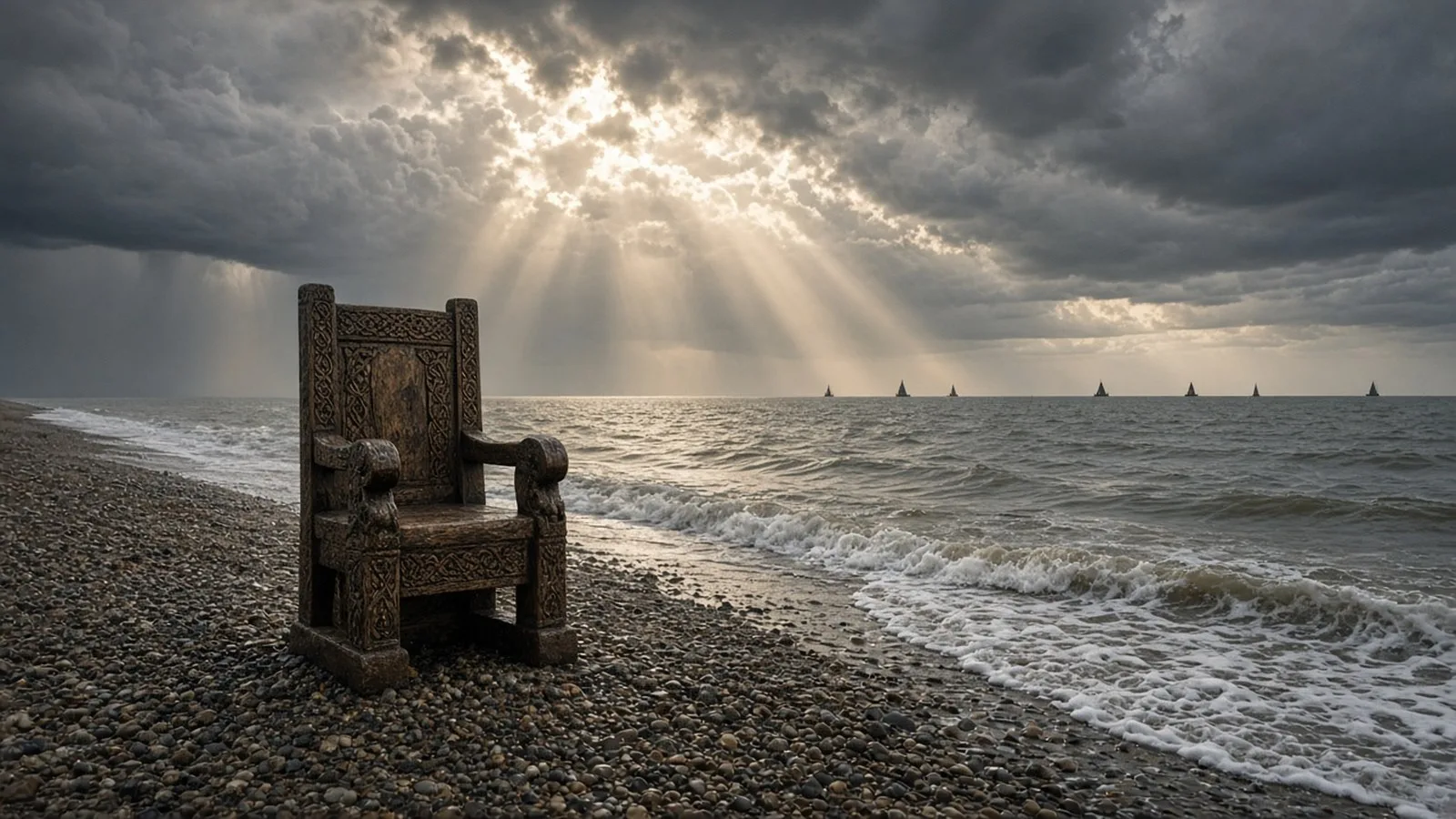
Cnut and the waves. The story that Cnut tried to order back the tide first appears in Henry of Huntingdon's History of the English, written more than a century after Cnut's death. In Henry's version Cnut is not foolish at all: he has his chair set at the shore to show his courtiers that "the power of kings is empty and worthless" beside God's. There is no earlier evidence that it happened. The story is best read as a sign of Cnut's reputation for piety, which is well documented, and not as a real event. Modern politicians who are mocked as "King Canute" are, ironically, misusing the legend.
Viking or Christian king? Cnut was almost certainly a Christian before he came to England. English sermons of the time called the invaders heathens sent to punish English sins; Cnut seems to have worked hard to show the opposite.
Where is Cnut now? He was buried in the Old Minster at Winchester. When the Old Minster was demolished after the Norman cathedral was built, the royal bones were moved, and as early as 1158 a chronicler complained that "kings were mixed with bishops, and bishops with kings". They ended up in painted wooden mortuary chests, which were ransacked again by Parliamentarian soldiers in 1642. A University of Bristol team reported in 2019 that the 1,300-plus bones belonged to at least 23 people of the late Anglo-Saxon and early Norman period, and that a mature woman among them could be Queen Emma. It is not yet certain. Whether Cnut himself is among them has not been confirmed.
Where to see it today
- Winchester Cathedral, Hampshire: the mortuary chests said to hold the bones of Cnut, Emma and other early kings and bishops.
- The British Library, London: the New Minster Liber Vitae with its drawing of Cnut and Emma.
- Gainsborough, Lincolnshire: Sweyn Forkbeard's base in 1013 and the place where he died.
- Roskilde and Jelling, Denmark: the royal centres of Cnut's Danish family.
At a glance
| Rulers | Sweyn Forkbeard 1013–1014; Cnut 1016–1035; Harold Harefoot 1035–1040; Harthacnut 1040–1042 |
| House | House of Denmark (the Knýtlinga dynasty) |
| Predecessor | Æthelred II and Edmund Ironside |
| Successor | Edward the Confessor |
| Key dates | 1013 Sweyn conquers England; 1014 Sweyn dies; 1016 Assandun, Cnut king of all England; 1017 marries Emma; 1018 tribute of £72,000 and Oxford agreement; 1027 Rome; 1028 Norway; 1035 Cnut dies; 1042 Harthacnut dies |
| Legacy | A stable, English-style government under a foreign king; the rise of Earl Godwin; Emma's sons as the next claimants |
| Next | Edward the Confessor and Westminster Abbey |
Next in the series
In Part 7 the House of Wessex returns with Edward the Confessor, Æthelred and Emma's son, raised in Normandy. We follow his struggle with the mighty Godwin family, the building of Westminster Abbey and the question that his childlessness left hanging: who would be king after him? Until then, read more about the Vikings and Denmark, or revisit Alfred's fight against the first Danish conquerors in Part 3.
Sources
- The Royal Family, Canute 'The Great' (r. 1016–1035)
- The Anglo-Saxon Chronicle, eleventh-century entries, Avalon Project, Yale Law School
- Alison Hudson, British Library (2016), Turning the tide
- BBC News (2011), Is King Canute misunderstood?
- English Heritage (1995), Battlefield Report: Maldon 991, published by Historic England
- University of Bristol (2019), Winchester Cathedral mortuary chests research
- Winchester Cathedral, Mortuary Chests Project: FAQs