As of about 8:30 AM IST, Friday 20 November 2026. Based on Volkswagen's announcement, IG Metall's response, and reporting by Reuters, ZDF and tagesschau.
Volkswagen has asked its German workers to accept two years without a pay rise, give up two collectively agreed payments and work longer hours without extra pay when factories are busy. The carmaker set out the demands on Thursday, 19 November, ahead of wage talks for its in-house collective agreement that begin on 24 November in Emden.
The IG Metall union reacted furiously. "The VW Executive Board is stabbing its employees in the back," its chief negotiator, Thorsten Gröger, said, according to Reuters. With a legal no-strike period ending on 31 December, the stage is set for possible strikes at Europe's largest carmaker from January.
What Volkswagen is asking for
Volkswagen AG described its demands as an overall package aimed at "significant labor cost relief." According to the company's statement, the main points are:
- A pay freeze for 2027 and 2028.
- Scrapping the collectively agreed additional payment, worth 27.5% of average monthly earnings, which workers can also take as six extra days off.
- Scrapping a collectively agreed allowance of €167 a month.
- Much more flexible working hours. The standard week is 35 hours. VW wants to adjust it to factory utilisation, with no extra pay for longer hours and proportionally lower pay for shorter ones.
IG Metall says the full list goes further, including cuts to profit-sharing, long-service bonuses and a paid 20-minute break in three-shift operations, as well as questioning days off on Christmas Eve and New Year's Eve. The union calls it a "catalogue of horrors."
Why VW says it needs the cuts
Volkswagen blames tariff barriers, a shrinking Chinese market and tougher competition in Europe. "In light of our economic development, the cost measures agreed in 2024 are no longer sufficient on their own," the company said. Co-negotiator Kerstin Scholz said VW does not question its agreements "lightly," but conditions have "significantly worsened," ZDF reported. "Only a successful company can offer future-proof jobs in the long term," she said.
The wage demands are one part of chief executive Oliver Blume's wider "Future Plan 2030," which aims to cut costs across development, purchasing, production, quality and sales. Reuters described Blume's expanded restructuring drive as including plans to cut 100,000 jobs. German broadcasters ZDF and tagesschau reported that VW plans to cut about 12,000 more jobs in addition to the 35,000 already agreed by the end of the decade.
Chinese competition is a major factor. Reuters noted that low-cost rivals such as BYD have built a European market share of more than 10%, while steep tariffs are hurting the export model that German carmakers relied on for decades.
The union's response
IG Metall is demanding a 5% pay rise over 12 months, citing the higher cost of living. It says VW staff last received a raise in May 2024. "This will not be a storm in a teacup that settles by the end of the year," Gröger said in the union's statement. "It will be a tough, bitter and exhausting conflict that will leave deep marks on the company."
The union argues that pay is not VW's real problem. It says personnel costs have fallen from 17.5% of revenue in 2021 to 15.2% in 2025, according to VW's annual reports, and that even halving wages under the in-house agreement would make cars only about 5% cheaper. It points instead to products, technology and speed, and to one-off charges, including about €6 billion in non-cash write-downs linked to Porsche.
Daniela Cavallo, head of VW's general works council, said the workforce "feels betrayed" and that decades of "cooperative conflict resolution" would give way to a more confrontational approach. The union also notes that VW paid about €2.6 billion in dividends to shareholders in June.
How we got here
The last major showdown ended in December 2024 with a deal that avoided plant closures and forced layoffs. Under that agreement, IG Metall says workers give up about €1.5 billion a year in pay and benefits, and job security rules out compulsory redundancies until the end of 2030.
At the end of September this year, Volkswagen terminated ten collective agreements in full or in part, almost the whole in-house contract, with effect from the end of the year. It was required to present its demands by 19 November. Reuters said that Emden, where talks open, is one of four plants the company could close from the early 2030s under its restructuring.
Who is affected
The in-house agreement covers about 120,000 to 130,000 employees, depending on the count, at sites including Wolfsburg, Hanover, Emden, Kassel, Salzgitter, Braunschweig and, since 2026, Chemnitz, Dresden and Zwickau. It also covers subsidiaries such as Volkswagen Financial Services. IG Metall says it is one of Germany's largest company-level wage agreements, alongside those at Deutsche Bahn and Deutsche Post.
VW is not alone. Reuters reported that IG Metall is planning 24-hour walkouts at Mercedes-Benz, at VW's Audi unit and at other companies in parallel talks in the car and steel industries. Mercedes has also asked German workers to accept longer hours on the same pay and is considering factory closures, according to Reuters.
Why it matters beyond Germany
Germany's carmakers are under pressure from every side: Chinese competition, US tariffs and an expensive shift to electric cars. Rivals are making different bets. Tesla plans to spend €3 billion on its German factory to build robotaxis, while in the US, Ford has begun making cheaper LFP battery cells with Chinese technology to cut EV costs. How VW settles with its workers will shape whether it can make cars at competitive prices in its home market.
What to watch
Talks begin in Emden on 24 November, and a second round is planned for 15 December in Zwickau, tagesschau reported. Most observers expect no deal before the new year. From 1 January, IG Metall can call warning strikes. The key signals will be whether VW softens its demand for flexible hours, whether the union moves from 5%, and whether walkouts at Mercedes and Audi spread across the industry.
Sources
- Volkswagen Group: 2026 collective bargaining negotiations: Volkswagen AG calls for significant relief in labor costs
- Reuters (via Investing.com): Volkswagen seeks pay freeze, flexible hours in showdown with union
- IG Metall: Tarifrunde Volkswagen 2026/2027 (German)
- ZDFheute: VW verlangt Nullrunden und Einschnitte bei 35-Stunden-Woche (German)
- tagesschau: Volkswagen will Nullrunden für zwei Jahre (German)
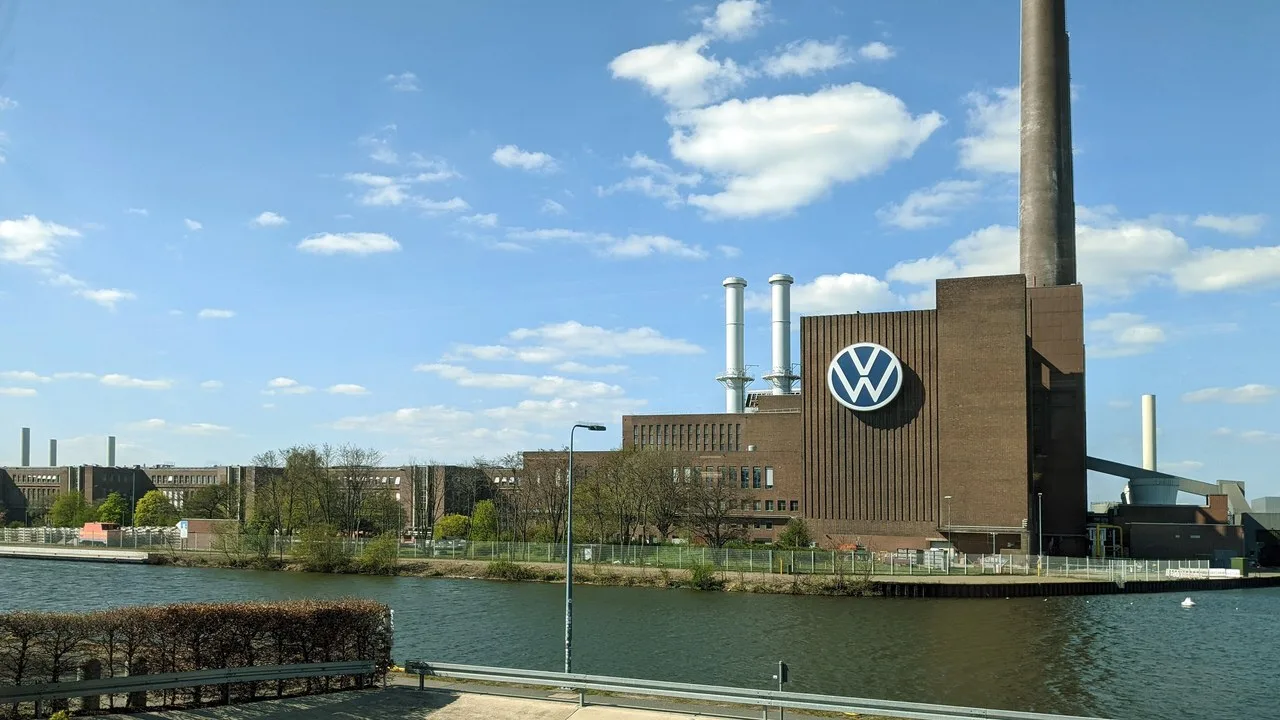
Featured image: The Volkswagen plant's power station on the Mittelland Canal in Wolfsburg, Germany, 23 April 2022 (file photo), Gerd Eichmann, CC BY 4.0, via Wikimedia Commons (cropped).