As of about 9:00 AM IST, Sunday 29 November 2026. Based on BMW's launch announcement as carried by Xinhua, BMW's third-quarter statement and reporting by CarNewsChina, BMWBlog and AutoNext. The car was launched at the Guangzhou Auto Show on Friday 27 November.
BMW has put the electric 3 Series it designed for China on sale, and the price says a lot about the market it is fighting in. The long-wheelbase i3, the first saloon from BMW's Neue Klasse electric platform to be built in China, starts at 249,900 yuan (about $37,300), with one fixed price nationwide and claimed range of up to 1,028 km on China's test cycle.
The car arrives two days after its SUV sibling, the long-wheelbase iX3, and at a difficult moment for BMW in China, where its sales have fallen by roughly a fifth this year. Here is what BMW is offering, how it differs from the European car and why the launch matters for the German carmaker.
The price and the line-up
The new i3 went on sale at the Guangzhou Auto Show on Friday, with orders open now and deliveries due to start in January 2027. There are three versions: the i3 30L at 249,900 yuan, the 40L at 279,900 yuan (about $41,800) and the 50L at 319,900 yuan (about $47,700), CarNewsChina reported. BMW said the car comes with nearly 40 high-value features as standard, according to Xinhua.
BMW is using a nationwide fixed price rather than letting dealers negotiate, BMWBlog reported, the same approach it took with the iX3. That sets a firm sticker price in a market known for heavy discounting. The entry i3 30L is 20,000 yuan cheaper than the equivalent long-wheelbase iX3, which BMW launched on 25 November at 269,900 yuan, AutoNext noted, making the saloon the cheapest Neue Klasse car on sale anywhere.

Range, batteries and charging
The three versions are rated at 708 km, 802 km and 1,028 km on China's CLTC test cycle. According to CarNewsChina, the 30L uses a 77 kWh lithium iron phosphate battery from CATL, the 40L an 86.9 kWh nickel-based battery from CATL, and the 50L a 113.4 kWh nickel-based battery from Eve Energy. AutoNext reported that an i3 50L covered 1,213 km on a single charge on a mixed route in China in October, though BMW has not said under what conditions.
The CLTC cycle is far more generous than Europe's WLTP or the US EPA test, so these figures should not be compared directly with ratings elsewhere. The car uses an 800-volt electrical system and BMW's sixth-generation eDrive technology, and BMWBlog said DC fast charging from 10% to 80% takes about 21 minutes, one minute longer on the entry model. CarNewsChina listed a single 235 kW motor, 0-100 km/h in 4.7 seconds and a top speed of 200 km/h.
Built in China, for China
The car, coded NA8, is built in Shenyang by BMW Brilliance Automotive, BMW's joint venture with Brilliance. AutoNext said BMW has produced its new Gen6 batteries in Shenyang since 15 October for both the i3 and the iX3.
It is noticeably larger than the European i3. It measures 4,864 mm long, 1,865 mm wide and 1,490 mm tall, with a 3,005 mm wheelbase, and the extra length goes to rear legroom, which BMWBlog noted is particularly important to buyers in China. ElectricFleet put the wheelbase at 108 mm longer than the European car's.
There are other local changes. The Chinese car has more conventional door handles instead of the flush ones BMW uses elsewhere, to comply with a new Chinese safety rule that effectively bans flush handles, BMWBlog and AutoNext reported. Its driver assistance comes from Chinese specialist Momenta and, unlike the European version, can also handle city streets, according to AutoNext and ElectricFleet. Both versions remain driver-assistance systems, so the driver stays responsible at all times.

Why China matters so much to BMW
China is one of BMW's most important markets, and it has been shrinking. BMW Group retail sales in China fell 24.8% in the third quarter, in line with a market that was down 24.6%, finance chief Walter Mertl said on 4 November. He said weak consumer demand was hitting the non-electrified part of the market especially hard. The combined effect of volume, model mix and pricing cut automotive earnings by around 600 million euros from a year earlier, mainly because of lower volumes in China and pricing pressure in several markets.
Across the first nine months, BMW and MINI delivered about 376,000 cars in China, 21.8% fewer than a year earlier, AutoNext reported. The shift towards electric and plug-in cars has been rapid: new energy vehicles are expected to take more than 70% of China's retail car sales in November, as we noted in our report on MG ending petrol-only production for China. That is a market in which foreign brands best known for petrol cars have lost ground to local makers.
The competition it faces
The i3 enters one of the most crowded parts of China's car market. Electric saloons in this price range are judged on range, rear space, screens and driver assistance as much as on brand, and buyers compare the BMW with local rivals such as Xiaomi's SU7, ElectricFleet noted. Chinese brands have used fast product cycles and aggressive pricing to win buyers who once defaulted to German premium cars.
BMW's answer is to combine its badge and driving reputation with local suppliers and software. Using CATL and Eve Energy batteries and a Momenta-based assistance system brings the car closer to what Chinese rivals offer, while the fixed price is likely aimed at protecting the brand from discount wars. Whether that is enough to win back buyers is the key question for 2027.
A wider product offensive
The i3 is the start of a larger push. BMW said nearly 20 new and updated models built on Neue Klasse technology will arrive in China by 2027, covering almost every core segment with both electric and combustion-engine versions, according to Xinhua. A new X5 will have its world premiere in 2027, and a new 3 Series will be shown in the first half of next year.
BMW's Greater China chief said the start of iX3 deliveries and the i3 launch meant the Neue Klasse had moved "from vision to reality" and that a new BMW product offensive had begun, according to Xinhua. BMW has also had other problems to manage this year, including a large US recall that we covered in our report on the 720,796-car water pump fire risk recall.
What it means outside China
The long-wheelbase i3 is not coming to Europe or North America. European buyers get the shorter i3, which BMW has built in Munich since August 2026, and BMW has said it may export more long-wheelbase China models but has ruled out those two regions, BMWBlog reported.
The price gap is striking. AutoNext pointed out that the cheapest iX3 in Germany costs 63,400 euros, while ElectricFleet said the i3 50 xDrive opened at 65,900 euros in Germany. Part of the difference reflects specification and taxes, but it also shows how much harder price competition is in China than in Europe.
What to watch next: early order numbers, the first deliveries in January, insurance registration data in the first quarter of 2027 and BMW's China sales for that quarter, which will show whether the new i3 and iX3 can slow the decline.
Sources
- Xinhua (Chinese): New BMW i3 officially launched, nearly 20 new models to follow
- CarNewsChina: BMW launches all-new i3 in China: up to 1,028 km CLTC range, priced from 37,300 USD
- BMWBlog: China's new long-wheelbase BMW i3 starts at just $37,500
- AutoNext: BMW's long-wheelbase i3 is the cheapest Neue Klasse car so far
- ElectricFleet: How the Chinese BMW i3 differs from the one built in Munich
- BMW Group: Statement by Walter Mertl on the quarterly statement to 30 September 2026
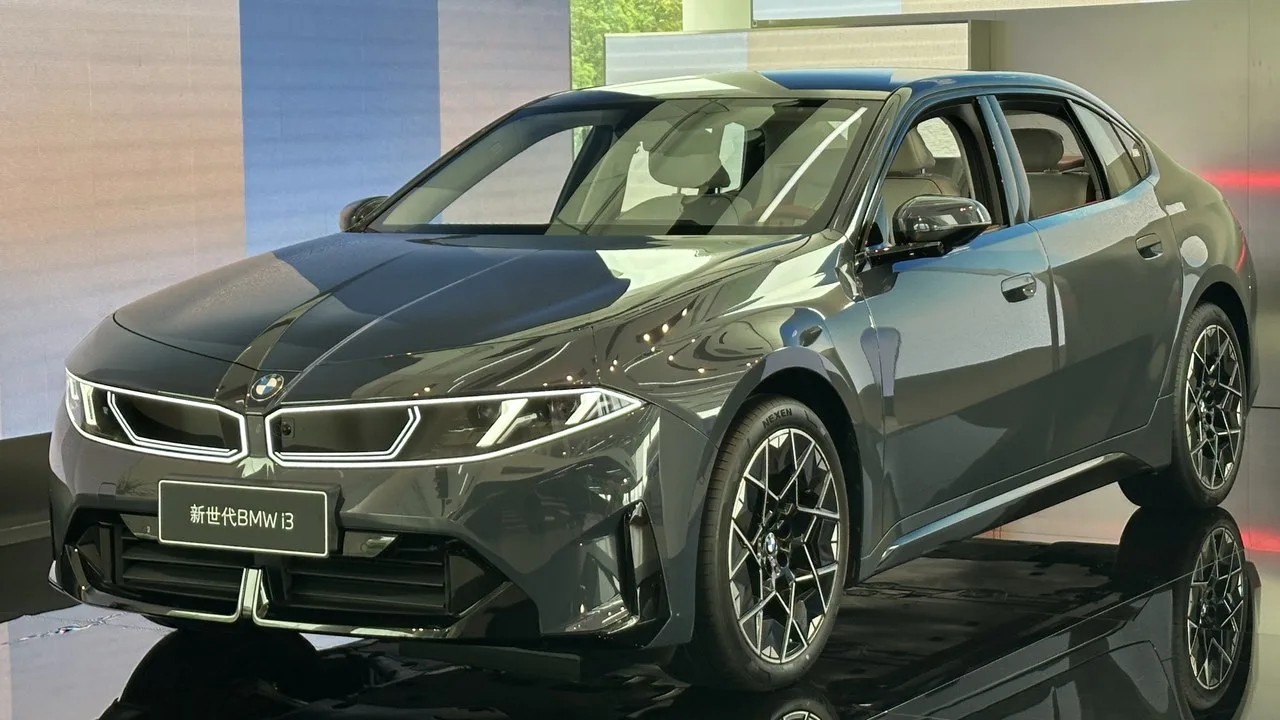
Featured image: A BMW i3 40L long-wheelbase electric saloon on display in China (September 2026, file photo), JustAnotherCarDesigner, CC0, via Wikimedia Commons (cropped).