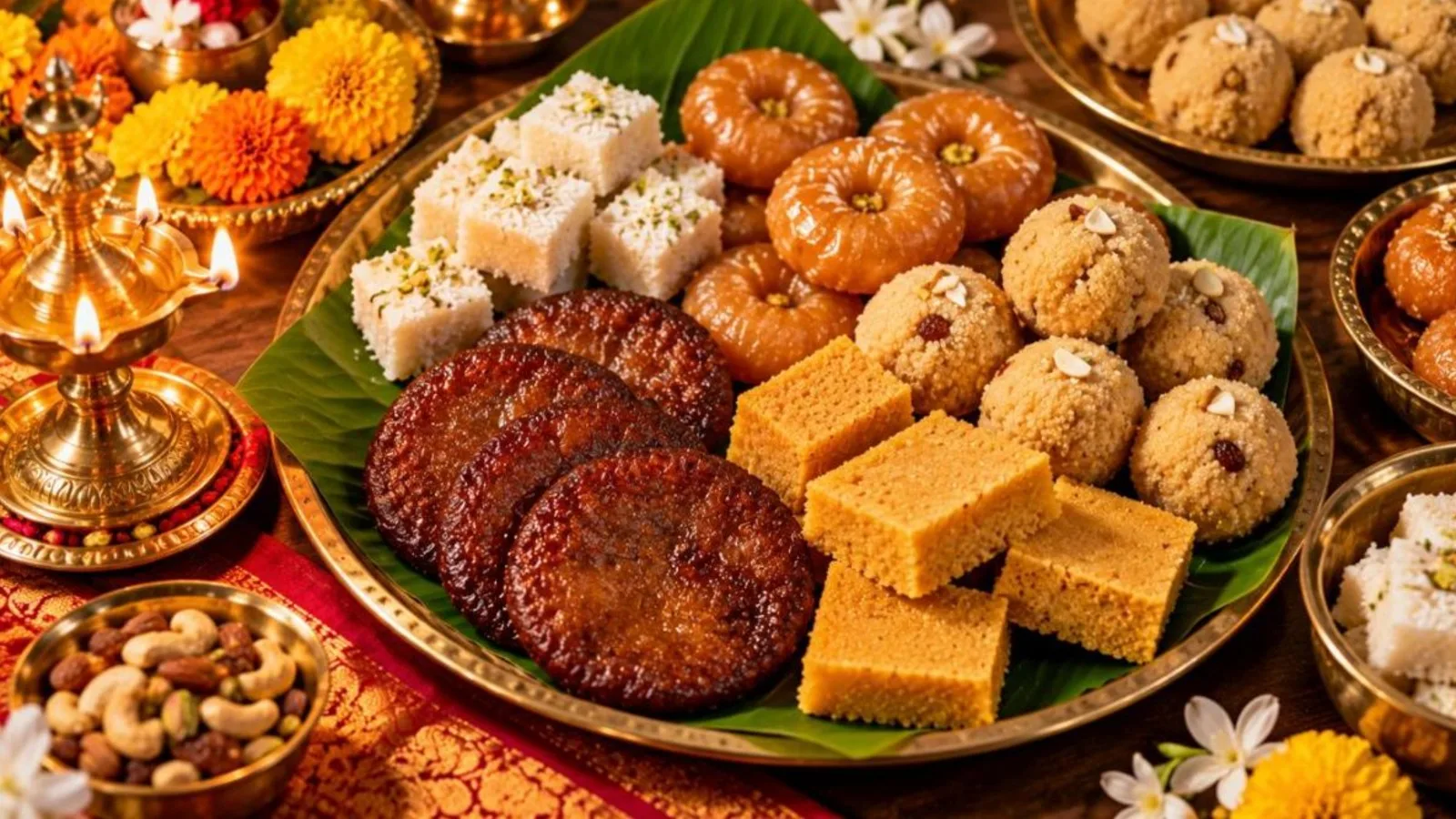
In South Indian homes, Deepavali morning begins with an oil bath, new clothes and a plate of homemade sweets and savouries. With Deepavali falling on Sunday, November 8, 2026, now is the time to plan your palagaram. Here are five classic sweets you can make at home, from the easiest to the most traditional.
Looking for North Indian favourites too? Try our kaju katli and besan ladoo recipes. And since sugar prices have risen this season, see what it means for your mithai.
1. Coconut burfi (easiest)
Time: 30 minutes · Makes: about 16 pieces · Keeps: 4-5 days in the fridge
Ingredients
- 2 cups freshly grated coconut (white part only)
- 1 cup sugar
- 1/4 cup milk
- 1 tbsp ghee, plus extra for greasing
- 1/2 tsp cardamom powder
Method
- Grease a plate or tray with ghee.
- In a heavy pan, combine coconut, sugar and milk. Cook on medium-low heat, stirring constantly.
- The sugar will melt and the mixture will turn wet, then slowly thicken. After 15-20 minutes it will start leaving the sides of the pan and come together.
- Add ghee and cardamom, mix well, and immediately spread onto the greased plate. Level with a spatula.
- Cut into squares while warm and separate once cool.
Tip: Don't overcook, or the burfi turns hard and crumbly.
2. Rava laddoo
Time: 25 minutes · Makes: about 12 laddoos · Keeps: 4-5 days (with milk)
Ingredients
- 1 cup fine rava (sooji)
- 3/4 cup sugar, powdered
- 1/4 cup desiccated or fresh grated coconut
- 1/4 cup ghee
- 10-12 cashews and a few raisins
- 1/2 tsp cardamom powder
- 2-3 tbsp warm milk
Method
- Heat 1 tbsp ghee and fry the cashews and raisins until golden. Set aside.
- In the same pan, add the remaining ghee and roast the rava on low heat for 5-6 minutes until aromatic, without letting it brown.
- Add the coconut and roast for another minute. Turn off the heat and let it cool slightly.
- Mix in powdered sugar, cardamom, cashews and raisins.
- Sprinkle warm milk a little at a time and shape into firm laddoos while the mixture is warm.
Tip: For a longer shelf life (about a week), use warm ghee instead of milk to bind.
3. Mysore pak
Time: 30 minutes · Makes: about 16 pieces · Keeps: 1-2 weeks
Ingredients
- 1 cup besan (gram flour), sifted
- 1 1/2 cups sugar
- 1/2 cup water
- 1 1/2 cups ghee, kept hot (or 1 cup ghee + 1/2 cup neutral oil)
Method
- Grease a tray. Keep the ghee hot in a separate pan on low heat.
- Dry-roast the besan on low heat for 2-3 minutes until it smells nutty. Set aside.
- In a heavy pan, boil sugar and water to a one-string consistency.
- Lower the heat and add the besan a spoon at a time, whisking constantly so no lumps form.
- Add the hot ghee one ladle at a time, stirring well after each addition. The mixture will sizzle and bubble.
- Keep cooking until it turns frothy and porous, smells roasted and starts leaving the sides of the pan, about 8-10 minutes.
- Pour into the tray immediately. Cut into pieces after 5 minutes, while still warm.
Tip: Hot ghee is the secret to the classic porous, melt-in-the-mouth texture.
4. Badusha
Time: 1 hour (including resting) · Makes: about 12 · Keeps: 1 week
Ingredients
- 1 cup maida (all-purpose flour)
- 1/4 cup soft ghee or butter
- 2 tbsp thick curd
- 1/4 tsp baking soda and a pinch of salt
- 2-3 tbsp cold water
- Oil or ghee for deep frying
- For the syrup: 1 cup sugar, 1/2 cup water, a pinch of cardamom
Method
- Rub the ghee into the flour, soda and salt until it looks like breadcrumbs.
- Add curd and just enough cold water to bring it together into a soft dough. Do not knead. Rest it covered for 20-30 minutes.
- Meanwhile, make a one-string sugar syrup with cardamom and keep it warm.
- Divide the dough into balls, flatten slightly and make a dent in the centre with your thumb.
- Fry on low heat for 10-12 minutes, turning, until golden and crisp. High heat leaves the inside raw.
- Drop the hot badusha into the warm syrup for 2-3 minutes, then lift out and let them set.
5. Athirasam (most traditional)
Time: 1 hour active, plus resting · Makes: about 12-15 · Keeps: 1-2 weeks
Athirasam is one of the oldest sweets of Tamil Nadu and is made with fresh rice flour and jaggery. Start two days ahead if you can.
Ingredients
- 1 cup raw rice
- 3/4 cup grated jaggery
- 1/4 cup water
- 1/2 tsp cardamom powder and a pinch of dry ginger powder
- 1 tsp ghee
- Oil for deep frying
Method
- Wash and soak the rice for 2-3 hours. Drain and spread on a cloth for 20-30 minutes until it is just slightly moist.
- Grind into a fine flour and sieve it. The flour should hold its shape when pressed.
- Heat jaggery and water, strain out impurities, and boil until it reaches soft-ball stage (a drop in water forms a soft ball).
- Turn off the heat, add cardamom, dry ginger and ghee, then add the rice flour gradually, mixing into a soft, thick dough.
- Cover and rest for at least 12 hours; traditionally it is rested for 1-2 days, which improves the texture.
- Pat small portions into flat discs on a greased sheet or banana leaf and fry in medium-hot oil until deep brown on both sides.
- Press each one between two ladles to squeeze out excess oil.
Tip: If the dough is too soft, the athirasam will spread in oil; add a spoon of rice flour. If it cracks, the syrup was cooked too long.
Make-ahead plan for Deepavali week
- Thursday, November 5: make the athirasam dough and mysore pak.
- Friday, November 6 (Dhanteras): fry the athirasam and make badusha.
- Saturday, November 7: make rava laddoo and coconut burfi so they are fresh for Deepavali morning.
Store each sweet in a separate airtight container, and keep milk- or coconut-based sweets in the fridge.