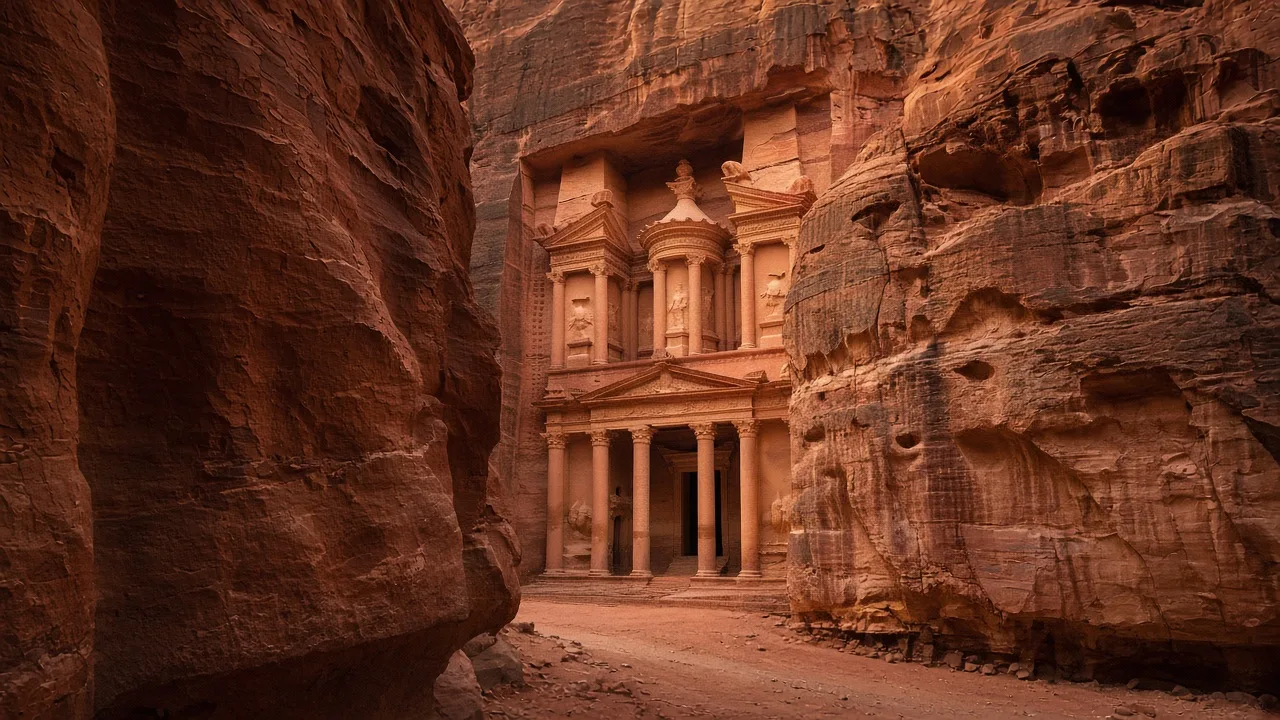
The rose-red city in the desert
Few arrivals in travel match the moment at Petra when the narrow walls of the Siq part and the carved facade of the Treasury glows ahead of you. Set among the sandstone mountains of southern Jordan, Petra was inscribed as a UNESCO World Heritage Site in 1985 and is one of the most memorable historical places an Indian traveller can reach within a short flight connection via the Gulf.
A brief history of Petra
Petra was the capital of the Nabataeans, an Arab people who grew rich controlling the caravan routes that carried incense, spices and textiles between Arabia, Egypt and the Mediterranean. Settled from at least the 4th century BCE, the city flourished from roughly the 1st century BCE, when the Nabataeans carved monumental tombs and temples directly into the rock and built a clever system of dams, channels and cisterns to capture scarce rainwater.
In 106 CE the kingdom was absorbed into the Roman Empire, and Petra remained important for some centuries, later gaining churches in the Byzantine era. Shifting trade routes and a damaging earthquake in 363 CE contributed to its decline. It was largely forgotten by the outside world until 1812, when the Swiss explorer Johann Ludwig Burckhardt reached it in disguise. Today it is protected and managed by the Petra Development and Tourism Region Authority (PDTRA).
What to see
- The Siq: A winding gorge of a little over a kilometre, with traces of water channels and carved niches along the walls.
- Al-Khazneh (the Treasury): Petra's most famous facade, almost 40 metres high, most likely a royal tomb rather than a treasury. Morning light is best.
- Street of Facades and the Theatre: Rows of Nabataean tombs and a theatre carved into the hillside.
- The Royal Tombs: Including the Urn Tomb, the Silk Tomb with its striped rock, and the Palace Tomb.
- Colonnaded Street and Great Temple: The Roman-era heart of the city, with the remains of a large temple complex and the Byzantine church nearby.
- Ad-Deir (the Monastery): A climb of around 800 rock-cut steps leads to this enormous facade, often quieter than the Treasury.
- High Place of Sacrifice: A steep trail to a hilltop ritual site with sweeping views.
- Petra by Night: On selected evenings, the Siq and Treasury are lit by candles. It needs a separate ticket.
Little Petra (Siq al-Barid), a short drive north, is a free and quieter taste of Nabataean architecture, and Wadi Rum's desert landscapes are about two hours away.
Best time to visit
Spring (March to May) and autumn (September to November) are ideal, with warm days and cooler mornings. Summer can be very hot on exposed trails, while winter (December to February) brings chilly days, occasional rain and even rare flash flood warnings, which can close the Siq. Start early whatever the season.
How to get there from India
- Flights: Most Indian travellers reach Amman's Queen Alia International Airport with one stop via Gulf hubs such as Dubai, Abu Dhabi, Doha or Muscat, from Delhi, Mumbai, Bengaluru, Hyderabad, Chennai, Kochi and other cities. Direct options are limited and change, so check current schedules.
- Amman to Petra: Petra is about 230 km south of Amman, roughly three to three and a half hours by road via the Desert Highway. JETT buses, private drivers and organised tours all run the route.
- Via Aqaba: Aqaba's airport is about two hours from Petra by road, useful if you are combining a Red Sea stay.
- Base: The town of Wadi Musa sits next to the site entrance and has accommodation in all budgets.
Tickets for Indian travellers
According to the PDTRA ticketing site, Petra entry for visitors who stay at least one night in Jordan is about 50 Jordanian dinars (JOD) for one day, 55 JOD for two days and 60 JOD for three days. Day-trippers who do not stay overnight in Jordan, such as cruise or Israel day-tour visitors, pay a higher rate of around 90 JOD. Children under 12 have been free. Petra by Night is not included in these tickets.
The Jordan Pass is worth considering: recently listed at about 70, 75 or 80 JOD for one, two or three Petra days, it bundles entry to over 40 sites. Hours vary with the season, roughly from early morning to late afternoon or early evening. All fees here are approximate; check before travel.
Visa notes for Indian passport holders
The Embassy of India in Amman lists three routes for Indian nationals: an e-visa through Jordan's Ministry of Interior portal, a tourist visa on arrival, or a visa from a Jordanian mission. For visa on arrival, the embassy notes that tourists have been asked for a confirmed return ticket, a hotel booking and sufficient funds, cited as about US$1,000 in cash (or more without a hotel booking), and that processing can take two to three hours. Jordan's tourism ministry lists a single-entry visa on arrival at about 40 JOD.
The Jordan Pass can waive this visa fee if bought before arrival and you stay at least two nights (three days), but eligibility rules vary by nationality and have changed in the past. Visa rules are approximate and can change at short notice; check the Indian Embassy, the Jordanian embassy in New Delhi and the official e-visa portal before you book.
Practical tips
- Allow at least two days. One day covers the Siq, Treasury and Royal Tombs; the Monastery and High Place need fresh legs.
- Enter at opening time to see the Treasury before the crowds.
- Wear sturdy shoes, a hat and sunscreen, and carry plenty of water.
- Consider avoiding donkey and camel rides, especially on the Monastery steps, due to animal welfare concerns.
- Carry some cash in JOD; card acceptance inside the site is patchy.
- Dress modestly; Jordan is welcoming but conservative.
- Vegetarian travellers will find plenty of hummus, falafel, mutabbal and salads.