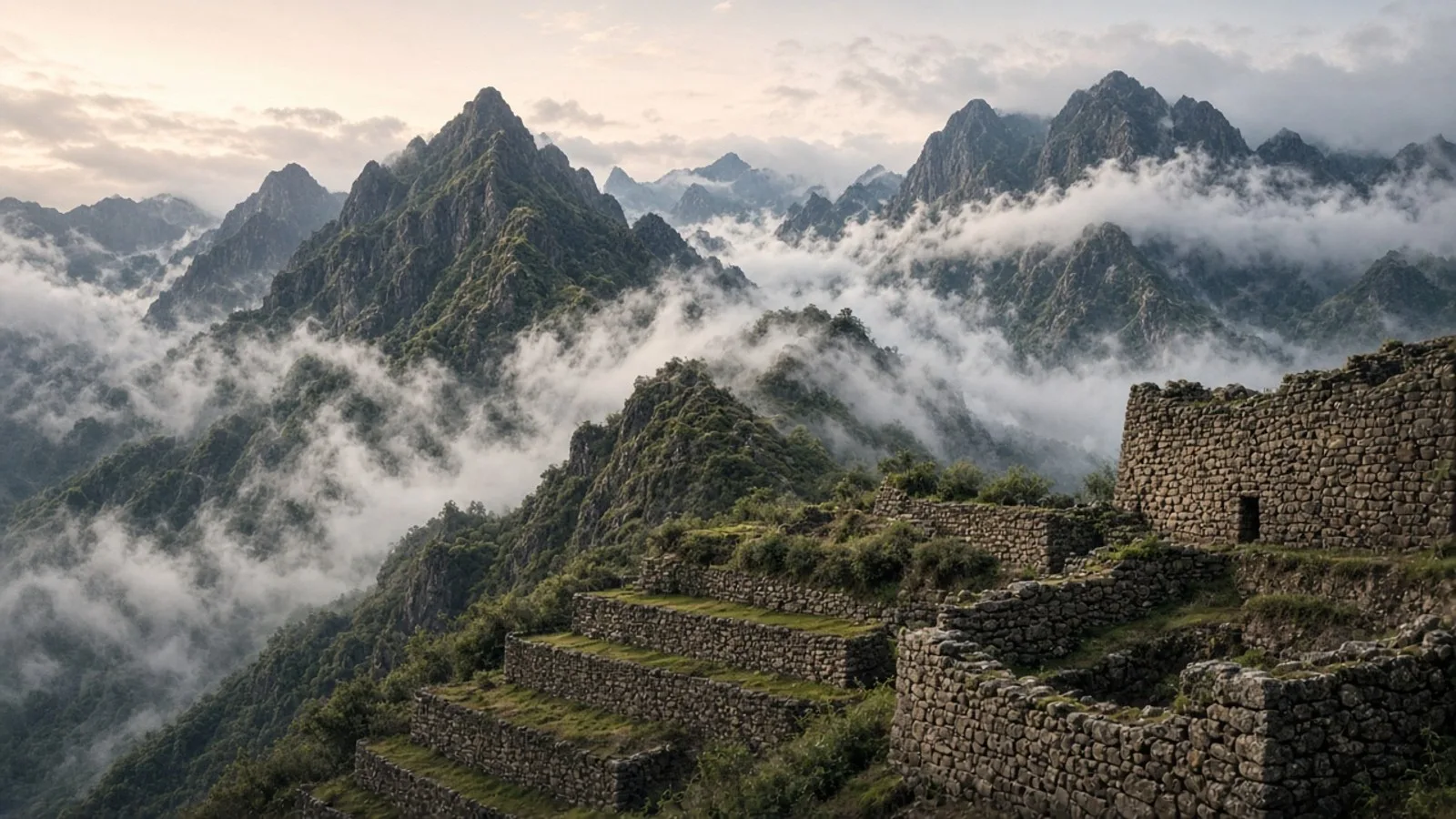
Machu Picchu sits on a narrow saddle of granite about 2,430 metres above sea level, between the peaks of Machu Picchu and Huayna Picchu. The Urubamba River curves around the ridge far below. The view looks remote, and that helped build a myth: a “lost city of the Incas,” hidden for centuries until an American explorer found it in 1911. The real story is more interesting. Machu Picchu was most likely a royal estate, built in the fifteenth century and lived in for only about a century. Local farmers never lost track of it. Hiram Bingham made it famous. He did not find something nobody knew.
This long read covers the Inca context, Pachacuti and the new radiocarbon dates, how the site worked, the Spanish conquest and abandonment, Bingham’s 1911 visit and the dispute over the word “discovery,” the Yale artifacts, the UNESCO listing, today’s ticket circuits, and the conservation pressures that follow. Where scholars disagree, we say so.
The Inca World Before Machu Picchu
In the early fifteenth century the Inca were one of several regional powers in the Cusco basin. Within about a hundred years they had built Tawantinsuyu, the largest state in the pre-Columbian Americas. It stretched more than 4,000 kilometres, from present-day Ecuador to central Chile. It had no writing system in the European sense. It recorded information on khipu, knotted cords. It held its territory together with roughly 40,000 kilometres of roads, known as the Qhapaq Ñan, plus labour-tax systems and royal estates.
Most of what we know about Inca chronology comes from Spanish and mestizo chroniclers who wrote after 1532. They include Pedro Cieza de León, Juan de Betanzos, Garcilaso de la Vega and Bernabé Cobo. They do not always agree. Those disagreements matter when we try to date Machu Picchu.
Pachacuti and the Royal Estate
Inca tradition credits the expansion to Pachacuti Inca Yupanqui. According to the chronicles, he defeated the Chanka confederation and took power around 1438. He rebuilt Cusco and led campaigns down the Urubamba valley. Inca rulers founded private estates for themselves and their descendants, much as European royalty did. Pisac, Ollantaytambo and Chinchero are examples.
The key documentary link comes from colonial land records of the 1560s, studied by historians including Luis Miguel Glave and María Remy and analysed by the archaeologist John Rowe in 1990. A 1568 document about lands at “Picchu” mentions property belonging to Pachacuti’s descendants. Rowe argued that this placed Machu Picchu among Pachacuti’s royal estates. Most specialists now accept that interpretation. A few still argue for a more ceremonial or strategic role. Machu Picchu was not the capital. Cusco was.
New Radiocarbon Dates: Older Than the Chronicles Say
For decades scholars dated construction to roughly 1440–1450, following the chroniclers and Rowe’s 1945 chronology. In August 2021 Richard Burger, Lucy Salazar and colleagues published accelerator mass spectrometry (AMS) dates in the journal Antiquity. They tested bones and teeth from 26 people buried in four cemeteries around the site. Bingham’s team had excavated those remains in 1912.
The results point to continuous occupation from about 1420 to about 1530. That is at least twenty years earlier than the chronicles imply. The authors suggest that Pachacuti’s rise, or the Inca expansion, began earlier than the date of 1438. Other researchers have welcomed the data but warn that one site cannot rewrite the whole Inca chronology. This debate is still open.
How the Estate Worked
The site has about 200 structures, divided into an agricultural sector of terraces and an urban sector of temples, plazas, residences and storehouses. The finest buildings use ashlar masonry, in which granite blocks were cut to fit so tightly that no mortar was needed. Well-known features include the Temple of the Sun (Torreón), the Temple of the Three Windows, the Intihuatana stone, the Temple of the Condor and the Royal Residence.
Engineering studies led by Kenneth Wright and Alfredo Valencia Zegarra described sophisticated drainage. These included layered terrace fills, more than 100 drainage outlets and a spring-fed system of 16 fountains. A widely repeated estimate holds that much of the construction effort, perhaps around 60 percent, lies underground in foundations and fill. Treat that number as an approximation. The design has helped the site survive heavy rain and earthquakes for more than five centuries.
Population estimates vary. Burger and Salazar suggest perhaps 750 people lived there when the ruler was in residence, falling to a much smaller staff at other times. The skeletons studied show little sign of heavy construction work and include people from many regions. That fits with yanakuna, retainers attached to the royal household, who lived beside visiting nobility.
Conquest, Abandonment and Silence
In 1532 Francisco Pizarro captured the ruler Atahualpa at Cajamarca, at a time when the empire had already been weakened by civil war and by epidemics that probably arrived before the Spaniards themselves. Atahualpa was executed in 1533, and Cusco fell the same year. Manco Inca led a revolt in 1536. Later, Inca rulers held out in the Vilcabamba region until 1572, when Túpac Amaru was captured and executed.
The occupation evidence fades around the 1530s or 1540s. Royal estates relied on the ruling lineage and the labour system, and both collapsed. Unlike Cusco, Machu Picchu has no known record of Spanish looting, priests destroying shrines or settlers moving in. Its stones were left largely intact, possibly because colonial officials barely knew the site mattered. Exactly when the last residents left is uncertain.
Local Knowledge Before 1911
The ruins were never truly “lost” to people in the valley. Colonial land records mention Picchu place names. Nineteenth-century travellers recorded the place names too. The explorer Charles Wiener, for example, heard of Machu Picchu and Huayna Picchu in the 1870s, although he never reached the ruins. A charcoal inscription, “Lizárraga 1902,” was written on a wall at the site. It came from Agustín Lizárraga, a local tenant farmer, who visited with companions. Bingham saw the inscription in 1911 and noted it in his journal, but he gave it little attention in later popular accounts.
When Bingham arrived, families named Richarte and Álvarez were farming the old terraces. A third possible earlier visitor is the German entrepreneur Augusto Berns. The researcher Paolo Greer argued that Berns knew the site in the 1860s and tried to exploit it. That claim is still debated and should be treated with caution.
24 July 1911: Hiram Bingham’s Visit
Hiram Bingham III (1875–1956) was a Yale lecturer in Latin American history. He was looking for Vilcabamba, the last Inca refuge. On 24 July 1911 a local farmer, Melchor Arteaga, led him up the slope with a Peruvian police sergeant named Carrasco. At the top, a boy from the Richarte family guided them to the ruins. Bingham photographed walls covered in vegetation and realised that the stonework was of the finest Inca quality.
He returned in 1912 with backing from Yale and the National Geographic Society, cleared the site and excavated burials. National Geographic gave its whole April 1913 issue to Machu Picchu, and that issue made it world famous. Bingham insisted for decades that he had found Vilcabamba. The site later identified as Vilcabamba is Espíritu Pampa, which Bingham had also visited in 1911 and dismissed. Gene Savoy’s work in 1964 and later research established that identification. Bingham went on to a political career as Governor of Connecticut and then U.S. Senator. The popular claim that he inspired Indiana Jones is often repeated but has never been documented.
What Was It Really Called?
Even the name may be modern. In 2021, the historians Brian Bauer and Donato Amado Gonzales published research in Ñawpa Pacha based on colonial documents and Bingham’s field notes. They argued that the Inca probably called the settlement “Huayna Picchu” or simply “Picchu.” “Machu Picchu,” meaning “old peak,” was the name of the mountain beside it. Peru is not renaming the site, but the finding is another reminder that the famous story was built partly in the twentieth century.
The Yale Collections Dispute
Bingham’s expeditions shipped thousands of objects and human remains to Yale’s Peabody Museum. Counts reach tens of thousands if fragments are included. Peru argued that they had been sent only on loan. Yale disputed parts of that claim. After years of negotiation and a lawsuit filed in 2008, the two sides reached an agreement in 2010. The collections went back to Peru between 2011 and 2012 and are now in the Casa Concha museum in Cusco, managed with the National University of San Antonio Abad (UNSAAC). The case is often cited in wider debates about returning cultural property.
UNESCO, Wonders and Mass Tourism
UNESCO listed the Historic Sanctuary of Machu Picchu as a World Heritage Site in 1983. It is a rare “mixed” site, recognised for both its culture and its cloud-forest ecology, and covers about 32,592 hectares. The Hiram Bingham Highway, a switchback road up from the valley, opened in 1948. A rail line already reached the valley floor, so access grew quickly. In 2007 a private online poll named Machu Picchu one of the “New Seven Wonders of the World,” and visitor numbers rose further. Before the pandemic they were around 1.5 million a year.
Under the Ministry of Culture’s 2026 rules, visitors buy timed, named tickets through the official tuboleto.cultura.pe portal. The daily cap is 5,600 in the high season, including 19 June to 2 November, and 4,500 at other times. Visits follow three circuits: Panoramic, Inka City and Royalty. These are split into ten routes, including the Huayna Picchu and Machu Picchu mountain climbs. The classic Inca Trail has its own permit system and closes every February for maintenance.
Conservation Tensions
Tourism supports the economy of the Cusco region, but it puts pressure on paths, terraces and the town of Machu Picchu Pueblo (Aguas Calientes). In 2016–17 UNESCO considered adding the site to its List of World Heritage in Danger. Peru avoided that by introducing timed entry and fixed routes. The Intihuatana stone was chipped in 2000 when a crane fell during a commercial shoot. Ticket-sales disputes and local protests closed or disrupted access at times in 2023 and 2024. A planned international airport at Chinchero has raised concerns about crowds and the landscape. Landslide risk, climate change and erosion on the ridge are ongoing problems.
Timeline
- c. 1420: Earliest occupation, according to the 2021 AMS dates.
- c. 1438: Pachacuti’s accession, according to the chronicles; construction traditionally dated to c. 1440–1450.
- 1532–33: Spanish conquest; Atahualpa is executed.
- c. 1530s–40s: Occupation fades.
- 1568: A colonial document links “Picchu” lands to Pachacuti’s heirs.
- 1902: Lizárraga’s inscription is written on a wall.
- 24 Jul 1911: Bingham is guided to the ruins.
- 1912; April 1913: Excavations, then the National Geographic issue.
- 1948: Hiram Bingham Highway opens.
- 1983: UNESCO World Heritage listing.
- 2007: “New Seven Wonders” poll.
- 2011–12: Yale collections return to Cusco.
- 2021: Studies of the AMS dates and the original name are published.
- 2026: Visitor caps of 5,600/4,500 and three circuits.
Myths vs Facts
- Myth: Bingham discovered a city unknown to anyone. Fact: Local farmers were living on the terraces, and Lizárraga had visited by 1902. Bingham publicised the site and excavated it.
- Myth: It was the Inca capital. Fact: Cusco was the capital. Machu Picchu was a royal estate.
- Myth: It was the last refuge, Vilcabamba. Fact: Vilcabamba is identified with Espíritu Pampa.
- Myth: The Spanish destroyed it. Fact: There is no evidence of that. Its survival is partly due to colonial neglect.
- Myth: It was home to tens of thousands of people. Fact: Estimates are in the hundreds.
FAQ
How old is Machu Picchu? It was occupied from about 1420 to about 1530, according to the AMS dates. The older consensus put construction at around 1450.
Can you visit without a guide or a ticket? No. Entry requires a timed ticket, and the rules are set by Peru’s Ministry of Culture.
Related on HorizonDesk: the 1953 Everest first ascent and the Nilgiri Mountain Railway.
Final Thoughts
Machu Picchu is impressive without the “lost city” legend. Inca engineers built a royal estate on a knife-edge ridge that has outlasted an empire. Andean farmers kept working its terraces. A Yale explorer made it famous, and Peru won back the objects he took. Telling all of those stories together is more accurate than repeating the old one.
Sources
- UNESCO World Heritage Centre: “Historic Sanctuary of Machu Picchu” (listing 274).
- Encyclopaedia Britannica: “Machu Picchu” and “Pachacuti Inca Yupanqui.”
- R. L. Burger, L. C. Salazar et al., “New AMS dates for Machu Picchu,” Antiquity 95 (2021), plus Yale News coverage.
- B. S. Bauer and D. Amado Gonzales, on the original name of Machu Picchu, Ñawpa Pacha (2021).
- J. H. Rowe, “Machu Picchu a la luz de documentos del siglo XVI,” Histórica (1990).
- K. R. Wright and A. Valencia Zegarra, Machu Picchu: A Civil Engineering Marvel (2000).
- Peru Ministry of Culture: Resolución Ministerial 285-2025-MC (2026 capacity and circuits).
- Christopher Heaney, Cradle of Gold: The Story of Hiram Bingham (2010).