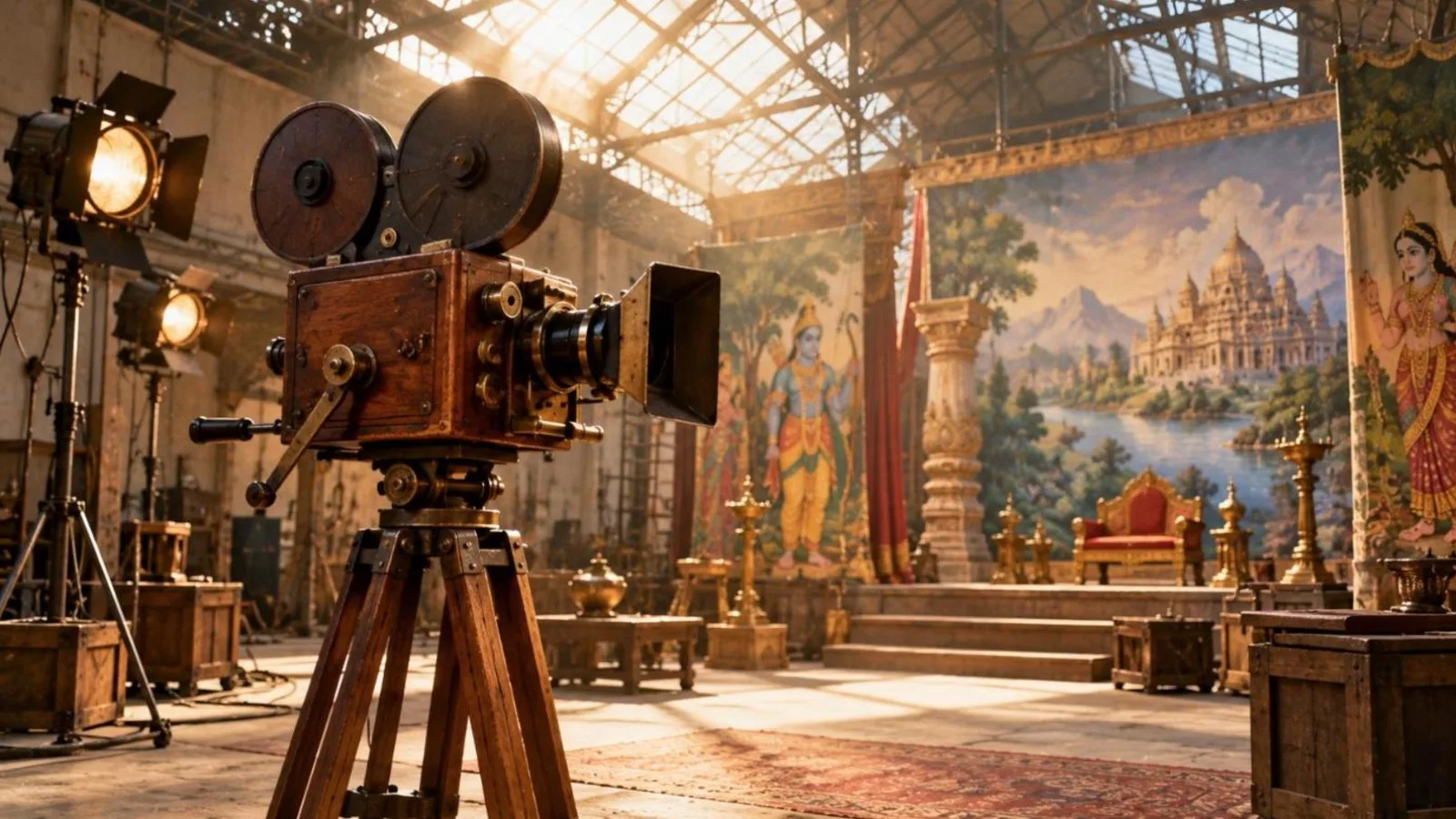
This is Part 1 of Legends of Indian Cinema, our 20-part series on the actors, filmmakers and musicians who shaped Indian films across languages.
Every year, India's highest film honour goes to one person for a lifetime of work. It carries the name of the man who started it all: Dhundiraj Govind Phalke, known to history as Dadasaheb Phalke. More than a century ago, with borrowed money and a lot of stubbornness, he made India's first full-length feature film.
Early life
- Born in 1870 in Trimbak, near Nashik in Maharashtra, into a family of Sanskrit scholars.
- He studied at the Sir J.J. School of Art in Bombay and at the Kala Bhavan in Baroda. He then tried painting, photography, printing and even stage magic.
- He worked with the painter Raja Ravi Varma's printing press, which shaped his love of mythological imagery.
The film that changed his life
Around 1910–11, Phalke watched a film on the life of Christ in a Bombay tent cinema. He later said that while watching it, he imagined Indian gods on the screen. He studied every film he could find, and in 1912 he travelled to London to learn filmmaking and buy a camera and equipment.
Raja Harishchandra (1913)
- On 3 May 1913, Raja Harishchandra opened at the Coronation Cinema in Bombay. It is regarded as India's first full-length feature film.
- It was a silent film based on the legend of the truthful king Harishchandra, with intertitles in English and Hindi.
- No women would act in films then, so men played the female roles. Anna Salunke played Queen Taramati.
- Phalke was producer, director, writer, cameraman, editor and set designer. His wife Saraswatibai helped process the film.
Building an industry
- He followed it with mythologicals such as Mohini Bhasmasur (1913), in which women appeared on screen, as well as Lanka Dahan (1917) and Shri Krishna Janma (1918). Audiences loved the camera tricks.
- In 1917 he set up Hindustan Films in Nashik with business partners.
- Over his career, he made about 95 feature films and 27 short films.
- When sound arrived in the 1930s, his career faded. His only talkie, Gangavataran (1937), was his last film. He died in Nashik in 1944.
The Dadasaheb Phalke Award
In 1969, the Government of India created the Dadasaheb Phalke Award to honour lifetime contribution to Indian cinema. The first recipient was the actress Devika Rani. Many of the legends in this series have received it, including Satyajit Ray, Raj Kapoor, Lata Mangeshkar, Amitabh Bachchan, Rajinikanth and, most recently, Mohanlal.
Why he matters
Phalke proved that Indians could make films about their own stories, myths and people. The industry he started now makes more feature films each year than any other country, in dozens of languages. Every legend in this series stands on the foundation he built.
Next in the series: Part 2: Satyajit Ray.