As of 7:55 AM IST, Saturday 24 October 2026. This is a fast-moving situation. Casualty figures and military claims come from the Israeli military, the Israeli government, the UN and news agencies, and some have not been independently verified.
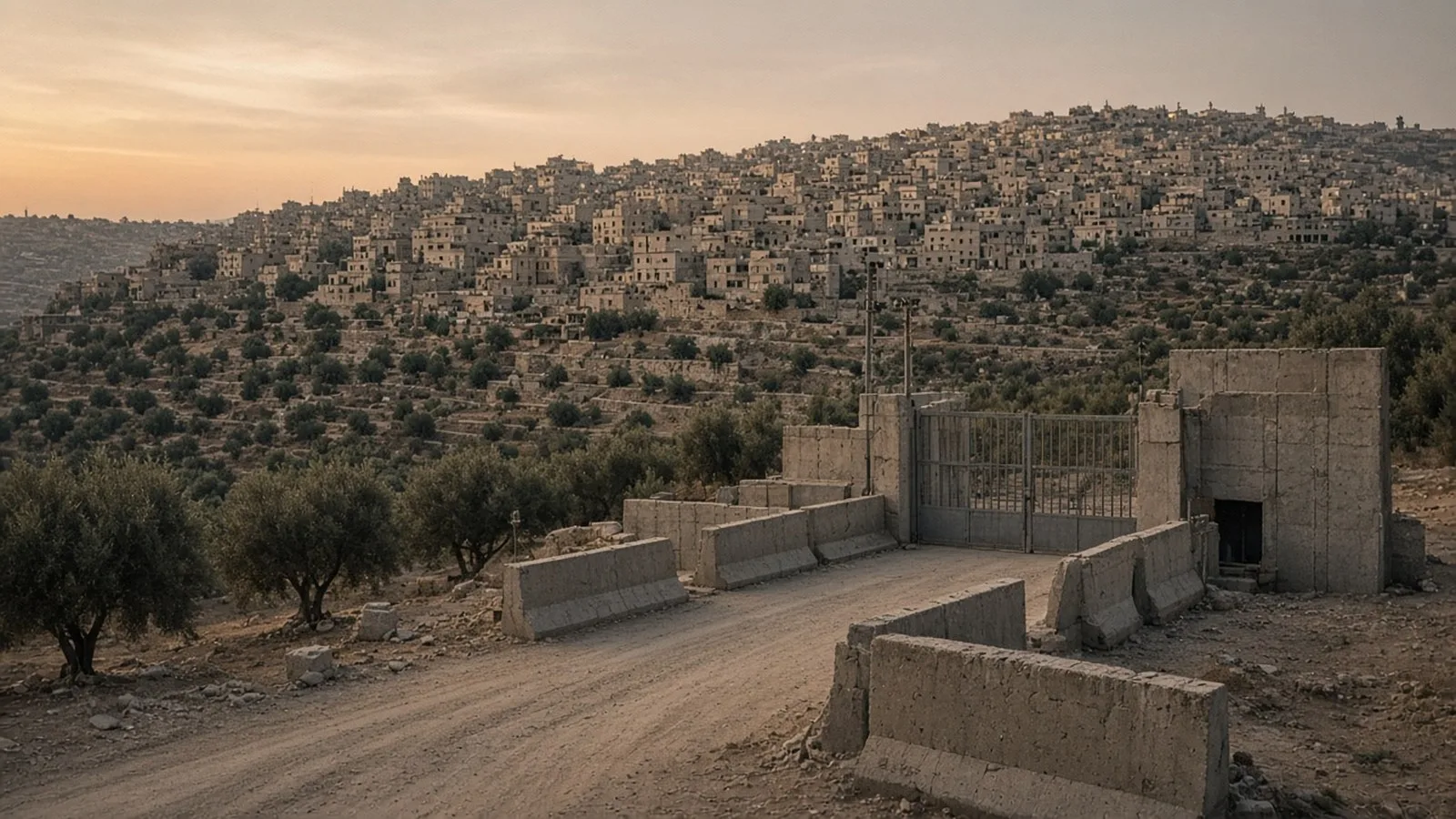
Israel has sealed off the occupied West Bank city of Hebron and begun demolishing Palestinian buildings there, after two Palestinian gunmen killed two Israeli soldiers at a checkpoint outside the city on Friday, 23 October 2026. Prime Minister Benjamin Netanyahu said he had reviewed plans for what the BBC described as the largest military operation in the West Bank in decades. The UN said it was "extremely alarmed". The escalation comes four days before Israel's general election on Tuesday, 27 October.
What happened
According to the Israeli military, two Palestinian gunmen got out of a car and opened fire on soldiers at a junction checkpoint near Hebron. The IDF said the attackers carried an M16 rifle and a handgun. Both gunmen were shot dead.
The IDF named the two soldiers killed as Staff Sergeant Ron Yonatan Roytman and Sergeant Yuval Shai Svilem. Reports differ on the number of wounded. The IDF and the BBC said three soldiers were wounded, which CBS News described as lightly. UN News, citing media reports, said at least five.
The military said it found a large amount of weapons and ammunition in the attackers' car. It believes they planned a bigger attack on nearby Route 35 but ran into the checkpoint. HorizonDesk cannot independently verify that assessment.
Who was behind it?
Netanyahu called the gunmen "Hamas terrorists". Hamas called the attack "heroic" but, according to CBS News, it stopped short of claiming responsibility. No group had formally claimed the attack at the time of writing.
Israel's response
- Hebron cordoned off. Netanyahu ordered the army to seal Hebron, a city of about 200,000 people, and nearby Halhul. UN rights officials said the Ibrahimi Mosque was shut for Friday prayers.
- Demolitions. The BBC reported that diggers were demolishing Palestinian buildings in Hebron on Friday afternoon. Referring to the attackers' neighbourhood, Netanyahu said: "Our first step will be to demolish this site and completely transform it."
- House-to-house raids. Netanyahu said residents of the attackers' neighbourhood would be evacuated and troops would search house to house. The IDF said it had arrested about 70 wanted Palestinians in the West Bank over the past week.
- A wider operation. Netanyahu said Israel was "prepared for an extensive operation" in the West Bank but did not say when.
- Territory-wide closures. UN News said this was the fourth time in a month that Israel has imposed restrictions across the West Bank.
Far-right ministers pushed further. Finance Minister Bezalel Smotrich called for a campaign "exactly like in Gaza or Lebanon", and National Security Minister Itamar Ben Gvir called for dismantling the Palestinian Authority, the BBC reported.
The UN reaction
At the UN's noon briefing on 23 October, spokesperson Stéphane Dujarric said Secretary-General António Guterres was "extremely alarmed" by the situation and deeply concerned by the closures and reported demolitions in Hebron.
Mayy El Sheikh, spokesperson for the UN human rights office (OHCHR) in the Occupied Palestinian Territory, described the closures as part of a "pattern of collective punishment". Israel says its measures are aimed at preventing further attacks.
Olive harvest and settler violence
The closures come at the height of the West Bank olive harvest, which many Palestinian families depend on. According to OHCHR:
- It documented more than 160 settler attacks in the first two weeks of October.
- EU diplomats were among those targeted, and a Washington Post photojournalist was assaulted near Ramallah.
- CBS News reported that US congressional candidate Brad Lander was briefly detained in the West Bank.
Guterres also condemned the record level of settler attacks recorded in 2026.
For scale: the UN figures cited by the BBC say at least 96 Palestinians have been killed by Israeli forces or settlers in the West Bank so far this year, and four Israelis have been killed there by Palestinians, not counting Friday's attack.
Gaza aid and the "El Niño of war"
The Hebron escalation adds to wider warnings from Guterres. Speaking to reporters in New York on 22 October, before a trip to Egypt, he said Israel was still "severely" restricting essential aid to Gaza ahead of winter. He also said there were difficulties implementing the Security Council-endorsed Comprehensive Plan to End the Gaza Conflict. He said the World Food Programme urgently needs $450 million to feed people in Gaza and the West Bank for the next six months, "the equivalent to what the world spends on its militaries in around 90 minutes".
Guterres described a world in which "conflict is feeding conflict", calling it "an El Niño of war". Among the crises he mentioned were the Houthi attacks on civilian targets in Saudi Arabia (our explainer). United Nations Day, marking the founding of the UN in 1945 (our history piece), falls today, 24 October.
The election factor
Israelis vote on Tuesday, 27 October. Netanyahu has made security the centre of his campaign. He said the attack was aimed at influencing the vote. Likud cancelled its campaign events for the rest of Friday. Opposition leaders, including frontrunner Gadi Eisenkot and former Prime Minister Naftali Bennett, offered condolences, the BBC reported. For the state of the race, see our explainer on Israel's 27 October election.
The West Bank escalation also comes amid the wider US–Iran confrontation; see our earlier report on US–Israel strike planning and the Hormuz tanker attacks.
What to watch
- Whether the "extensive operation" begins, and whether it starts before or after Tuesday's vote.
- Displacement in Hebron. How many residents are evacuated and how many buildings are demolished.
- The olive harvest. Whether closures ease enough for farmers to reach their groves.
- Gaza aid flows as winter approaches, and whether donors fill WFP's $450 million gap.
What is still unclear
- The exact number of wounded soldiers (three according to the IDF and BBC; at least five according to UN News, citing media).
- Who organised the attack. Hamas praised it but did not claim it.
- The scale and timing of any wider West Bank operation.
- Whether the attackers really planned a larger attack on Route 35, as the IDF says.
Sources
- BBC News: Hebron demolitions after two Israeli soldiers killed
- CBS News: Netanyahu orders Hebron cordoned off, reviews major West Bank operation plans
- UN News: UN alarmed by West Bank closures after Hebron attack (23 Oct 2026)
- UN News: Guterres press encounter coverage (22 Oct 2026)
- UNifeed: Guterres press encounter, 22 October 2026
- AP News: report on the West Bank shooting ahead of Israel's election