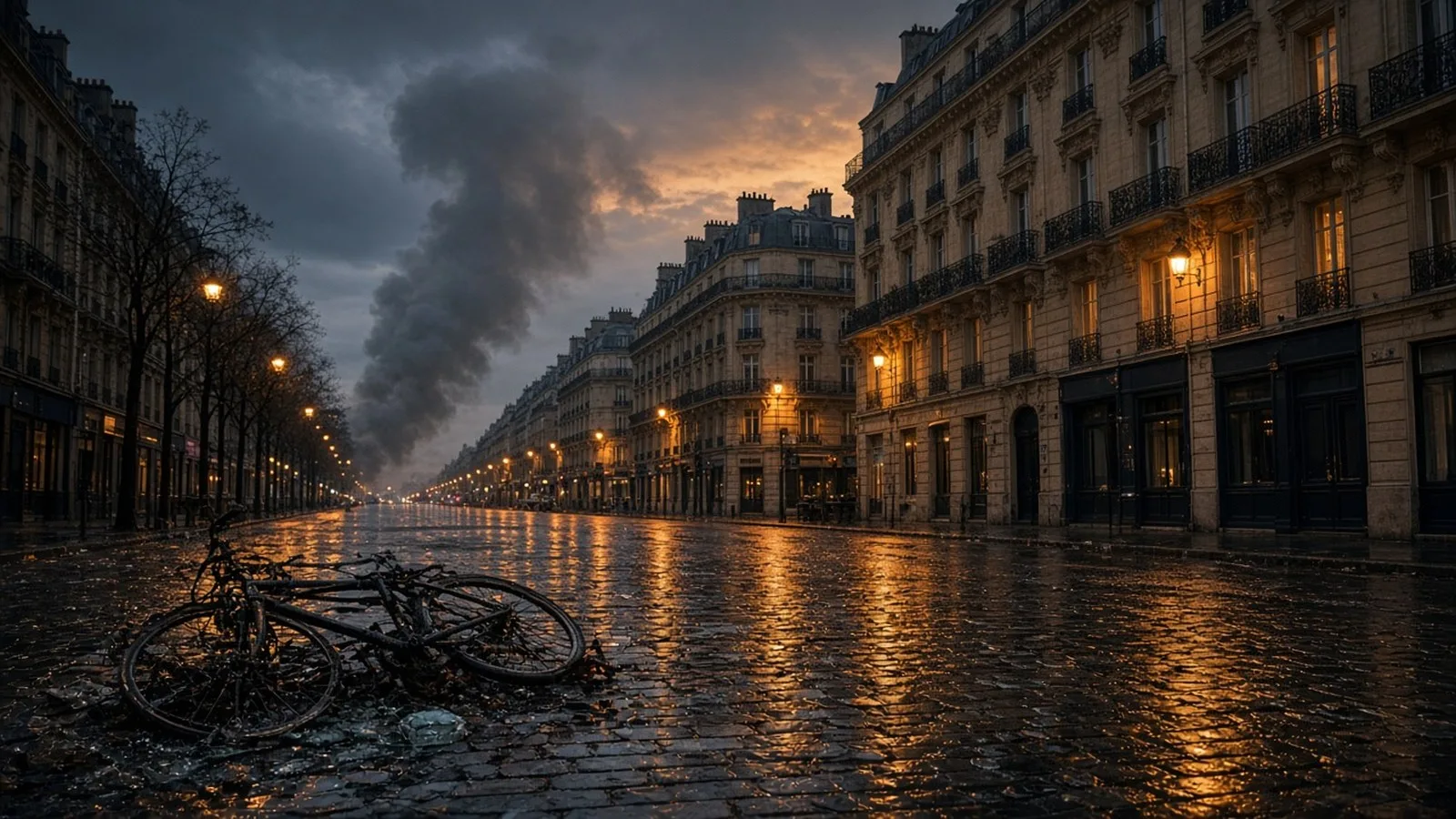
France woke up on Sunday, 18 October 2026, to smashed shop windows, burnt-out cars and a gutted 19th-century town hall. The day before, more than half a million people had marched across the country against the rising cost of living, high fuel prices and run-down public services, especially schools. Most of the marches were peaceful. By evening, though, masked groups and looters had turned parts of Paris, Marseille, Lyon, Lille, Bordeaux, Limoges and other cities into scenes that Reuters described as one of France's most violent days of unrest in years.
Here is what happened, why people are angry, how the government is responding and what could come next.
What happened on Saturday, 17 October?
Saturday's protests were billed as a national day of action. The call first spread on social media, then lycée (high school) student unions, trade unions and a revived "yellow vest" (gilets jaunes) movement took it up. France's interior ministry put nationwide turnout at about 550,000, including 110,000 in Paris. The CGT trade union and its partners gave a higher estimate of around 800,000.
The BBC reported that the main Paris march looked largely peaceful during the afternoon. As the day went on, groups lit fires in the street and set vehicles alight, including around the Place de la République. Shops were ransacked and at least one restaurant was gutted by fire. Riot police used tear gas, water cannon and batons. Graffiti such as "tax the rich" and "eat the rich" was left on many storefronts, and luxury boutiques on some of the capital's best-known shopping streets had their windows smashed.
The toll so far
- Arrests: Interior Minister Laurent Nuñez said about 1,800 people were arrested across France. Paris police reported 855 arrests in the capital, which they called a record. According to DW, citing AFP, prosecutors said 517 people were still in custody, 171 of them minors. These figures are provisional.
- Injuries to police and emergency services: On Saturday night, Prime Minister Sébastien Lecornu said 150 police officers had been injured. On Sunday the interior ministry raised the figure to more than 500 police officers, gendarmes and firefighters.
- A death: One demonstrator died in Paris. Reuters reported that the person suffered a cardiac arrest. The Paris police prefecture said the death was not linked to the violence or to police action.
- Injured protesters: In Saint-Étienne, Mayor Régis Juanico said a young man had his hand blown off by a small explosive. Le Figaro, as cited by DW, reported that the 17-year-old was hit by a grenade fired by police. This has not been independently confirmed, and officials have not given a full count of injured demonstrators.
- Businesses: Retail groups estimate that around 1,500 shops were damaged or looted nationwide. Alexandre Bompard, head of the Federation of Commerce and Distribution, put the damage at "hundreds of millions of euros", France 24 reported. This is an early industry estimate, not an official figure.
Where was the violence worst?
The disorder was spread across the country rather than confined to Paris:
- Limoges: Rioters set fire to the 143-year-old town hall and part of the building collapsed. Mayor Guillaume Guérin told LCI: "There are no words to condemn what happened, so appalling is it. The country is in chaos." He also told BFMTV that no national police officers were there to protect the building for an hour.
- Lyon: A city tourist office building was ransacked and set on fire. Mayor Grégory Doucet called it "a tragedy". Local police said "hostile individuals" stopped firefighters from reaching the blaze.
- Marseille: Protesters broke into the city hall, reportedly using a metal fence as a battering ram, and a municipal police station was damaged.
- Lille: An Apple store was broken into and emptied, and a McDonald's restaurant was set on fire, police said.
- Bordeaux: According to Reuters, a masked mob invaded the local prefect's residence. Mayor Thomas Cazenave said up to 100 stores were looted.
- Elsewhere: Damage was reported in Grenoble, Avignon, Rennes, Toulouse, Angers, Pau, Montpellier and Valence. In Grenoble, footage verified by BBC Verify showed masked men driving a tourist train down a narrow street towards riot police.
Why are people protesting in France?
Saturday's violence was the peak of a movement that began about a month earlier with a much narrower complaint: the state of France's secondary schools.
It started in the schools
According to AFP, the protests began in mid-September at a lycée in Créteil, a suburb south-east of Paris. Students there came out in support of teachers who were striking over staff shortages and a lack of resources. Class strikes and blockades soon spread to other Paris suburbs and then across the country.
Students' main complaints include:
- Teachers who are absent and not replaced, and too few staff
- Overcrowded classes and timetables that can run from 8am to 6pm
- Run-down buildings with leaks and broken fittings, and poor insulation exposed by the summer heatwaves
- A sense that schools in low-income neighbourhoods get a worse deal than those in wealthier areas
Some school blockades turned violent from early on, with bins set alight and clashes with police. By 8 October the government said 6,877 people had been arrested since the movement began, 86% of them under 18, the BBC reported.
Then it widened into a cost-of-living revolt
As the weeks went on, the student movement merged with wider anger. Trade unions were already fighting the government's budget plans. Al Jazeera reported that the plans include about €54 billion in spending cuts and savings and a proposed freeze on public-sector base salaries in 2027. High fuel prices, low wages and distress among farmers and firefighters added further grievances.
The fuel issue carries particular weight in France. The gilets jaunes movement began in 2018 over planned fuel tax rises and grew into more than a year of protests about living costs and inequality, some of them violent. That pressure forced the government to drop the fuel tax increase. Online calls to revive the movement had circulated for weeks before 17 October, and the date had been set aside as a yellow-vest day of action.
Money is tight
France's high public debt and budget deficit sharply limit what the government can offer. The BBC noted that ministers are wary of being seen to "buy social peace" while international bond markets watch France's finances closely. Fights over public spending are nothing new in France. HorizonDesk's history explainer on how a debt crisis helped bring down Louis XVI shows how state finances and popular anger have collided before.
How has the government responded?
The government has paired a tough line on the violence with a small concession on schools.
- President Emmanuel Macron wrote on X: "No room for violence in our Republic. Those who have ransacked, attacked the prefectures as well as businesses, looted even our town halls, will be prosecuted and punished." The Élysée said he would meet the prime minister and relevant ministers on Sunday afternoon and then address the nation at 8pm Paris time on Sunday (11:30pm IST). This article was written before that speech.
- Prime Minister Sébastien Lecornu said police had faced "violence of extreme intensity" and that the government would not be "intimidated". He blamed what he called organised "ultra-left" groups, joined by criminals intent on looting, and accused some of using the protests as a "warm-up" for next year's presidential election.
- Economy Minister Roland Lescure promised support for business owners who suffered losses and said that "those who break things will pay".
- On schools, Education Minister Édouard Geffray announced on 8 October that 3,000 extra supply teachers would be sent to around 500 of the lycées in greatest need. He also offered more money for teachers' overtime and promised that students' concerns would feed into the 2027 education budget. Protesters said this fell far short of the investment they want, and demonstrations grew.
Criticism of the policing
The government is also under fire over how Saturday was policed. Reuters reported that the mayors of Paris, Lyon and Marseille asked to meet Lecornu. Marseille Mayor Benoît Payan said he wanted to know "what orders were given" and whether police had been told to focus on demonstrators rather than looters. Green party leader Marine Tondelier called for Nuñez to resign. Former president François Hollande said the state "was not able to ensure public order everywhere".
The political backdrop
The unrest comes at a tense time in French politics. Macron cannot stand again and leaves office in 2027. Polls cited by the BBC suggest the April presidential election could come down to a contest between Marine Le Pen of the far-right National Rally and Jean-Luc Mélenchon of the hard-left La France Insoumise.
Both quickly used the violence to attack each other. Mélenchon had backed the demonstrations. He accused police of "unleashing" on protesters but told demonstrators to stay away from looting, calling it "contrary to our methods". Le Pen said protesters' "legitimate demands" had been "held hostage by the far left" and accused Mélenchon's party of legitimising the violence. Lecornu called Mélenchon's comments "dangerous and cynical".
France is not the only European country facing tension over security and stretched budgets. For a different example, see our explainer on what the UK is really doing to prepare its defences.
What happens next?
- Macron's address: Sunday night's speech is the next big moment. It is not yet clear whether he will announce new security measures, new spending on schools, or both.
- Prosecutions: With hundreds still in custody, fast-track court hearings are likely in the coming days, and ministers have promised to pursue those responsible.
- More protests: RFI reported that unions have called a nationwide strike and day of demonstrations for 5 November. Whether the student movement keeps going will also matter. The government hopes that the half-term school holidays, due to start at the end of next week, and colder weather will take some heat out of the protests.
- Budget fights: The 2027 budget debate in parliament will test whether the government can offer more to schools and households without alarming financial markets.
- Travel: Visitors to France should follow local news and official advice, avoid demonstrations, and expect possible disruption around big protest days. If you are planning a trip to Europe, read our guide to the EU's new biometric border checks.
Is this like France's past riots?
France has a long tradition of mass street protest, and some of it has turned violent. The 2018–19 gilets jaunes protests are the most obvious comparison, because they also started over fuel costs and grew into a broader revolt against inequality and a distant political elite. What stands out about the current wave is who is in it: teenagers angry about their schools have joined unions, yellow-vest activists and workers worried about prices, all a few months before a presidential election.
Most of Saturday's marchers were peaceful. One group of young people told the BBC they were "pacifists" who were "just trying to make things change, but nothing is moving". How the government answers both the violence and the underlying grievances will shape the weeks ahead.
Sources
- BBC: Burnt out cars and shattered glass on Paris streets after protests turn to riots (18 October 2026)
- BBC: Violent clashes, looting and buildings ablaze in France (18 October 2026)
- Reuters (via The Star): France faces aftermath of worst unrest in years (18 October 2026)
- AP: French police arrest 1,800 after violent clashes and looting mar protests
- DW (with AFP, dpa): Over 1,800 arrested after looting, arson during protests (18 October 2026)
- France 24 live coverage (French, 18 October 2026)
- RFI: «La France tourne mal» (French, 18 October 2026)
- AFP: What is fuelling French school protests?
- Al Jazeera: What's behind French student protests that turned violent? (30 September 2026)
- BBC: France promises 3,000 extra teachers in bid to calm student protests
This article reflects information available as of the afternoon of 18 October 2026 (IST). Figures are provisional and may change.