As of about 8:30 AM IST, Monday 16 November 2026. Based on statements from United Launch Alliance and Amazon, and reporting by Reuters, Ars Technica, Spaceflight Now and SpaceNews.
United Launch Alliance's Vulcan rocket failed on Sunday, 15 November, roughly 10 minutes after lifting off from Cape Canaveral Space Force Station in Florida, and the 40 Amazon Leo broadband satellites on board were lost. It was the first total mission failure in ULA's 20-year history, and it came on the first of 38 Vulcan launches Amazon has bought to build its rival to SpaceX's Starlink.
The rocket left Space Launch Complex 41 at 12:40 p.m. Eastern time (11:10 p.m. IST on Sunday). About 50 minutes later ULA confirmed that the vehicle "suffered an anomaly 10 minutes into the flight and failed to deliver the Amazon mission to orbit." The company said it did not yet have "any specific data to understand what occurred." The satellites themselves can be rebuilt. The bigger problem is that the rocket Amazon and the U.S. military were counting on for the coming year is now expected to be grounded for an indefinite period.
What happened during the flight
The early part of the flight looked normal. The six Northrop Grumman solid rocket boosters, which had caused problems on two earlier Vulcan flights, burned out and separated on schedule, Spaceflight Now and Ars Technica reported. Trouble appeared after that. Both outlets said the two methane-fuelled BE-4 engines on the first stage, supplied by Jeff Bezos's Blue Origin, appeared to fire for longer than ULA's pre-launch timeline called for. Ars Technica said the overrun was at least 30 seconds, which can mean a stage is underperforming and burning longer to compensate.
The telemetry-driven animation on ULA's webcast then showed the rocket starting to spin around the time the first stage shut down, according to Ars Technica. The Centaur V upper stage separated and lit its two RL10 engines, and the animation showed them steering in what looked like an attempt to recover. ULA ended the broadcast without mentioning a problem and announced the failure later on social media.
The cause is not yet known
Accounts of where the fault lies differ, and nothing has been confirmed. Multiple sources told Ars Technica the anomaly originated in the booster stage, not in the Centaur upper stage or the solid boosters. Spaceflight Now, reading ULA's update, said something went wrong during the Centaur's planned 12-minute burn. Reuters said the failure appeared to happen after stage separation and that it was unclear whether the BE-4 engines played a role. A person familiar with the matter told Reuters that Blue Origin is working with ULA on the investigation.
The BE-4 question matters well beyond this flight. Blue Origin's own New Glenn rocket, which uses a version of the same engine, exploded on its pad in May. That investigation traced the cause to an oxygen valve in one of the BE-4s, and ULA said the engines flown on Sunday had been retrofitted with Blue Origin's fix. If the BE-4 turns out to be involved again, both of the U.S. heavy rockets that rely on it could face longer delays.
A heavy blow to Amazon's Starlink challenger
For Amazon, losing 40 satellites is the smaller part of the problem. Ars Technica noted that Amazon has 37 more Vulcan launches booked, each meant to carry 40 or more satellites, so Vulcan was supposed to be the backbone of its deployment. Reuters counts 398 Leo satellites deployed since 2025 across 14 launches, about 12% of the 3,236 the company needs for global coverage. Starlink, by comparison, has more than 11,000 satellites in orbit, Reuters said.
Amazon's other options are thin. New Glenn is still recovering from the May explosion. Europe's Ariane 6 has flown three of 24 Amazon missions, with the fourth due later this month from French Guiana, according to Ars Technica. Amazon also has about 10 more Falcon 9 launches reserved with SpaceX, its direct competitor, but Reuters reported that SpaceX is no longer taking new Falcon 9 bookings as it moves toward Starship.
Amazon struck a conciliatory tone. "There is risk with any launch, and that's especially true for inaugural missions like LV-01," the company said. "ULA has been a trusted partner for Amazon, and we believe they'll learn from this mission and deliver on their long-term plans for Vulcan." Amazon told Ars in October it had enough satellites in orbit to start initial commercial service by the end of this year, but full capacity needs many more launches. The scale of the gap helps explain why investors value SpaceX and its Starlink network so highly: owning the rocket and the satellites has turned out to be a big advantage.
The regulatory clock is still running
Amazon already had some relief from regulators. In June the Federal Communications Commission waived the July 2026 requirement for Amazon to have half of its planned constellation in orbit, SpaceNews reported, but satellites launched after that date temporarily lose spectrum priority, which gives SpaceX and others more leverage. The FCC order still requires the full first-generation constellation by July 2029. Every month Vulcan stays grounded makes that target harder to reach and keeps Amazon's satellites in storage rather than in service. Amazon recently said it had built its 1,000th satellite, Ars Technica reported, meaning more than half of what it has made is still on the ground.
Why the Pentagon and NASA are watching
Vulcan is not just a commercial rocket. Ars Technica said it is under contract to launch roughly half of the U.S. military's national security space missions over the next few years. According to Reuters, the Pentagon had not yet cleared Vulcan to resume national security launches after the booster nozzle issues and was waiting to see how this Amazon flight performed. Earlier Vulcan delays had already led the Space Force to move six missions from ULA to SpaceX. Ars Technica expects more swaps now, which would deepen the military's reliance on a single provider.
NASA also has a stake. The agency recently chose a version of ULA's Centaur upper stage for future flights of its Space Launch System Moon rocket, so investigators will want to rule out a Centaur problem quickly. NASA Administrator Jared Isaacman offered help on X: "Artemis, Moon Base, and the nation need ULA. We are in your corner and here to help."
What it means for ULA
ULA, the joint venture of Boeing and Lockheed Martin formed in 2006, had built its reputation on reliability. Sunday's flight was only the fifth for Vulcan and its first in nine months after earlier investigations. The countdown itself was bumpy: Spaceflight Now reported that a Friday attempt was scrubbed by a nitrogen supply problem, Saturday's by a network issue, and Sunday's launch went at the end of its window after a hold at T-minus 20 seconds. Whether that hold had anything to do with the failure is not known.
ULA said its customers "will have visibility into the investigation process." Long groundings are costly for any launch company because the rocket earns nothing while fixed costs continue. As with large outages elsewhere in critical infrastructure, including the recent FAA nationwide ground stop, the lesson is how much depends on a small number of systems with little spare capacity behind them.
What to watch next
Three things will shape the next few months. The first is the root cause: a problem in the BE-4-powered booster would hit both Vulcan and New Glenn, while a Centaur fault would raise questions for NASA. The second is the length of the grounding, which ULA has not estimated. The third is whether Amazon shifts more of its deployment to Ariane 6 and its remaining Falcon 9 slots to keep its service launch on track. Until those answers arrive, the gap between Starlink and its main Western challenger has just become wider.
Sources
- Reuters: Rocket from Boeing-Lockheed firm fails mid-flight, destroys payload of Amazon satellites
- Ars Technica: Vulcan rocket fails during launch, dealing major blow to SpaceX competitors
- Spaceflight Now: ULA suffers first outright failure with loss of Vulcan rocket carrying 40 Amazon Leo satellites
- SpaceNews: Vulcan launch of Amazon Leo satellites fails
- SpaceNews: FCC lets Amazon Leo miss deployment deadline with temporary spectrum penalty
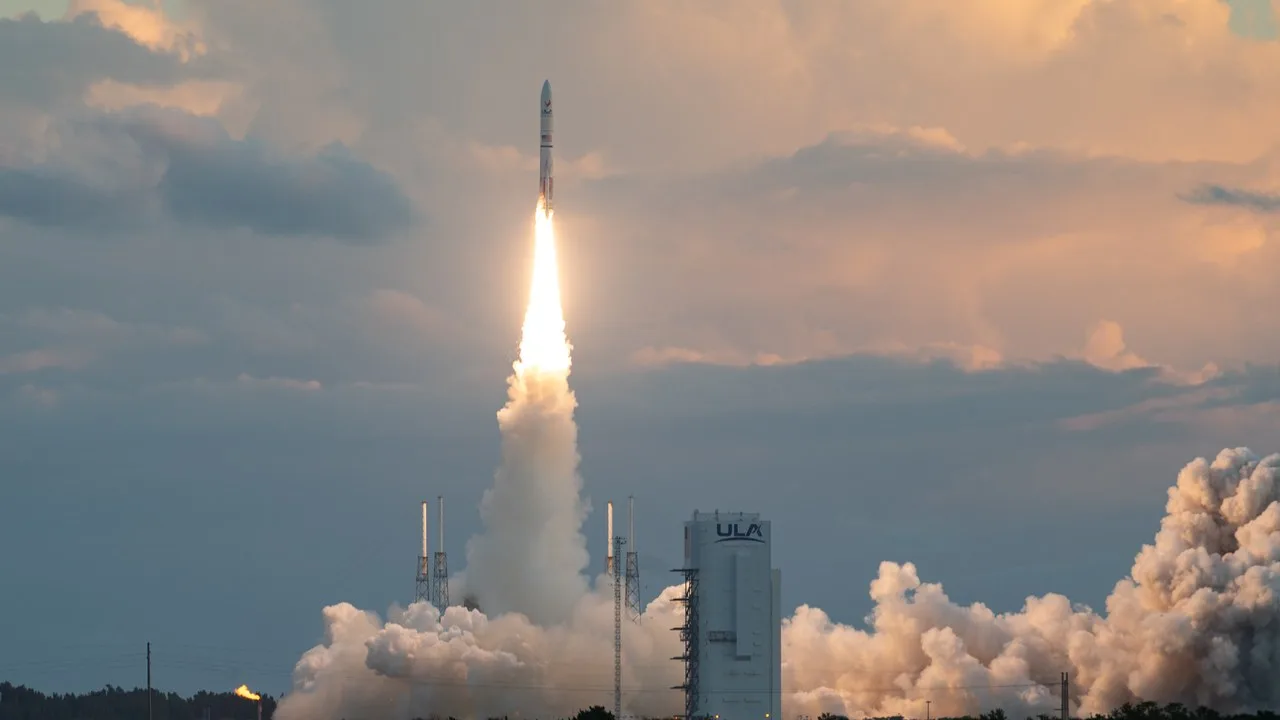
Featured image: A United Launch Alliance Vulcan rocket lifting off from Space Launch Complex 41 at Cape Canaveral on its second certification flight, 4 October 2024 (file photo, not the 15 November launch), U.S. Space Force photo by Airman 1st Class Collin Wesson, public domain, via Wikimedia Commons (cropped).