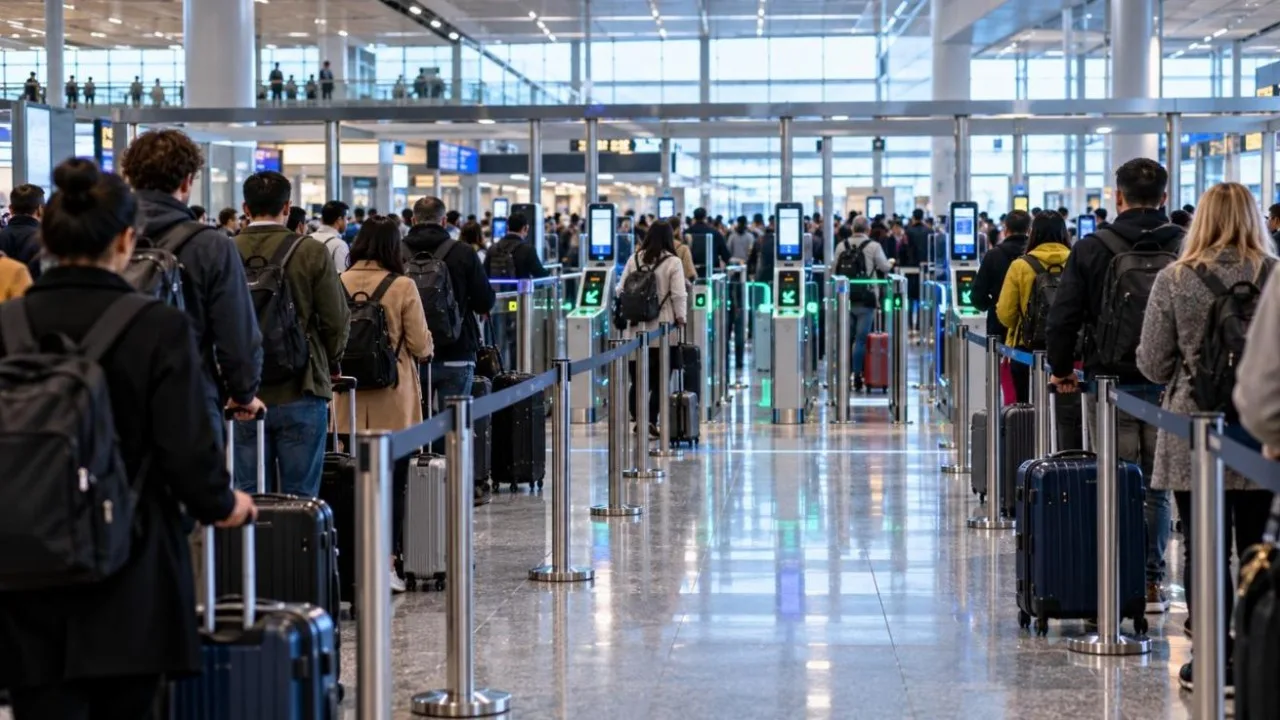
Europe's digital border system was supposed to replace passport stamps with quick biometric checks. Six months after it became fully operational, airports and airlines say it is doing the opposite. In mid-October 2026 Europe's airport and airline industries published a plan to fix the Entry/Exit System (EES), UK travel agents asked for emergency measures to continue into 2027, and a senior European Commission official said there "will be some further flexibility". Here is what is happening and what it means for your next trip.
What is the EES?
The Entry/Exit System records the fingerprints, facial image and passport details of non-EU visitors on short stays when they cross into or out of 29 European countries. It replaces manual passport stamping and is designed to track the 90-days-in-180 limit automatically. The rollout began on 12 October 2025 and the system has been fully operational since 10 April 2026. Your first crossing takes longest, because your biometrics must be registered.
The problem: long queues
On 12 October, the airport body ACI Europe and the airline group Airlines for Europe (A4E) said border waits "routinely exceed two hours" and can reach five hours at peak times. They blamed:
- too few border officers;
- unstable IT systems;
- limited use of kiosks and automated gates;
- weaknesses in the "Travel to Europe" pre-registration app.
"This is no longer a teething problem," the two groups said, while noting that EES has strengthened the security of Europe's borders.
The industry's six-point plan
- End double verification of travellers.
- Speed up biometric checks.
- Prevent duplicate EES profiles.
- Upgrade the Travel to Europe app and website.
- Roll out automated border gates faster and more consistently.
- Allow border staff to partially suspend EES during severe congestion, as a permanent option.
That last point matters because a temporary rule allowing countries to skip biometric registration when queues grew too long expired in early September 2026.
UK travel industry wants relief into 2027
On 14 October, the UK travel association ABTA called for those contingency measures to be extended into 2027. Its survey of more than 2,000 people found that half of travellers queued for under 30 minutes and 87% for under an hour, but 6% said EES made them much less likely to travel to the EU. Ryanair and other airlines also want the flexibility extended until early 2027.
Brussels responds
Speaking at Skift's Transatlantic Summit in Dublin on 15 October, Maja Bakran Marcich, a deputy director-general at the European Commission, said "there will be some further flexibility" and that "a balance will be found". She also admitted that "these queues are here to stay", noting that some countries had not provided enough staff and equipment and that some airports, such as Brussels, are physically constrained. She did not say what the new flexibility would involve or when it would start.
And ETIAS? Still no date
The related ETIAS travel authorisation, which visa-free visitors from 59 countries and territories will eventually need, still has no launch date. The European Commission says the system is not operating and no applications are being accepted. The earlier "last quarter of 2026" target has been dropped, and press reports point to 2027. When it does launch, ETIAS will cost €20 (free for under-18s and over-70s) and last three years. For more, read our earlier report on ETIAS delays and scam websites.
Practical tips for travellers
- Allow extra time, especially on your first entry into the Schengen area and for tight connections.
- Use pre-registration apps or self-service kiosks where your arrival country offers them; availability varies.
- Do not pay any website for ETIAS yet. There is no official application process.
- Book longer connections if you change planes at a Schengen hub after arriving from outside Europe.
- Check your airport's advice before travel, as some publish expected border waiting times.
What happens next
Watch for the Commission's announcement of what "further flexibility" means and when it applies. The European Commission's new EU tourism strategy is due on 4 November, and the management board of eu-LISA, the agency running EES and ETIAS, meets on 17–19 November, which could bring news on the ETIAS timetable.
Sources
- Skift – Easing EU Border Friction: There Will Be ‘Flexibility,’ Official Says (15 Oct 2026)
- The Independent via Yahoo Travel – Calls for EU entry/exit system suspension to continue into 2027 (14 Oct 2026)
- Airport Industry-News – ACI Europe and A4E Call for EES Changes Amid Five-Hour Airport Border Control Queues
- SchengenVisaInfo – ETIAS Has No Launch Date After Years of Delays (19 Oct 2026)