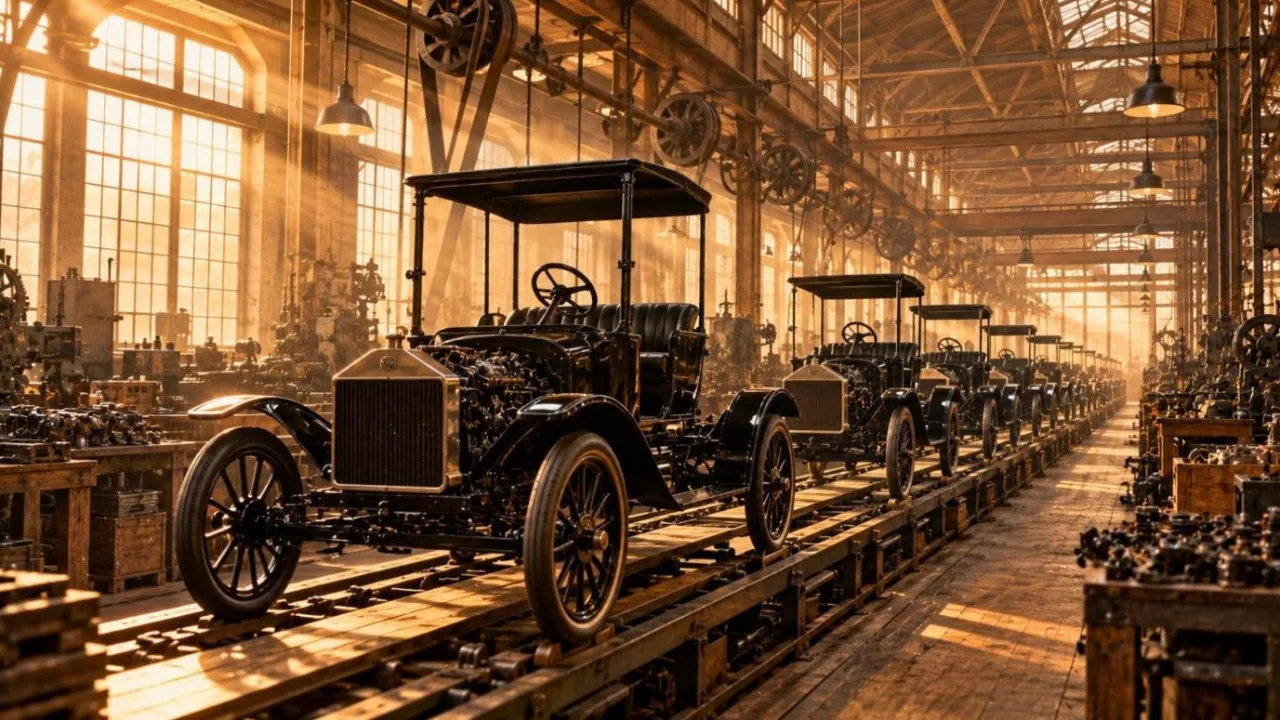
Welcome to Cars That Changed the World, a 10-part HorizonDesk series about the vehicles that reshaped industry, culture and the way we live. We begin with the car that started it all for ordinary people: the Ford Model T.
Quick facts
| Introduced | 1 October 1908 |
|---|---|
| Maker | Ford Motor Company, USA |
| Production | About 15 million, until 1927 |
| Engine | 2.9-litre four-cylinder, about 20 hp |
| Nickname | "Tin Lizzie" |
The story
In the early 1900s, cars were expensive, hand-built machines for the wealthy. Henry Ford wanted to build "a motor car for the great multitude": simple, rugged and cheap enough for farmers and factory workers. The Model T, launched in 1908, had high ground clearance for rough rural roads, a tough design that owners could repair themselves, and controls that made it relatively easy to drive.
The assembly line revolution
The real breakthrough came in 1913, when Ford introduced the moving assembly line at its Highland Park plant in Michigan. Instead of workers moving around a stationary car, the car moved past workers, each doing one task. The time to build a Model T fell dramatically, from more than 12 hours to around 90 minutes.
As production rose, prices fell. A Model T that cost about $850 at launch was available for roughly $260 to $300 by the mid-1920s. In 1914, Ford also introduced the famous $5 working day, roughly doubling typical factory pay, so his own workers could afford the cars they built.
"Any colour, as long as it is black"
Ford is famously quoted as saying customers could have any colour "so long as it is black". Between 1914 and 1925, black was the only option, partly because black paint dried faster and kept the line moving.
Why it changed the world
- Mass motoring: by the 1920s, about half the cars in the world were Model Ts.
- Mass production: the assembly line spread to almost every industry, from radios to refrigerators.
- Modern life: affordable cars led to paved roads, petrol stations, suburbs, motels and road trips.
Legacy
The Model T held the record as the best-selling car of all time until the Volkswagen Beetle overtook it in 1972. More than a century later, its biggest legacy is not the car itself but the idea that complex products can be built quickly, cheaply and for everyone.
Cars That Changed the World: the full series
- Part 1: Ford Model T (you are here)
- Part 2: Volkswagen Beetle
- Part 3: The Original Mini
- Part 4: Porsche 911
- Part 5: Toyota Corolla
- Part 6: Land Rover and Defender
- Part 7: Ford Mustang
- Part 8: Toyota Prius
- Part 9: Tesla Model S
- Part 10: Ferrari F40
Figures such as production numbers, prices and specifications are commonly cited historical values and may vary slightly between sources.