This is Part 8 of Sports Explained, our 12-part series of simple guides to the rules of the sports Indians love. New here? Start with Part 1: Cricket Formats, or read the previous part, Part 7: Kho-Kho.
Field hockey holds a special place in Indian sporting history: India won eight Olympic gold medals between 1928 and 1980, and has returned to the Olympic podium with bronze medals at Tokyo 2020 and Paris 2024. Here is how the modern game works.
The basics
- Two teams of 11 players, including a goalkeeper, with rolling substitutions.
- Matches have four quarters of 15 minutes.
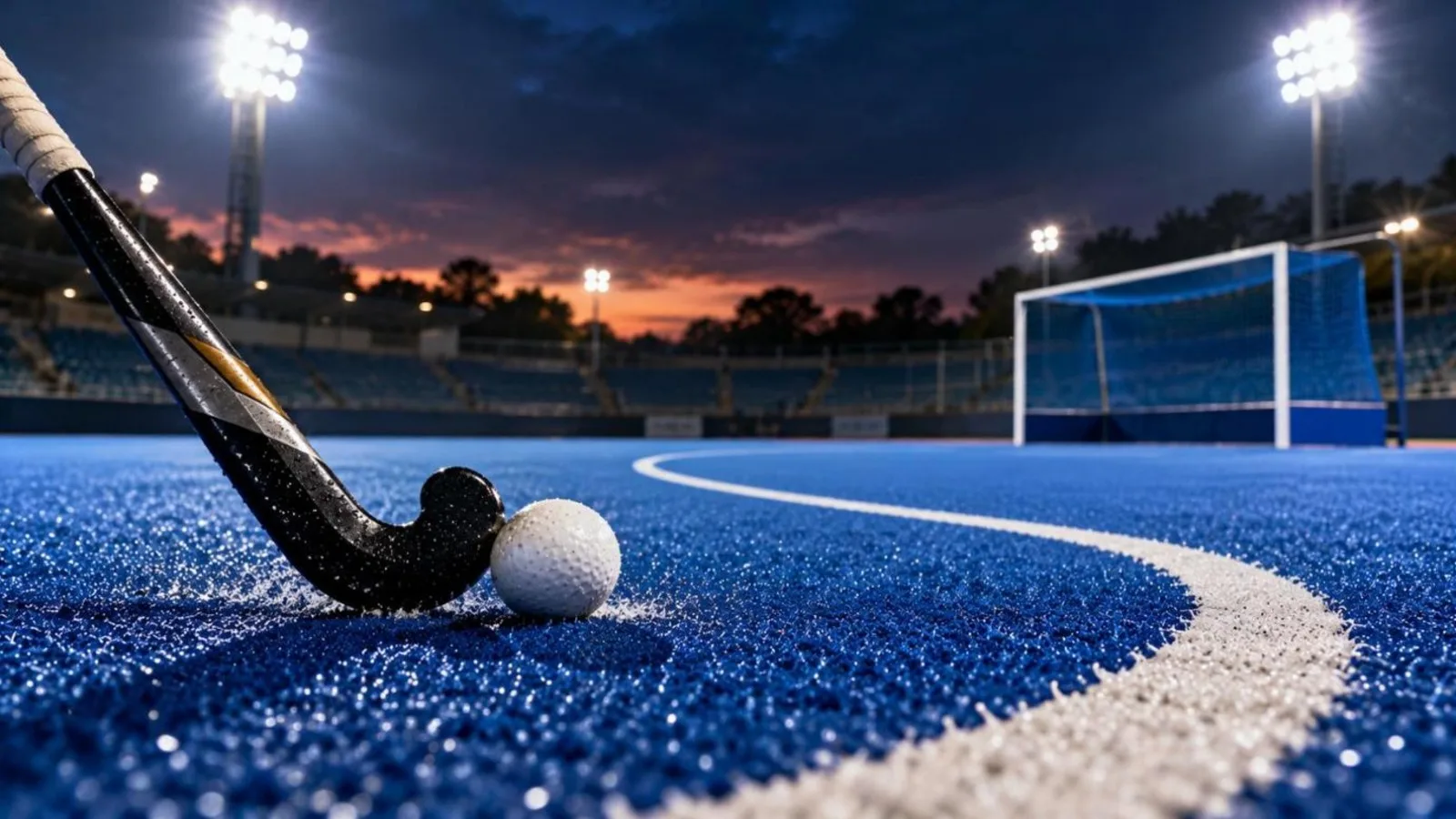
- Players may only hit the ball with the flat side of the stick. Using feet or the rounded back of the stick is a foul.
- Games are played on artificial turf, which makes the ball move fast.
The shooting circle
A goal only counts if the attacker touches the ball inside the shooting circle, the D-shaped area in front of each goal. A shot from outside the circle that goes in does not count.
Penalty corners
A penalty corner is awarded for most fouls by defenders inside their circle, or deliberate fouls near it.
- An attacker pushes the ball from the backline to teammates waiting at the top of the circle.
- The ball is stopped, then shot at goal, often with a powerful drag flick.
- Up to five defenders, including the goalkeeper, rush out from behind the goal line to stop it.
Penalty corners decide many matches, so specialist drag-flickers are among the most valuable players on any team.
Penalty strokes
A penalty stroke is awarded when a foul prevents a probable goal. One attacker takes a shot from the penalty spot with only the goalkeeper to beat.
Cards
- Green card: A two-minute suspension.
- Yellow card: A suspension of at least five minutes.
- Red card: Sent off for the rest of the match.
A suspended player's team plays with fewer players during that time.
Shootouts
Drawn knockout matches are decided by a shootout: an attacker starts at the 23-metre line and has eight seconds to score one-on-one against the goalkeeper.
India's hockey story
India dominated Olympic hockey for decades, and the legendary Dhyan Chand remains a national icon; India's highest sports award, the Khel Ratna, is named after him. Learn how teams qualify for the Games in Part 12: Olympic Qualification.
Rules are explained as they stand in October 2026. Governing bodies update their rules regularly, so check the latest official regulations for any competition.
Next in the series: Part 9: Badminton Scoring.