This is Part 7 of Sports Explained, our 12-part series of simple guides to the rules of the sports Indians love. New here? Start with Part 1: Cricket Formats, or read the previous part, Part 6: Kabaddi.
Most Indians played some version of kho-kho at school. The traditional chasing game has gone professional with Ultimate Kho Kho, launched in 2022, and the first Kho Kho World Cup, held in New Delhi in January 2025, where India won both the men's and women's titles.
The field
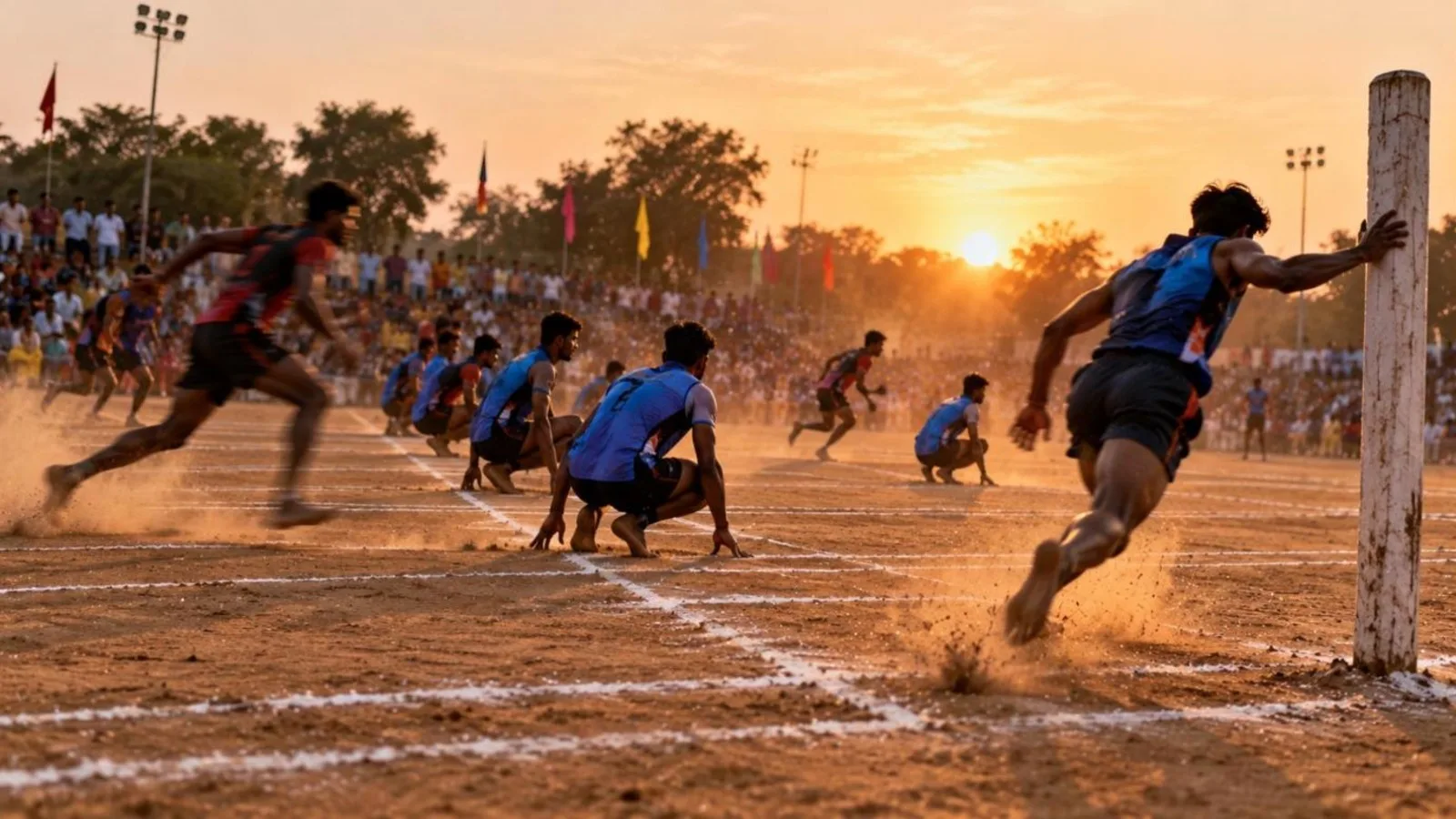
- A rectangular court with a wooden pole at each end.
- A central lane runs between the poles, divided into squares.
- Chasers cannot cross the central lane, which forces them to run around the poles to change sides.
The teams
- Each team has 12 players.
- The chasing team places eight players sitting in the squares, facing alternate directions, with one active chaser.
- The defending team sends defenders onto the court in batches of three.
How a chase works
- The active chaser runs to touch (tag) a defender. A touched defender is out, and the chasers score.
- The chaser can pass the chase to a seated teammate by touching their back and calling "kho". That teammate becomes the new active chaser.
- A chaser may run in one direction only towards a pole, and can change direction only after reaching the pole, which is why the kho is so important.
- When all three defenders in a batch are out, the next batch enters.
The newer, faster format
The World Cup and Ultimate Kho Kho use modern rules designed for television:
- Turns: Each innings has a chasing turn and a defending turn, typically of seven minutes each.
- Wazir: One chaser wears a different jersey and is allowed to change direction freely while chasing, though they still cannot cross the central lane.
- Dream run: Defenders earn bonus points by surviving on the court. At the World Cup, defenders who stayed in for three minutes earned a point, plus a point for every extra 30 seconds.
- Dives: Chasers can tag defenders with spectacular pole dives and sky dives.
Why it's worth watching
Kho-kho rewards speed, agility and teamwork, and matches are short and intense. With a pro league and a World Cup, it is one of the fastest-growing Indian sports.
Compare it with India's other homegrown contact sport in Part 6: Kabaddi.
Rules are explained as they stand in October 2026. Governing bodies update their rules regularly, so check the latest official regulations for any competition.
Next in the series: Part 8: Hockey.