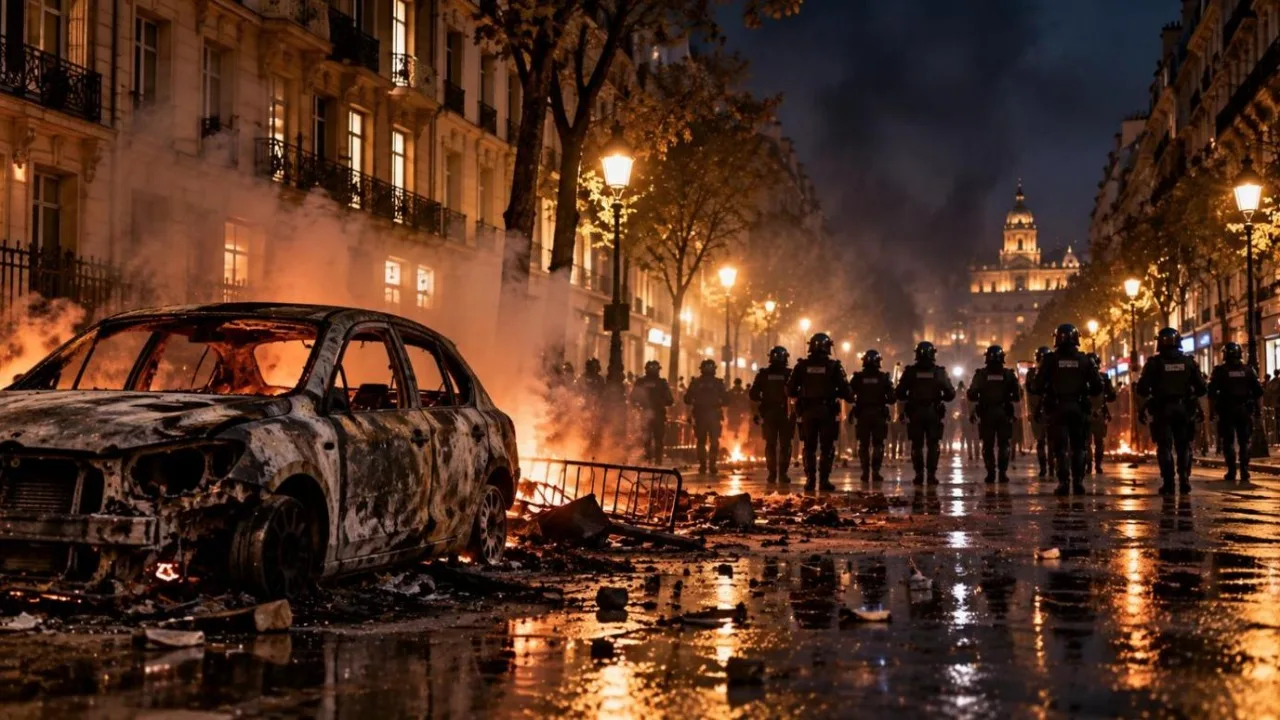
French authorities have tightened restrictions after the country's worst unrest in years. Paris police banned street gatherings around key landmarks, and curfews were renewed for a third night on 21 October 2026 in Paris, Lyon and other cities, according to Rio Times and AFP. This follows our earlier report on what is happening in France.
Protest ban in central Paris
The Paris Police Prefecture banned gatherings from 8am to 8pm in a zone including the Élysée Palace, the National Assembly, the Senate, the Champs-Élysées, Place Vendôme, Bastille, Châtelet-Les Halles and six main railway stations. Reports differ on whether the ban applies on Thursday 22 or Friday 23 October. A student march to Bastille was banned; organisers Interfac IDF are challenging it in court, saying: "We will not let this happen."
No state of emergency has been declared. In Marseille, the curfew covers only unaccompanied minors.
Scale of the unrest
- A cost-of-living protest on 17 October turned into riots and looting in several cities.
- Sunday's demonstrations drew more than half a million people nationwide, after four weeks of student protests that closed many schools, according to AFP.
- Justice Minister Gérald Darmanin said 2,500 people had been taken into custody, 174 jailed and 917 formally prosecuted.
- Italy has sent 500 troops to Milan to contain violence there, and Belgium has seen smaller unrest.
Macron hits back
Speaking in Doha during a Gulf tour, President Emmanuel Macron criticised "leaders who are in campaign mode" for exploiting the riots, without naming anyone. US President Donald Trump had blamed "migrants, jihadists, and communists" and praised far-right leader Marine Le Pen, while Israeli Prime Minister Benjamin Netanyahu spoke of an "invasion of extremist Islam." Analysts quoted by AFP dismissed claims that migrants drove the protests.
On the same tour, Macron secured about 295,000 tonnes a month of extra diesel from Saudi Arabia, the UAE and Bahrain, just over 10% of French consumption, according to Al Jazeera, as fuel prices drive public anger.
Markets and politics
France's 10-year government bond yield passed 5% on Wednesday, and Moody's is expected to downgrade French debt on Friday, according to AFP. Read our report on how the protests rattled French markets. An Ifop poll puts Le Pen well ahead in the first round of the presidential election, about six months away.
What happens next
Prime Minister Sébastien Lecornu was due to meet the mayors of Paris, Marseille and Lyon on Thursday. A "Yellow Vest Act II" march is planned for Saturday 24 October, and unions have called a strike and nationwide demonstrations for 5 November. Travellers can find practical advice in our guide to Paris curfews and metro closures.