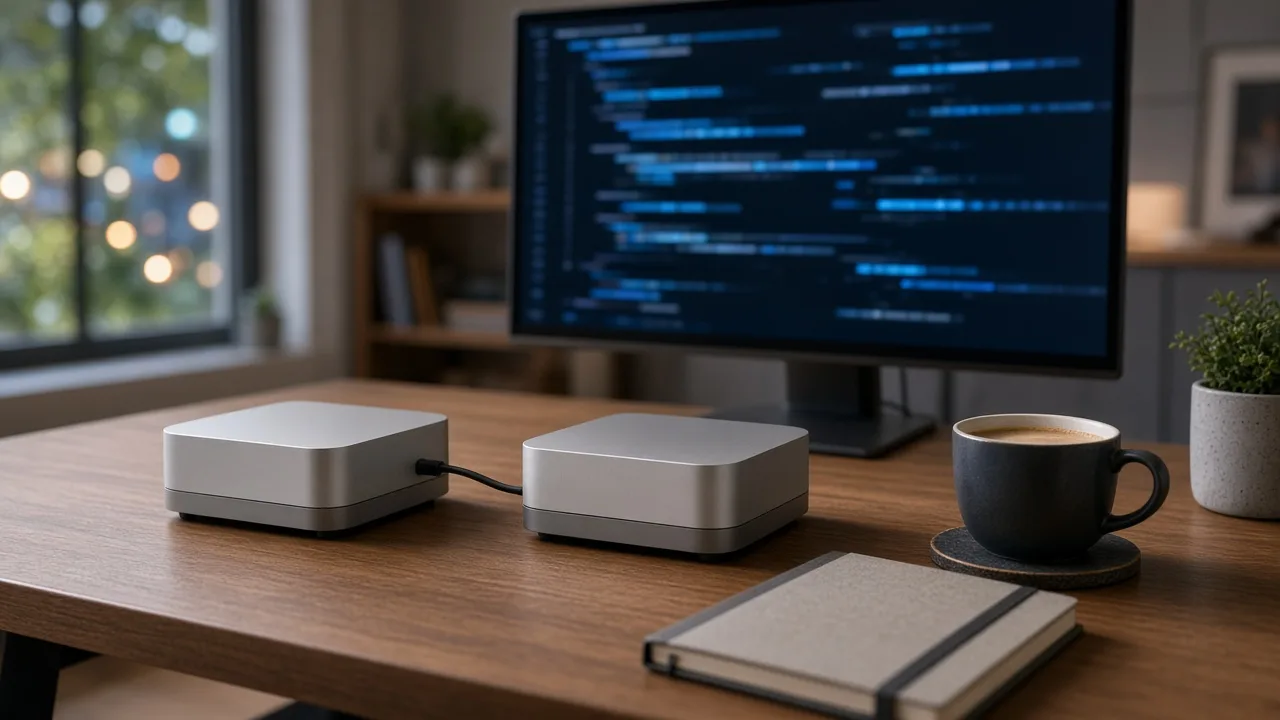
Meta has released the weights of Muse Spark Open, a large artificial intelligence model that the company calls "the most capable US open-weight model to date." Announced on 15 October 2026, the model is built for coding and so-called agentic work, where an AI carries out multi-step tasks on its own. Unusually for a model of its size, Meta and Apple have also made it run on a desk: two Apple Mac Studio computers with the M5 Ultra chip are enough to hold the whole thing.
Here is what Meta released, what it takes to run it, and why it matters.
What Meta announced
According to Meta's research blog, Muse Spark Open is a natively multimodal model with 816 billion total parameters, of which 42 billion are active at any one time. It has a context window of 1 million tokens, which means it can take in very long documents or large codebases in a single prompt.
Meta says the model "excels at long-horizon tasks, complex software engineering, and multi-step reasoning." In its launch post, the company said it paired the model with Muse Code, its AI coding tool, and used it to ship real changes to Ice Cubes, an open-source Mastodon app for iOS, including bug fixes, new features and a full build. Meta also showed it driving the DaVinci Resolve video editor, reviewing footage frame by frame and cropping clips to a vertical format.
TechCrunch noted that Meta's benchmark results claim better performance than other popular open-weight models. Those results come from Meta itself and have not yet been independently reproduced.
What "open-weight" means
An open-weight model is one where the trained model files can be downloaded and run by anyone with the hardware. That is different from closed models such as those behind most chatbots, which can only be reached through the company's own apps or paid API.
Open weights let companies run AI on their own servers, keep data in-house, fine-tune the model for their needs and avoid per-request fees. TechCrunch points out that they can be more cost-efficient and offer more transparency and flexibility than closed models.
Meta is releasing Muse Spark Open under its own Muse Model License, which it describes as having "limited commercial terms" that "allow many developers to use the model for free." This is not a standard open-source licence, so businesses should read the terms before building products on it.
Running a frontier-scale model on a desk
The headline feature is local use on Apple hardware. Meta says Muse Spark Open is "the first model in its class to run on your desktop using two Apple M5 Ultra Mac Studios" with Apple's MLX framework.
The reason is memory. Meta explains that Apple's unified memory lets the M5 Ultra's graphics processor use up to 512 GB per Mac Studio, so two machines together have about a terabyte, enough to hold the full model. The chip's memory bandwidth of 1.2 TB per second, Meta says, is fast enough to read the small part of the model each token needs. TechCrunch, citing Engadget, put the requirement at "at least 1 terabyte of RAM."
That makes this a workstation setup, not something for an ordinary laptop. Two top-end Mac Studios are a serious investment. For most developers and companies, the practical way to use the model will be through the cloud.
Where else it runs
Meta says the model is available through API providers including Baseten, Fireworks AI, Groq, Modal, Nebius, OpenRouter and Together AI. The weights can be downloaded from Hugging Face, Amazon SageMaker AI, Google Cloud Model Garden and Microsoft Foundry Models.
It also works with common inference software such as vLLM, SGLang, TensorRT-LLM, llama.cpp and Hugging Face Transformers, with optimisations for AMD, Apple, Intel and Nvidia chips. Meta says custom GPU kernels shipped with the model deliver kernel-level speed-ups of 1.03 to 3.95 times on Nvidia and AMD GPUs.
Safety checks
Releasing powerful weights publicly carries risks, because anyone can modify a downloaded model. Meta says Muse Spark Open received "additional safety post-training" for that reason and was evaluated under its Meta Superintelligence Scaling Framework, where it "met the thresholds our framework requires for release." The company says detailed results are in the model card, with a full evaluation report "available soon."
Outside researchers have not yet published their own assessments, so these safety claims should be treated as Meta's own view for now.
Why it matters
For developers: A very large, coding-focused model with a 1-million-token context is now available to download. Teams that cannot send code to outside services for privacy or compliance reasons get another option to run AI on their own machines.
For Apple: The launch is a strong showcase for the Mac Studio as an AI machine. Apple's unified memory is the key reason two desktops can hold a model this large. Local AI hardware is becoming a competitive field, as we saw with AMD's Ryzen AI Halo and its 192GB of memory.
For the AI race: Muse Spark Open lands as closed models keep improving, such as Google's Gemini 4 "Argon". An open model that companies can run cheaply on their own hardware puts pressure on the pricing of closed rivals, a theme also behind efforts to cut AI running costs like Microsoft's Maia 300 chip.
What to watch next
The key questions now are how the model performs in independent tests, how the Muse Model License works in practice for larger companies, and what Meta's full safety evaluation report shows when it is published. Developers will also be watching for smaller versions that could run on more affordable hardware.
FAQ
What is Muse Spark Open? An open-weight, multimodal AI model from Meta with 816 billion total parameters (42 billion active) and a 1-million-token context window, built for coding and agentic tasks.
Can I run it on my laptop? Not realistically. Meta says it needs two Mac Studios with the M5 Ultra chip, giving about 1 TB of combined memory. Most people will use it through cloud API providers.
Is it free? The weights are downloadable under Meta's Muse Model License, which Meta says has limited commercial terms that let many developers use it for free. Check the licence before commercial use.