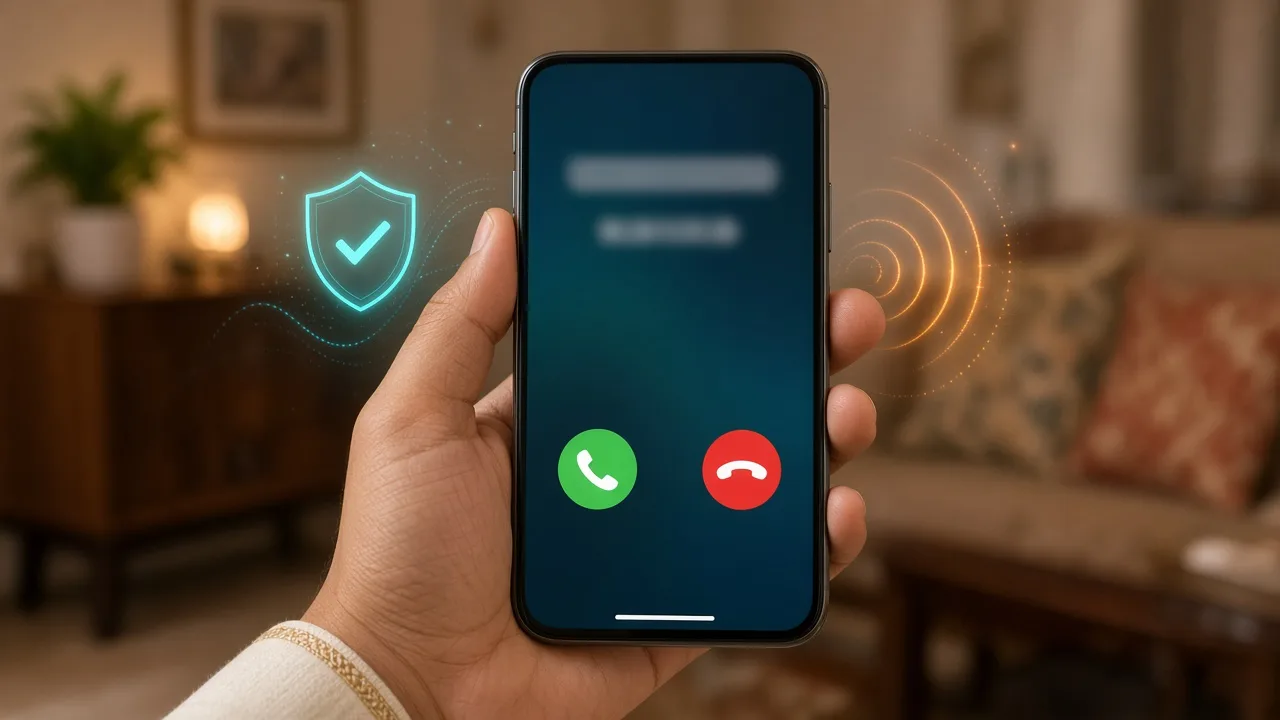
Calls from unknown numbers are about to come with a name attached. The Department of Telecommunications (DoT) has directed all access telecom operators to introduce Calling Name Presentation (CNAP) across their service areas from November 1, 2026. A call from a number you have not saved will then show the caller's name, as recorded by their operator, alongside the number.
The instruction comes in DoT Circular No. 01/Licensing Policy/2026, dated October 13, 2026. It applies to every operator holding an access service licence or authorisation, which covers Reliance Jio, Bharti Airtel, Vodafone Idea (Vi) and BSNL.
What changes on November 1
The caller identification shown on the receiving phone will now have two fields: the number, as today, and a name, chosen in this order:
- If you have saved the number, your phone shows the name in your contact list, as it does now.
- If the number is not saved and the call is domestic, you see the caller's "calling name identity", which is the name in the originating operator's subscriber records.
- If the call is international, the screen shows the words "International Call" instead of a name.
Operators must provide the service "without the requirement of any separate request" from users. In other words, it is on by default.
How CNAP works
CNAP is a network feature, not an app. Each operator must maintain a database mapping its subscribers' numbers to their names, which the receiving operator queries when a call arrives. The name comes from the subscriber records created when the connection was taken, the KYC details collected at SIM purchase.
Which networks and phones are covered
The November 1 mandate applies to wireless networks built on 4G and newer technologies, including 5G. The circular says CNAP on 2G and 3G networks and on public switched telephone networks (traditional landlines) "shall be considered separately, after examination."
So users of 2G feature phones may not see names for now. Display also depends on handset support, an issue DoT said in 2025 it would take up with the Ministry of Electronics and IT (MeitY).
Where operators stand
Operators began pilots in late 2025, with Haryana among the first circles. DoT told TRAI in October 2025 that 4G-and-above trials had been "conducted successfully", though no detailed pilot figures have been published.
Jio, Airtel and Vi have since switched the feature on for many customers, while BSNL was still integrating with private networks earlier this year, ETTelecom reported. Calls between different operators have been the trickiest part. November 1 makes CNAP a formal obligation for every operator in every service area.
What users need to do
For most people, nothing. CNAP is switched on by default, needs no app and works without mobile data. Some practical points:
- Check your registered name. Operators must handle CNAP complaints through a time-bound grievance process.
- Keep your phone software updated, as handset support matters.
- Businesses can apply for a "preferred name", a registered trademark or GST-registered trade name, on business or bulk connections, subject to operator verification.
Privacy safeguards and exceptions
Operators must follow a "security-by-design" approach in which the lookup system itself ensures the caller's name is not retained after the call ends. Users who have taken the Calling Line Identification Restriction (CLIR) facility will not have their names displayed.
On opting out, DoT told TRAI in 2025 that a recipient who does not want the service "may request to disable it as per procedure," and TRAI noted that view. The October 13 circular does not spell out an opt-out process, so users should check with their operator.
Concerns remain: your name now reaches anyone you call, and the KYC name may not match the actual user, as with a SIM taken in a relative's name.
CNAP vs Truecaller
Truecaller relies largely on crowdsourced data, so names can be inaccurate, and it needs an app and internet access. CNAP uses operator KYC records at the network level. But Truecaller offers spam scores, community reports and blocking, which CNAP does not. CNAP tells you whose name a number is registered in, not whether the call is a scam.
How it helps against spam and fraud
DoT says CNAP aims to help users make informed decisions about calls, including possible spam or fraud. A verified name makes it harder to pose as a bank or official from an ordinary mobile number, though SIMs obtained in someone else's name remain a loophole.
FAQ
Is CNAP mandatory from November 1, 2026?
Yes, on 4G and 5G networks, for all access operators.
Will it work on my feature phone or landline?
Not yet. 2G, 3G and landline networks will be considered separately.
Can I hide my name?
Names of CLIR users are not shown. Check with your operator.
Do I need Truecaller now?
CNAP gives a verified name. Apps add spam tags and blocking, so many may keep both.
Sources
- DoT Circular No. 01/Licensing Policy/2026 on calling name presentation (October 13, 2026)
- TRAI response to DoT back-reference on CNAP (October 28, 2025)
- Business Standard: Govt mandates caller name display from Nov 1
- Mint: Incoming calls to show caller names from November 1
- The Economic Times: Telcos begin pilot runs of CNAP in one circle
- ETTelecom: BSNL's caller name presentation service may launch in 3-4 months
- Times of India: What is CNAP and how it differs from Truecaller