As of 9:00 AM IST, Monday 26 October 2026. ISRO Chairman V. Narayanan made these remarks at a university graduation ceremony in Chennai on Saturday, 24 October; PTI's report was published on Sunday, 25 October. Based on PTI copy carried by The Hindu and Hindustan Times, with coverage from Mint and The Times of India. ISRO has not yet published a detailed plan, cost or timeline for each new pad.
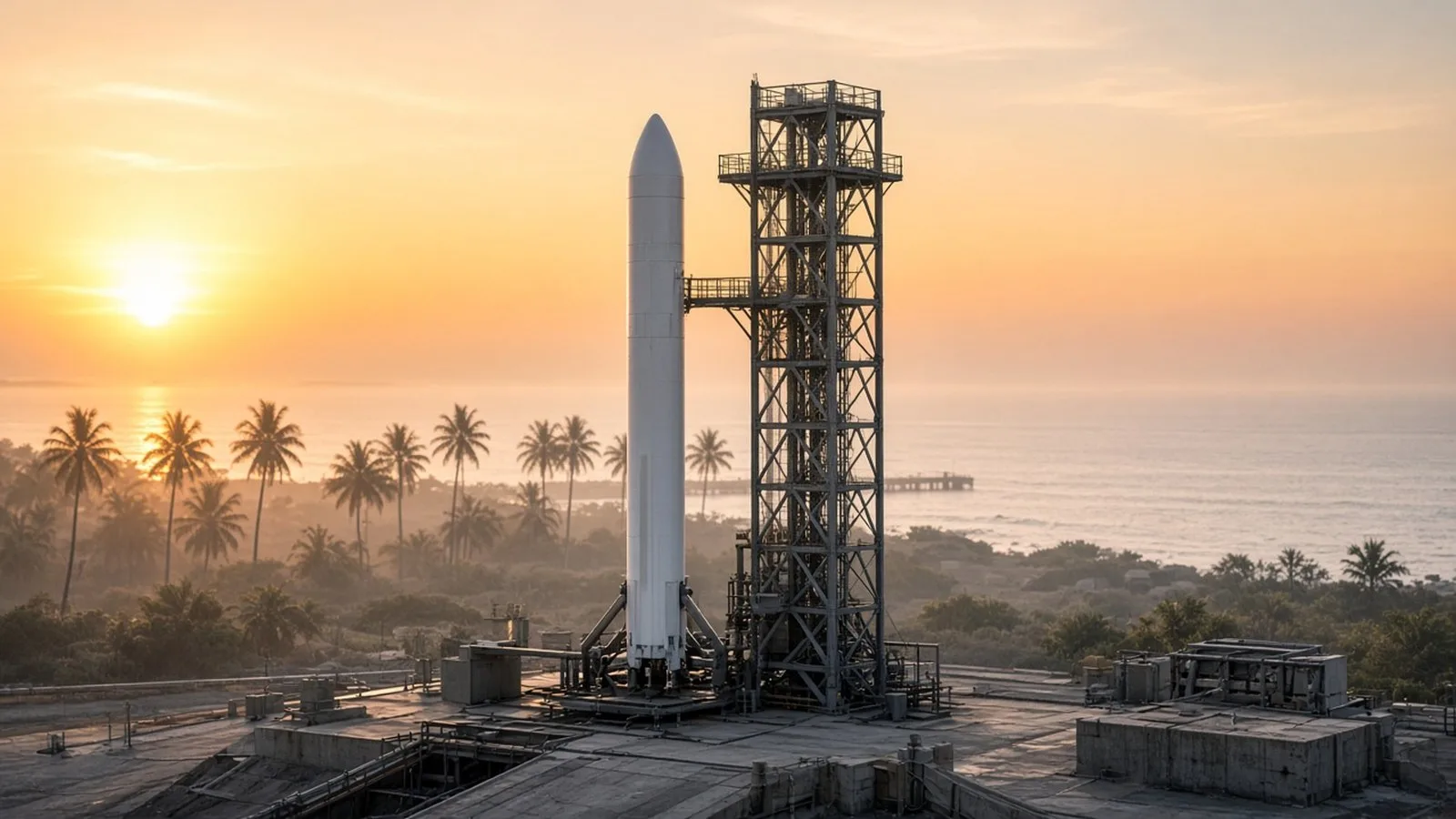
India will have four functional launch pads by 2029, ISRO Chairman V. Narayanan has said, as the space agency gets ready for a sharp rise in satellite launches and leans more on private industry. He also said the first uncrewed Gaganyaan test flight is planned within the next two months.
The key points
- Four pads by 2029: "India will expand its space operations significantly with four functional launch pads by 2029, supported by an increasing reliance on private industry partnerships to handle commercial operations," Narayanan said, according to PTI.
- A new SSLV spaceport: a 2,000-acre complex dedicated to the Small Satellite Launch Vehicle (SSLV) is coming up at Kulasekarapattinam in Thoothukudi (Tuticorin) district, Tamil Nadu.
- Gaganyaan tests: the first uncrewed test within two months, followed by two more uncrewed tests before India's first crewed mission.
- Not being privatised: Narayanan said ISRO will not be privatised, but partnering with private firms is essential.
- Chandrayaan-5: a joint lunar mission with Japan's space agency, with a 350-kg rover designed for 100 days of surface experiments.
What will be at Kulasekarapattinam
According to Narayanan, the Kulasekarapattinam facility will have integration buildings, launch pads, rail-track systems, and telemetry, tracking and command systems. Its purpose, he said, is to meet global demand for launching small satellites.
India's orbital launches currently take place from the Satish Dhawan Space Centre at Sriharikota in Andhra Pradesh. Hindustan Times noted that Narayanan did not say where the other three proposed pads would be, or how they split between existing and new sites. HorizonDesk will update this article if ISRO publishes those details.
Why a southern spaceport helps small rockets
Kulasekarapattinam sits near India's southern tip. Rockets launched south from there can reach polar orbits, which many small Earth-observation satellites use, without having to bend their path around Sri Lanka, as rockets from Sriharikota do. That manoeuvre costs fuel, and for a small rocket like the SSLV, fuel saved means more payload. This is the widely cited reason for choosing the site. Narayanan's remarks, as reported, focused on demand and infrastructure rather than orbital mechanics.
Gaganyaan: three uncrewed tests first
Narayanan said the uncrewed tests "will evaluate environmental control, safety systems, crew escape mechanisms, and module interiors under varying pressure, temperature, and humidity conditions." ISRO has run about 8,000 ground-based experiments for the mission, he said, and four astronaut-designates are in specialised training. He did not give a date for the crewed flight.
A bigger role for private industry
"To handle this expanding ecosystem, ISRO will handhold startups and private enterprises, transferring technological expertise to foster economic growth and generate thousands of high-tech jobs," Narayanan said. The comments point to a model in which ISRO keeps building national missions and capability, while private companies take on more commercial launch and satellite work.
Why it matters
- Launch capacity: more pads let India launch more often, which matters as satellite constellations need thousands of satellites.
- Commercial business: a dedicated small-satellite port could help Indian launchers win customers that now fly on foreign rockets.
- Jobs and suppliers: new spaceport and rocket work spreads demand to engineering firms and startups, especially in Tamil Nadu.
What to watch
- The date of the first uncrewed Gaganyaan test, which Narayanan placed within two months.
- The first launch from Kulasekarapattinam and any official list of the four pads.
- Further details on private-sector launch partnerships.
Related reading on HorizonDesk
- SpaceX, Starlink and the $2 trillion valuation debate
- SpaceX's Q3 numbers and the Tesla merger committees
- Apollo 11 and the space race
Sources
- The Hindu (PTI): ISRO to have four launch pads by 2029, says Narayanan (25 Oct 2026)
- Hindustan Times (PTI): ISRO plans four functional launch pads by 2029 (25 Oct 2026)
- Mint: ISRO to expand space ops, plans 4 launch pads by 2029; agency will not be privatised (25 Oct 2026)
- The Times of India: Four launch pads to be operational by 2029, says ISRO chairman Narayanan (25 Oct 2026)