Our newsroom is spread across three time zones, and we publish every day. When people ask how, they expect to hear about tools. The honest answer is that tools matter much less than habits. Every remote team has chat, video calls and a task board. The ones that ship consistently share a handful of behaviours that have nothing to do with which app they picked.
Write things down by default
In an office, context travels through overheard conversations and quick desk visits. Remotely, anything not written down effectively doesn't exist for half the team. The fix is a strong default towards writing.
Decision documents
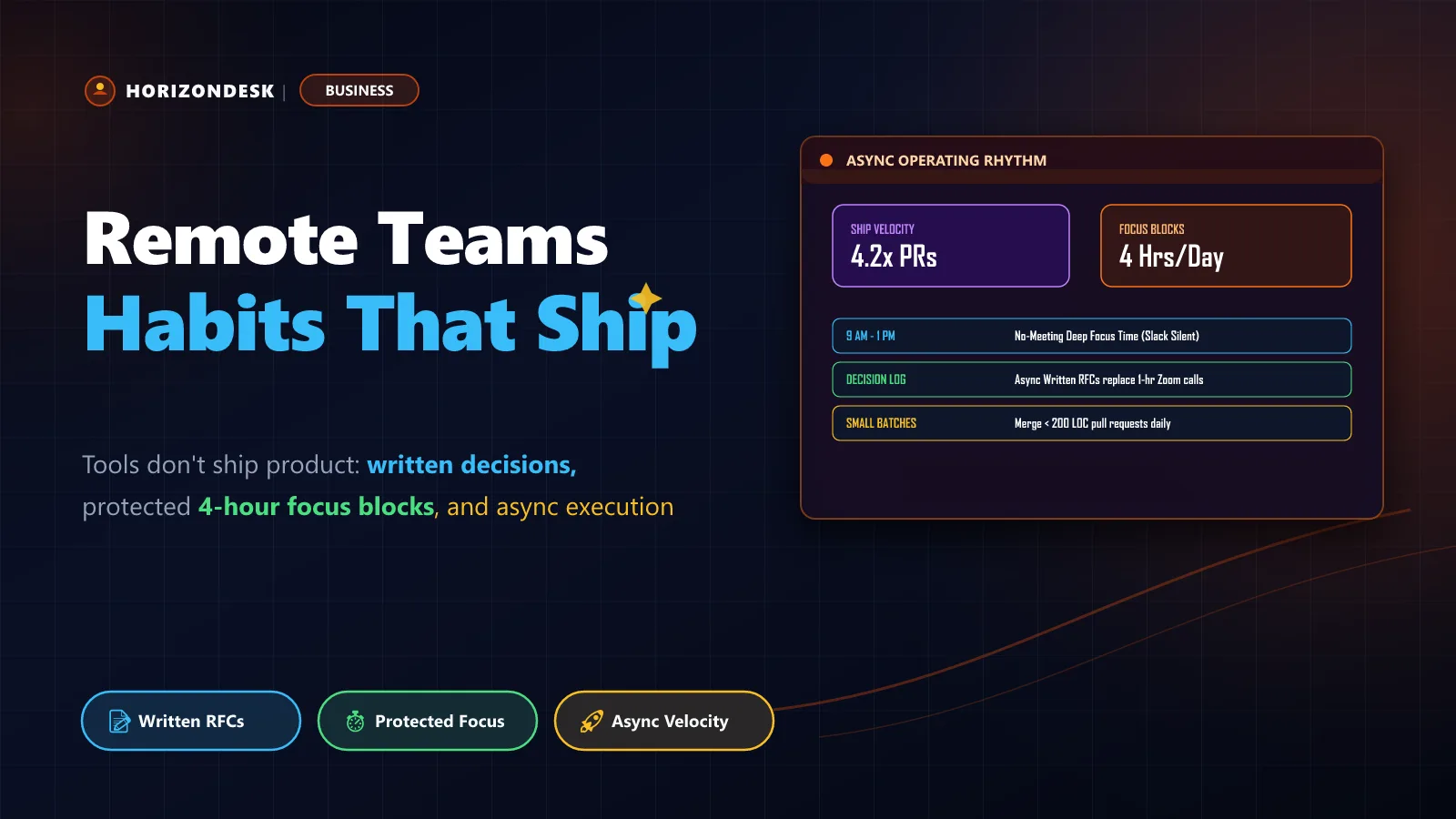
For any decision that affects more than one person, write a one-page note: the problem, the options considered, the decision, who owns it and when it will be reviewed. It takes fifteen minutes and saves hours of "wait, why did we do this?" later. New hires can read the history of a project instead of interrupting someone to ask.
Async status updates
Replace the daily status meeting with a short written update posted at the start of each person's day: what I finished, what I'm working on, where I'm blocked. Managers read them in five minutes. Meetings are then reserved for the things that genuinely need conversation.
Protect overlap hours, then protect focus
Distributed teams need some shared time. Two to four hours of overlap a day is usually enough, as long as it's used well. Put collaborative work — meetings, pairing, quick calls to unblock someone — inside that window, and treat the rest of the day as focus time.
That means a few explicit agreements:
- No expectation of instant replies outside overlap hours.
- Status settings and notifications that actually reflect when people are working.
- A clear way to escalate a genuine emergency, so nobody feels obliged to watch chat all day "just in case".
Remote teams don't fail from lack of communication. They fail from too much of the wrong kind.
Make work small and visible
Large pieces of work disappear for weeks and come back as surprises. Small pieces move quickly, get feedback early and make progress obvious to everyone. Here's how the same habits look in weak and strong teams:
| Habit | Weak version | Strong version |
|---|---|---|
| Task size | "Build the new dashboard" for a month | Pieces that ship in one to three days |
| Code and content review | Waits until someone has time | Reviewed within one working day |
| Progress | Reported in meetings | Visible on the board and in a weekly demo |
| Decisions | Made in calls, remembered differently | Recorded in a short decision doc |
| Blockers | Mentioned at the next stand-up | Raised in writing the moment they appear |
A weekly demo is particularly powerful. Fifteen minutes where people show what they shipped — a feature, an article, a dashboard — builds momentum and gives everyone a reason to finish things rather than keep them perpetually "nearly done".
Trust outcomes, not activity
The fastest way to wreck a remote team is to manage activity: tracking green status dots, counting messages or, worse, monitoring screens. People respond by performing busyness instead of doing good work.
Manage outcomes instead. Agree what each person or squad is responsible for this quarter, review progress weekly, and step in when results slip — not when someone was offline for an afternoon. Pair that with regular one-to-ones, which matter even more remotely because there are no hallway moments to notice when someone is struggling.
Onboarding sets the tone
Give every new hire a buddy, a written guide to how the team works, and a small real task to ship in the first week. Their first impression of the culture becomes the culture they reproduce.
None of this requires new software. It requires deciding how you work together, writing it down, and holding each other to it. The tools are just where those habits happen to live.