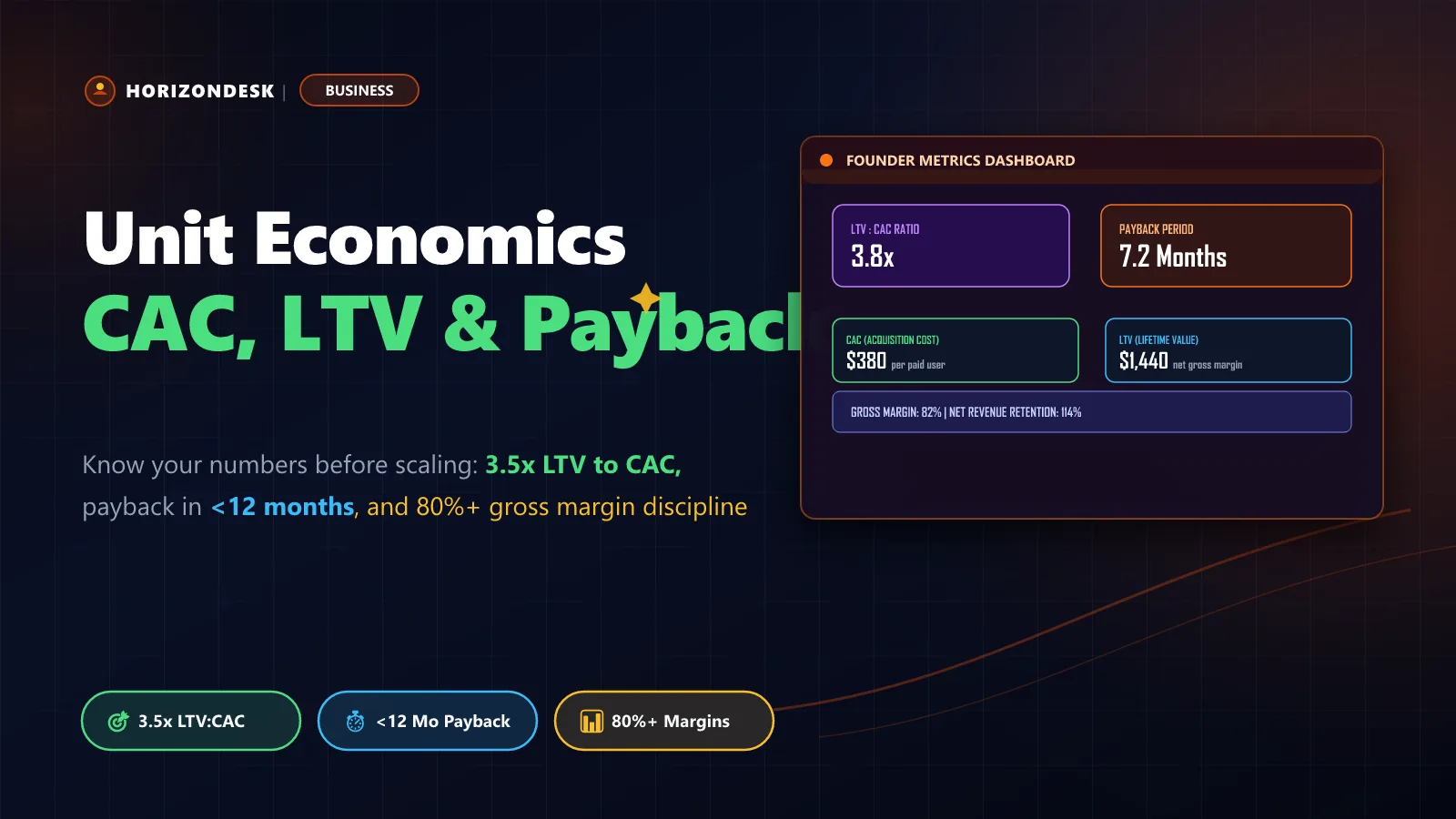
Every startup that ran out of money while growing quickly made the same mistake: it scaled before it understood its unit economics. More customers felt like progress, but each one cost more to win than it would ever pay back. Growth simply multiplied the losses.
Unit economics answer a simple question: when you win one more customer, do you make money or lose it — and how long does it take to find out? You need five numbers to answer it, and none of them requires a finance degree.
The five numbers
1. Customer acquisition cost (CAC)
Total sales and marketing spend in a period divided by new customers won in that period. Use the fully loaded figure: ad spend, tools, agencies and the salaries of people whose job is acquiring customers. If you spent $12,000 last month and signed 30 customers, your CAC is $400.
2. Average revenue per account (ARPA)
Monthly recurring revenue divided by the number of paying customers. Use what customers actually pay after discounts, not list price. For our example, say $50 a month.
3. Gross margin
The share of revenue left after the direct costs of serving customers: hosting, third-party APIs, payment processing and customer support. Software businesses often run at 70–85%. We'll use 80%, so each customer contributes $40 a month.
4. Churn and lifetime value (LTV)
Monthly churn is the percentage of customers who cancel each month. With 3% churn, the average customer stays about 33 months. Lifetime value is then:
LTV = ARPA × gross margin ÷ monthly churn = $50 × 0.80 ÷ 0.03 ≈ $1,333
5. CAC payback period
How many months of gross profit it takes to recover the cost of acquiring a customer:
Payback = CAC ÷ (ARPA × gross margin) = $400 ÷ $40 = 10 months
Putting it together
Here are the same calculations for two illustrative businesses — a global SaaS product priced in dollars and an Indian subscription business priced in rupees:
| Metric | Example A: SaaS ($) | Example B: subscription (₹) |
|---|---|---|
| CAC | $400 | ₹12,000 |
| ARPA (monthly) | $50 | ₹2,000 |
| Gross margin | 80% | 75% |
| Monthly churn | 3% | 4% |
| LTV | ≈ $1,333 | ₹37,500 |
| LTV : CAC | 3.3 : 1 | 3.1 : 1 |
| Payback period | 10 months | 8 months |
Both businesses are in reasonable shape. Widely used rules of thumb for subscription businesses suggest an LTV to CAC ratio of at least 3:1 and a payback period under 12 months for products sold to small businesses. Enterprise products can tolerate longer paybacks because their customers stay longer and expand more.
Growth multiplies whatever your unit economics already are — good or bad.
Traps that make the numbers lie
- Blended CAC. Averaging free word-of-mouth signups with paid ones hides the truth. If paid ads cost $900 per customer and referrals cost $50, the blended $400 tells you nothing about whether to increase ad spend. Track CAC by channel.
- Optimistic churn. Early customers are often your biggest fans. Their low churn won't hold as you reach less committed buyers. Measure churn by monthly cohort, and cap LTV at three to five years rather than assuming customers stay forever.
- Revenue instead of margin. Calculating LTV on revenue rather than gross profit inflates it by 20–30% or more. You can't spend revenue you pay straight back to your suppliers.
- Ignoring discounts and refunds. A heavy launch discount can make ARPA look healthy on paper while actual collections lag well behind.
Build the model this week
- Pull the last six months of sales and marketing spend, including salaries.
- Count new customers per month, by acquisition channel.
- Calculate ARPA from what customers actually paid.
- Estimate gross margin from hosting, tools, payment fees and support costs.
- Measure churn by monthly cohort, then calculate LTV, LTV:CAC and payback.
The first version will be rough, and that's fine. What matters is that you'll know which way the numbers are moving — and whether the next marketing rupee or dollar you spend is an investment or a donation.