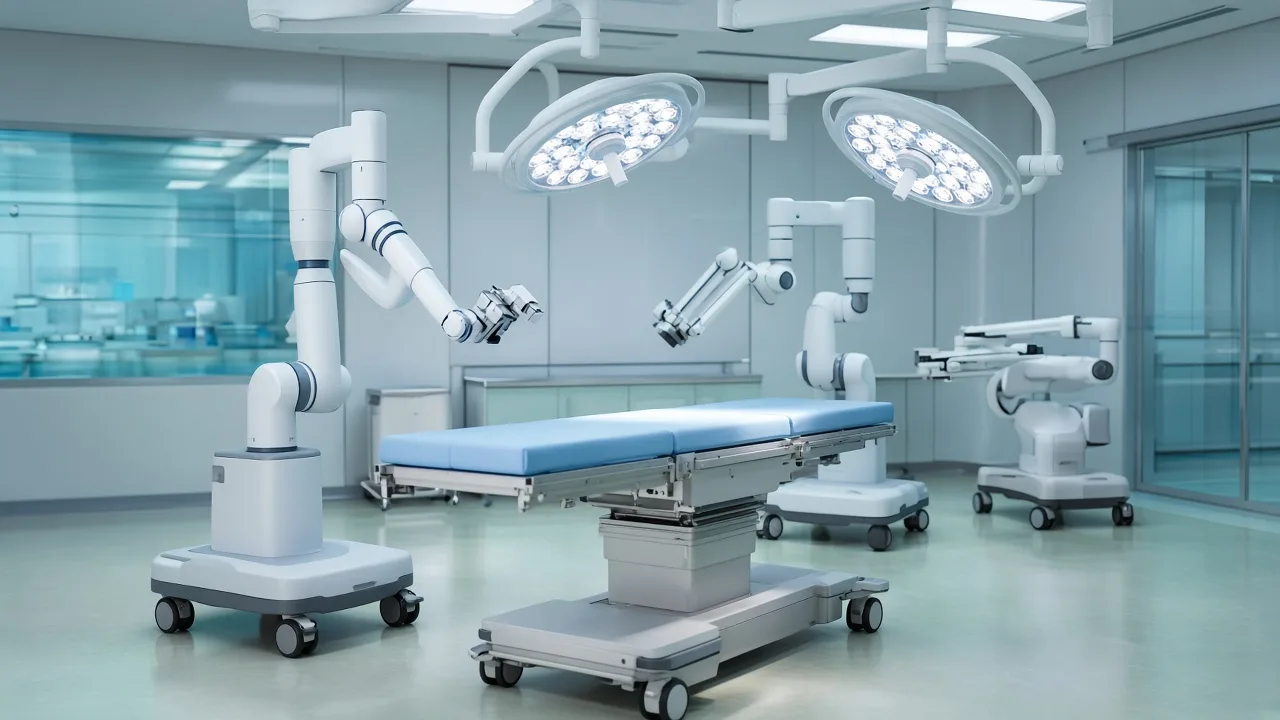
The global race in surgical robotics just gained a heavyweight new entrant. On October 12, 2026, US medical technology giant Stryker and Cambridge-based CMR Surgical announced a strategic alliance built around CMR's Versius surgical robot. Stryker will invest roughly $400 million (£300 million) in CMR through preferred equity, gets an exclusive option to buy the whole company later, and becomes the exclusive US sales agent for the Versius portfolio.
For a sector long dominated by a single type of large robotic system, the deal signals that big established players now see soft-tissue robotics as too important to sit out.
The deal in brief
- Investment: about $400 million (£300 million) of preferred equity from Stryker into CMR Surgical, to support innovation and global commercialisation of Versius.
- Acquisition option: an exclusive option for Stryker to acquire 100% of CMR's outstanding equity in the future, subject to the agreement's terms.
- Distribution split: Stryker becomes the exclusive US sales agent; CMR keeps leading product development and commercialisation outside the United States.
- Governance: Stryker's Andy Pierce, Group President of Medsurg and Neurotechnology, will join CMR's board.
- Conditions: the transaction is subject to regulatory approvals and customary closing conditions.
Who are the two companies?
Stryker describes itself as a global leader in medical technologies, with products in MedSurg, Neurotechnology and Orthopaedics, and says it impacts more than 150 million patients a year. It already has a strong position in orthopaedic robotics, but soft-tissue procedures, such as general, gynaecological and urological surgery, have been a gap.
CMR Surgical was founded in 2014 and is headquartered in Cambridge, UK. Its mission, in its own words, is to make robotic minimal access surgery "universally accessible and affordable." Its Versius platform uses a modular design intended to fit into existing operating rooms and move between procedures and sites of care.
What the executives said
"Soft-tissue robotics is a high-growth adjacency and a natural extension of Stryker's strengths in endoscopy, visualization and enabling technologies," said Andy Pierce. "We have evaluated the segment carefully for years, and this alliance represents a thoughtful and disciplined entry that combines the complementary strengths of both companies."
CMR chief executive Massimiliano Colella called it "a significant milestone for CMR and a strong endorsement of the technology, clinical experience and global business we have built," adding that Stryker's scale "create[s] a significant growth opportunity in the United States."
Why the structure is interesting
Rather than buying CMR outright, Stryker chose an "invest now, option to buy later" model. That structure is worth understanding for any business leader:
- It limits upfront risk. Stryker can test commercial traction in the US before committing to a full acquisition.
- It gives the start-up capital and reach. CMR gets funding plus access to Stryker's hospital relationships, the hardest thing for a young device maker to build.
- It keeps local expertise in place. CMR continues to run development and international sales, preserving the team that built the product.
Similar option-based partnerships are common in pharmaceuticals and increasingly in medtech, where regulatory and adoption risks make all-at-once acquisitions expensive bets.
Why it matters globally
Competition could widen access
Robotic-assisted surgery has historically required large capital outlays, which put it out of reach for many hospitals, especially in lower-resource settings. The companies say demand keeps growing and pitch Versius as a "scalable and practical solution" that can help health systems expand robotic programmes while preserving "long-term program economics." More credible competitors generally mean more pricing pressure and more choice for hospitals worldwide.
Ambulatory surgery centres are the next frontier
Stryker specifically mentioned growing adoption "in hospitals and ASCs," meaning ambulatory surgery centres. The shift of procedures to smaller outpatient sites is a global trend, and compact, modular robots are designed with that in mind.
European innovation, global scale
The deal is also an example of a pattern seen across deep tech: a European start-up develops a novel platform, then partners with a larger global company to scale in the world's biggest healthcare market.
A signal to investors and founders
For start-ups in capital-intensive hardware, the deal is a reminder that partnering with an incumbent can be a route to scale that falls between an IPO and an outright sale. CMR keeps its independence for now, gets money and a powerful sales channel, and its backers keep the possibility of a full exit later. For incumbents, it is a way to enter a new segment without building a product from scratch.
What to watch next
- Regulatory approvals needed for the investment to close.
- US uptake: how quickly Stryker's sales force places Versius systems in hospitals and outpatient centres.
- The option: whether, and when, Stryker exercises its right to acquire all of CMR, and at what valuation.
- Rival responses: how other medtech groups react as the soft-tissue robotics market becomes more crowded.
The bottom line
Stryker's carefully staged bet on CMR Surgical shows how established companies are entering fast-growing technology markets: buy a stake, use your distribution muscle, and keep the option to own the whole thing. For hospitals and patients worldwide, the bigger story is competition in surgical robotics, which could make the technology more affordable and widespread.