Fund fees are quoted as tiny percentages, and that's exactly why they're easy to ignore. A 0.2% expense ratio and a 1.5% expense ratio both look like rounding errors next to the double-digit returns in a fund's brochure. But fees are charged every year, on your whole balance, whether the fund does well or badly. Over a working life, they compound just as relentlessly as your returns do.
Fees are also the one part of investing you fully control. You can't control what the market does next year. You can control what you pay for exposure to it.
What you're actually paying for
An index fund buys every stock in a benchmark — the Nifty 50, the S&P 500, a total-market index — in the same proportions. There's no stock picking, so costs are low. Its goal isn't to beat the market; it's to match it as closely as possible. The gap between the fund and its index is called tracking error, and in a good fund it's small.
An active fund employs a manager and research team to pick stocks they believe will outperform. That work costs money, so expense ratios are higher. In India, active funds also come in two versions: regular plans, which include a distributor commission, and direct plans, which don't and are therefore cheaper for the same portfolio.
The 20-year cost of a small percentage
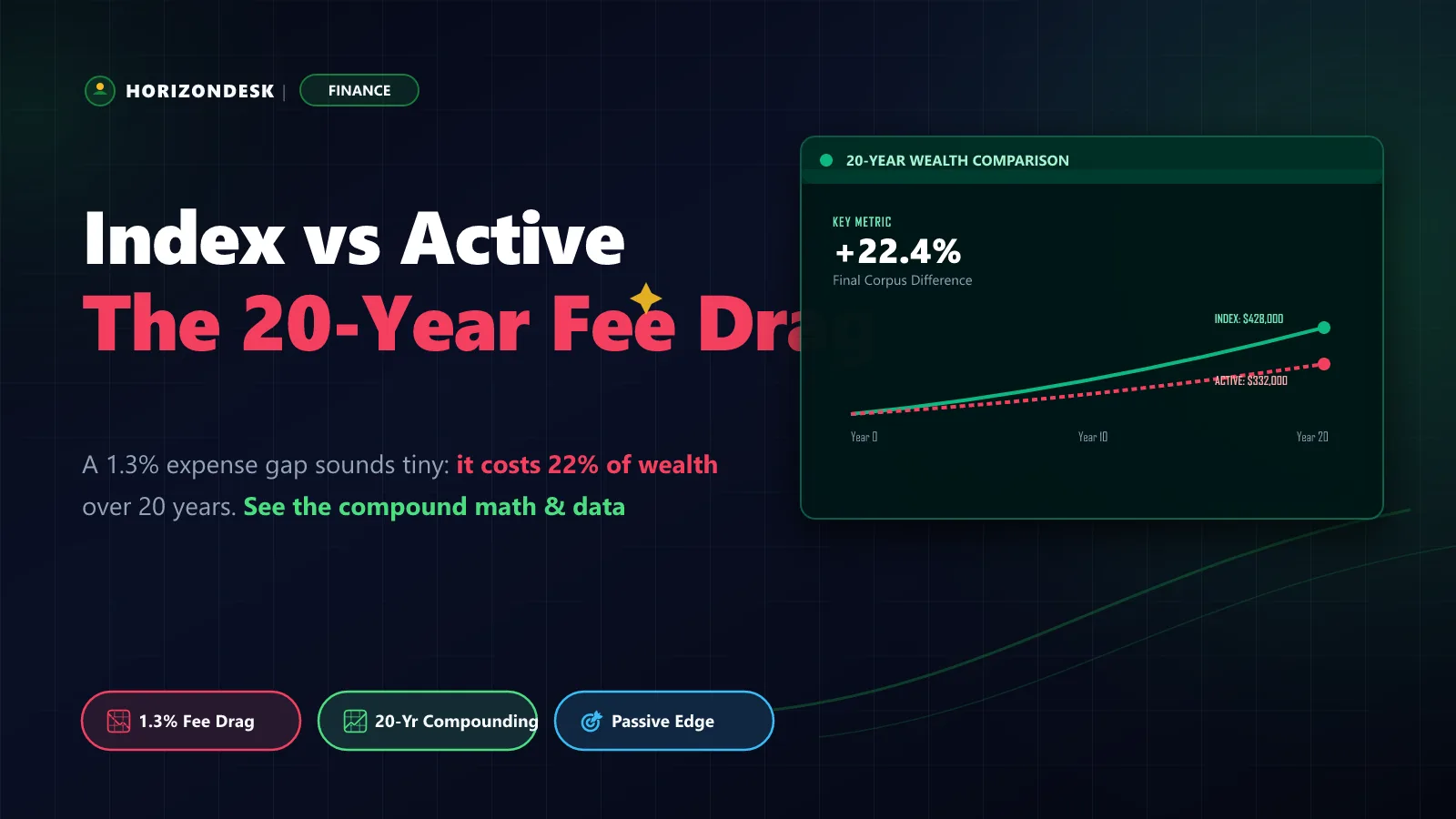
Let's take an illustrative example. You invest ₹10,00,000 (or $10,000 — the multiples are the same) once and leave it for 20 years. Assume all three funds earn the same 12% a year before costs, and only the fee differs:
| Fund type | Annual cost | Net return | Value after 20 years | Same on $10,000 |
|---|---|---|---|---|
| Index fund | 0.2% | 11.8% | ≈ ₹93.1 lakh | ≈ $93,100 |
| Active fund, direct plan | 0.8% | 11.2% | ≈ ₹83.6 lakh | ≈ $83,600 |
| Active fund, regular plan | 1.5% | 10.5% | ≈ ₹73.7 lakh | ≈ $73,700 |
Same market, same starting amount, and the difference between the first and last rows is almost ₹20 lakh. That's roughly a fifth of the final value, paid away for a portfolio that — in this example — did no better before costs. With monthly SIPs instead of one lump sum, the absolute numbers change but the pattern doesn't.
You don't need to find the best fund. You need to avoid paying for performance you don't get.
Can active funds earn their fee?
Some do, and it would be wrong to dismiss active management entirely. But to justify its fee, an active fund has to beat its benchmark by more than the cost difference, consistently, over many years. Long-running studies of fund performance across several countries have repeatedly found that a majority of active funds fall short of their benchmark over 10-year and longer periods, and that last year's winners rarely stay at the top.
The odds vary by segment:
- Large-cap stocks are heavily researched, so information advantages are rare. Index funds are hard to beat here.
- Mid- and small-cap stocks are less covered, which gives skilled managers more room — though volatility and fees are higher too.
- Specialised strategies may have no cheap index equivalent at all.
A simple way to decide
Use a core-and-satellite approach
Put the core of your portfolio, say 70–80%, into low-cost broad-market index funds. Use the remaining 20–30% for active funds where you have a genuine reason to believe a manager adds value. You get market returns on most of your money and room to back conviction on the rest.
Check the right numbers
- For index funds: expense ratio and tracking error. Between two funds on the same index, cheaper and tighter usually wins.
- For active funds: rolling 5- and 7-year returns against the benchmark, not just the past year's star rating.
- For both: prefer direct plans if you're comfortable choosing funds yourself.
Whichever route you choose, the habits matter more than the label: invest regularly, keep costs low, and don't switch funds every time a new one tops the charts. Fees compound quietly. So does patience.