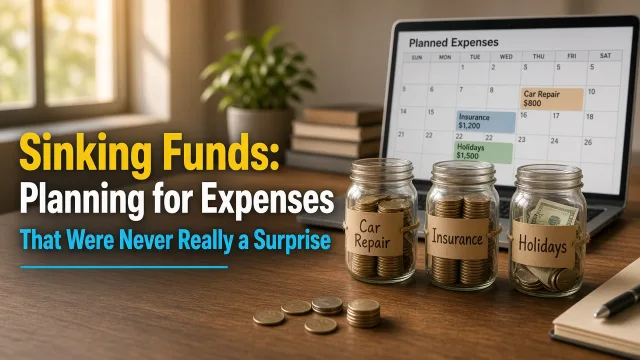
Every year, the same expenses seem to catch people off guard: an annual insurance premium, a child's school admission fee, a festival season of gifts and travel, a car service bill. None of these are actually surprises. They happen on a predictable schedule. The problem is not that they occur, it is that most budgets only plan for monthly expenses and treat anything annual or occasional as an emergency when it arrives.
The Expense That Keeps "Surprising" You
If an expense happens every year, every quarter, or even every couple of years, it belongs in your budget just as much as rent or groceries do. The trick is spreading its cost across the months in between, so that when the bill arrives, the money is already sitting there waiting, rather than having to be pulled from savings or a credit card.
Sinking Fund vs Emergency Fund: Not the Same Thing
These two get confused often, but they serve different purposes.
| Feature | Emergency Fund | Sinking Fund |
|---|---|---|
| Purpose | Unplanned, unpredictable events | Planned, predictable expenses |
| Examples | Job loss, medical emergency, urgent repair | Insurance renewal, annual fees, festival spending |
| Timing | Unknown | Known in advance |
| How much to hold | Several months of expenses | Exactly the cost of each specific goal |
An emergency fund protects you from the unexpected. A sinking fund protects your emergency fund from being raided every time something "expected but occasional" shows up.
How to Build a Sinking Fund
The process is simple arithmetic repeated for each category you want to plan for.
- List the occasional expenses you can see coming over the next twelve months, with their approximate cost.
- Divide each by the number of months until it is due. A ₹24,000 insurance premium due in eight months means setting aside ₹3,000 a month.
- Open a separate place to hold it, even if it is just a labelled sub-account, so the money is visible but not mixed with everyday spending.
- Automate a monthly transfer so the saving happens before you have a chance to spend that amount elsewhere.
A Worked Example
Say your occasional expenses for the year look like this: an annual vehicle insurance premium of ₹18,000, school admission-season costs of ₹40,000, and festival and gifting spending of ₹20,000. Spread evenly across twelve months, that is roughly ₹6,500 a month set aside in total, well before any of those bills actually arrive.
Where to Keep the Money
Because sinking fund money has a known due date, usually within a year, it does not need to chase high returns and should not sit somewhere volatile. A separate savings account or a short-duration liquid fund is usually enough. The priority is accessibility and stability, not growth, since the whole point is having the exact amount ready when the bill comes due.
How Many Sinking Funds Is Too Many
It is possible to overdo this. Splitting every irregular expense into its own named fund can turn budgeting into a spreadsheet exercise that eats more time than it saves. A practical middle ground is to group smaller, similar expenses together, such as combining gifts, celebrations, and minor annual subscriptions into one broad "occasional expenses" fund, while keeping genuinely large or important items, like an insurance renewal or school fees, as their own separate line. The goal is to remove financial surprises, not to create a second full-time bookkeeping job.
A sinking fund turns a once-a-year shock into twelve small, forgettable transfers.
Next Steps
List every expense you paid last year that was not monthly but was not truly unexpected either. Total them up, divide by twelve, and set up one automatic transfer for that combined amount into a separate account this week. The next time one of these bills arrives, it will feel like nothing at all.