Founders will spend three months perfecting onboarding and twenty minutes on pricing. Usually the process is: look at two competitors, pick a number slightly below theirs, ship it. The result is predictable — a product priced for the founder's nervousness rather than the customer's value, and a business that needs far more customers than it can realistically win.
Pricing is the most powerful lever you have. A better price improves revenue on every customer, past and future, without a single extra sale.
Start from value, not cost
Your hosting bill has almost nothing to do with what customers will pay. A tool that costs you $3 a month per account to run might save a customer ten hours of work, or help them close one extra deal. The price ceiling is set by that value; the floor is set by your costs. Your job is to find a point much closer to the ceiling.
Before choosing a number, write down in one sentence what your best customers get from the product, in money or time. "Agencies send invoices two days faster and get paid a week sooner" is a value statement you can price against. "Beautiful invoicing" isn't.
Choose your value metric
The value metric is the unit you charge for: seats, projects, contacts, API calls, invoices sent. Get this right and revenue grows naturally as customers succeed. A good value metric is:
- Aligned with value — customers who get more out of the product pay more.
- Easy to understand — a buyer can predict next month's bill without a spreadsheet.
- Hard to game — sharing one login across a team shouldn't break your model.
Per-seat pricing suits collaboration tools. Usage-based pricing suits infrastructure and APIs. Many products land on a hybrid: a base plan with a sensible usage allowance, and overages or upgrades beyond it.
Three tiers, one obvious choice
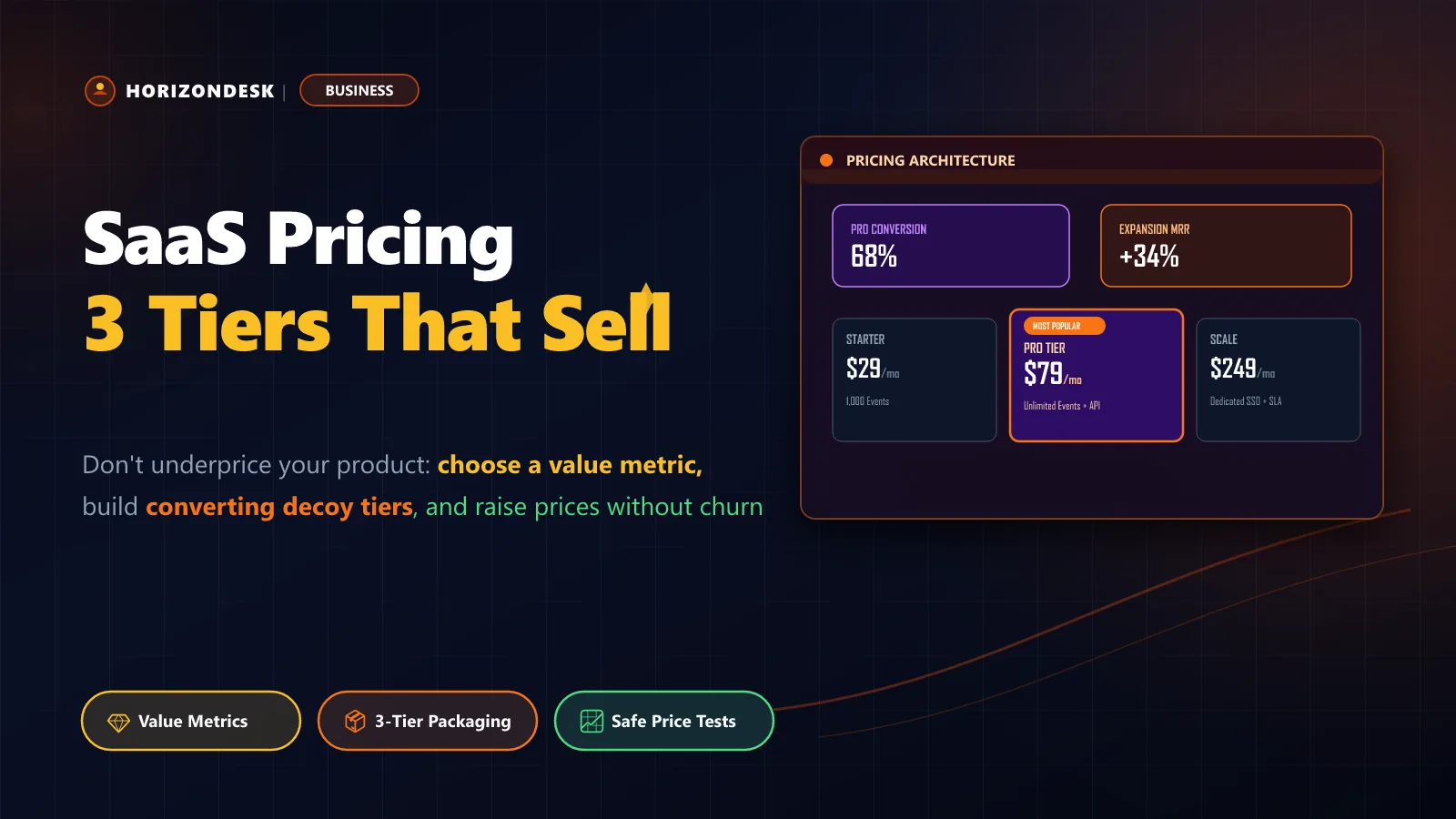
Three plans is the classic structure for a reason. It gives price-sensitive buyers an entry point, gives serious buyers a clear default, and anchors the middle plan against a more expensive option. Here's an example for a project-management tool:
| Plan | Price | Who it's for | Key limits |
|---|---|---|---|
| Starter | $19/month | Freelancers and solo users | 1 seat, 3 active projects |
| Team (most popular) | $49/month | Small teams | 5 seats, unlimited projects, integrations |
| Business | $149/month | Growing companies | 20 seats, SSO, audit log, priority support |
Design the tiers around who the customer is, not a random list of features. Put the features larger companies genuinely need — single sign-on, permissions, audit logs, invoicing by bank transfer — in the top tier. Those buyers have bigger budgets and expect to pay for them.
Offer annual plans
Offer annual billing at roughly two months free. You get cash up front, and customers who commit for a year churn far less. If you sell in India as well as abroad, consider local-currency plans — a ₹1,499 plan often converts much better than a dollar price converted at the day's rate.
If nobody ever pushes back on your price, it's almost certainly too low.
Mistakes that cost founders the most
- Pricing too low. At $5 a month you need 2,000 customers to reach $10,000 in monthly revenue. At $49 you need about 205. Support costs per customer barely change.
- A free plan that's too generous. If the free tier solves the whole problem, few will upgrade. A time-limited trial is often the better choice for B2B tools.
- Too many plans. Five tiers and a comparison grid of 40 rows slows decisions down. When in doubt, cut.
- Never raising prices. Your product improves every month. Your price should too, at least once a year.
How to test a price safely
You don't need a pricing consultant to learn a lot. Ask in customer interviews at what price the product would feel expensive, and at what price it would feel too cheap to trust. Then raise prices for new signups only, leaving existing customers on their current plan.
Watch conversion for a few weeks. The maths is often surprising: if a 40% price increase reduces conversions by 20%, revenue from new customers still rises by 12%, and you're serving fewer accounts for more money. Pricing isn't a decision you make once. It's an experiment you keep running.