Ask anyone how big an emergency fund should be and you'll hear the same answer: three to six months of expenses. It's a reasonable rule, but it hides two important questions. Expenses of what? And why three for one person and six for another? Answering those turns a vague target into a number you can actually plan around.
Start with essential expenses, not salary
An emergency fund exists to keep your life running when income stops or a big bill arrives. In a real emergency you'd cut dining out, shopping and holidays immediately. So size the fund on essential monthly expenses — the bills that keep arriving no matter what.
Take an illustrative household with a take-home income of ₹1,20,000 a month. Its essential costs might look like this:
- Rent: ₹30,000
- Groceries and household supplies: ₹10,000
- Home loan or car EMI: ₹12,000
- School fees (monthly equivalent): ₹7,000
- Electricity, gas, phone and internet: ₹4,000
- Commuting: ₹4,000
- Insurance premiums (monthly equivalent): ₹3,000
That adds up to ₹70,000 — well below the salary. Sizing on income would have overshot the target by 70% and kept extra money sitting idle for years.
How many months? Match it to your risk
The number of months depends on how likely you are to lose income and how long it would take to replace it:
| Your situation | Suggested cover | Example at ₹70,000/month |
|---|---|---|
| Two stable incomes, no dependents | 3 months | ₹2,10,000 |
| Single income with dependents | 6 months | ₹4,20,000 |
| Senior or specialised role (longer job searches) | 6–9 months | ₹4,20,000–₹6,30,000 |
| Freelancer, business owner or commission-based | 9–12 months | ₹6,30,000–₹8,40,000 |
| Ageing parents or limited health cover | Add 2–3 months | +₹1,40,000–₹2,10,000 |
The same logic works in any currency. If your essentials are $3,000 a month and you're the only earner in a household with children, six months means $18,000.
An emergency fund isn't an investment. It's the thing that lets your investments stay invested.
Where to keep it
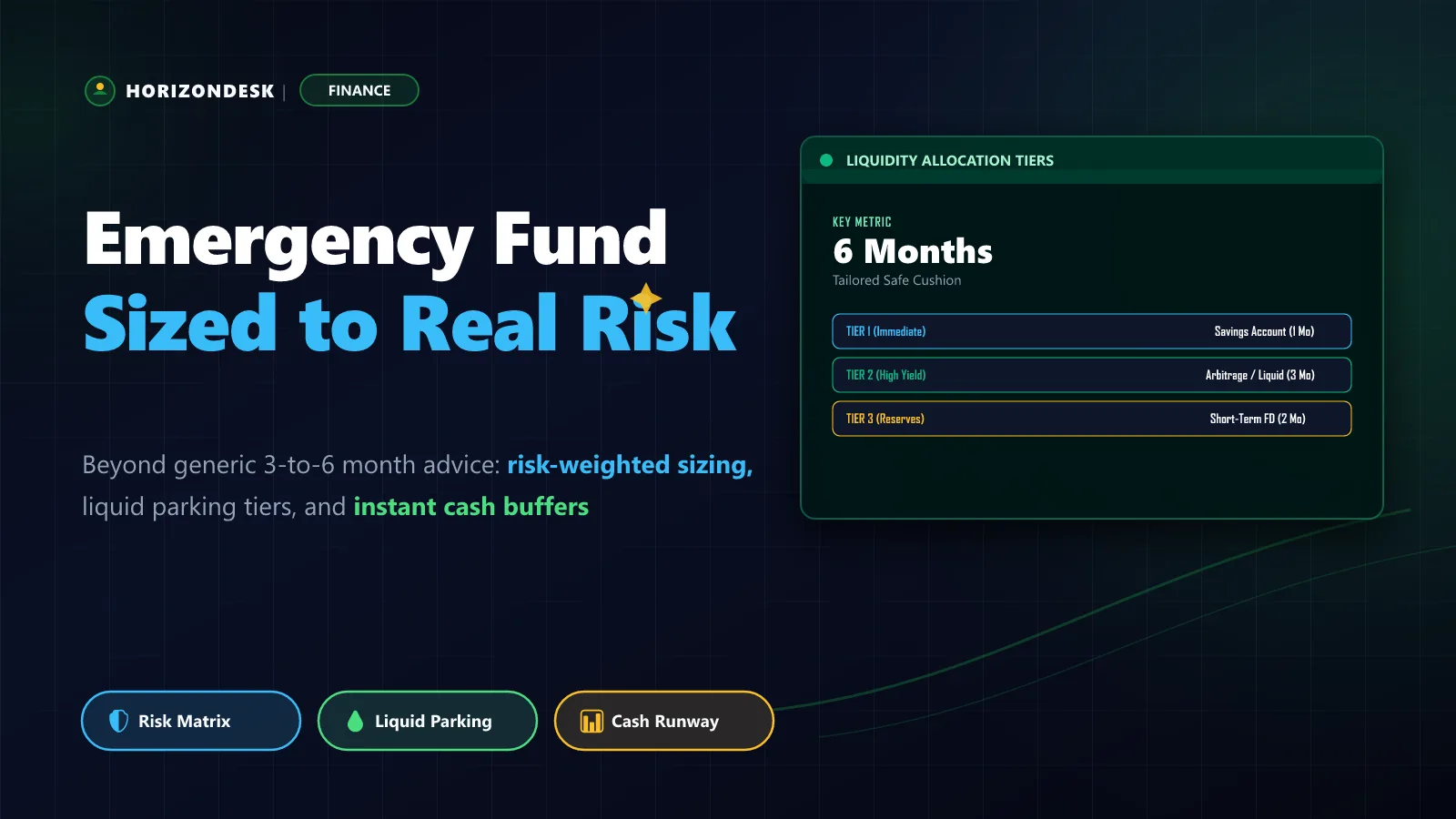
Emergency money needs to be safe and quick to access. Returns come third. A tiered approach balances all three:
Tier 1: one month in a savings account
Instantly available, for the emergency that happens on a Sunday night.
Tier 2: two to three months in a liquid fund or sweep-in deposit
Liquid mutual funds typically pay out by the next business day and usually earn more than a savings account, and some offer instant redemption for a limited amount. A sweep-in fixed deposit earns FD-like interest but breaks automatically when your savings balance runs low. In the US or UK, a high-yield savings account or money market fund plays the same role.
Tier 3: the rest in short-term deposits
Laddered fixed deposits or ultra-short-term debt funds for the remainder. You might pay a small penalty for breaking an FD early, which is acceptable for money you hope never to use.
What doesn't belong here: equity funds, stocks or crypto. Markets tend to fall at exactly the moment layoffs rise, which is precisely when you'd need to sell.
Building it without stalling everything else
- Get insured first. Health insurance and, if anyone depends on your income, term life cover. An emergency fund can't absorb a major hospital bill on its own.
- Aim for one month, then build. A first milestone you can hit in a few months beats a six-month target that feels endless.
- Automate a fixed amount on salary day, and send half of any bonus or windfall to the fund until it's full.
- Keep retirement contributions going where your employer matches them — that match is free money you won't get back.
Decide in advance what counts as an emergency: job loss, a medical bill, an urgent repair, a family crisis. Write it down. And when you do use the fund, refill it before restarting other goals. That's the whole system — a simple number, sized to your real life, waiting quietly until the day you need it.