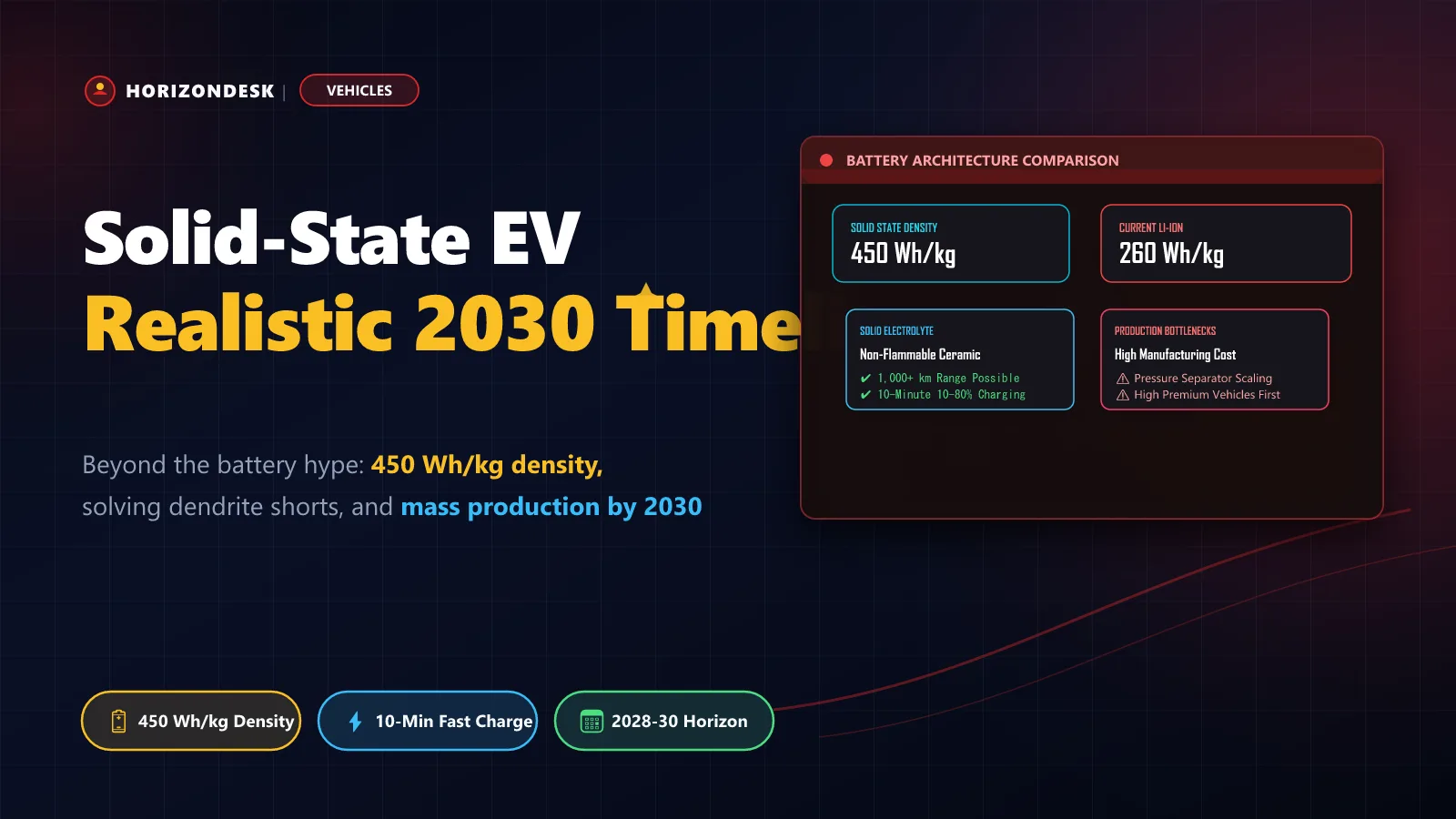
Every few months a headline announces that solid-state batteries are about to change everything: double the range, ten-minute charging, no fire risk. Then the next year's cars arrive with the same lithium-ion chemistry as before. Both things are true. Solid-state technology is real and progressing, but it's moving through the slow, expensive process of going from lab cell to millions of cars.
Here's what the technology is, why it's hard, and a grounded view of when it will matter to buyers.
What makes a battery "solid-state"
Today's lithium-ion batteries move lithium ions between two electrodes through a liquid electrolyte. That liquid works well but is flammable, and it limits which electrode materials can be used safely.
A solid-state battery replaces the liquid with a solid electrolyte — usually a ceramic, a sulfide-based material or a polymer. That change potentially unlocks:
- Higher energy density, especially if paired with a lithium-metal anode, meaning more range from the same size and weight.
- Better safety, because there's far less flammable liquid to feed a thermal event.
- Faster charging, in some designs, with less degradation.
- Wider temperature tolerance and potentially longer life.
Why it's so hard to scale
Making a few good cells in a lab is very different from making millions of identical ones cheaply. The main obstacles:
Interfaces and dendrites
Liquids naturally flow into every gap between electrode and electrolyte. Solids don't. Keeping tight contact as materials expand and contract during charging is difficult, and microscopic lithium filaments called dendrites can still grow through some solid electrolytes and short the cell.
Manufacturing
Some promising solid electrolytes are sensitive to moisture and need very dry production environments. Others require high stack pressure to work well. Existing gigafactories are built for liquid-electrolyte cells, so new processes and equipment are needed.
Cost
Conventional lithium-ion, and especially LFP chemistry, has fallen dramatically in price over the past decade. A new technology has to compete with an incumbent that keeps getting cheaper and better.
The question isn't whether solid-state batteries work. It's whether they can be made by the million at a price buyers accept.
A realistic timeline
Several carmakers and battery firms have publicly announced targets, and some have already road-tested prototype vehicles fitted with solid-state cells. Toyota, for example, has spoken publicly about aiming for a first application around 2027–28. Based on announcements and the usual pace of automotive adoption, a sensible expectation looks like this:
| Phase | Rough timeframe | What to expect |
|---|---|---|
| Semi-solid-state cells | Already on sale | Reduced liquid content; offered in a small number of premium EVs, mainly in China |
| Pilot lines and prototype test fleets | Now to 2027 | Road testing, sample cells supplied to carmakers, validation work |
| Limited production | Late 2020s | Low volumes in flagship or performance models at premium prices |
| Mainstream adoption | 2030s | Wider availability as costs fall, likely alongside, not replacing, lithium-ion |
Automotive timelines tend to slip. A battery has to survive years of validation for safety, cold weather, fast charging and crash performance before it appears in a mass-market car. Treat any announced date as a best case.
Should you wait to buy an EV?
For almost everyone, no. If an EV suits your driving today, waiting several years for a technology that will first arrive in expensive models doesn't make financial sense. Meanwhile, conventional batteries keep improving: LFP packs offer long life and lower cost, sodium-ion cells are entering production for smaller vehicles and energy storage, and charging speeds and software continue to get better with each model year.
When solid-state batteries do arrive in volume, they'll be an upgrade, not a reason today's EVs become obsolete. A well-maintained modern battery will still deliver years of reliable service. Buy the car that fits your life now, and let the next breakthrough be a pleasant surprise for your next one.