Building a simple mobile app with a few screens is straightforward. You pass callbacks down the widget tree, lift state up when necessary, or wrap widgets in a basic state container. But as your cross-platform application scales to support hundreds of thousands of active users, live inventory synchronization, dynamic multi-step checkout flows, and international transactions across various currencies—from ₹50,000 online purchases to $600 SaaS subscriptions—unstructured state management quickly turns into an intractable maintenance headache.
When your cross-functional engineering team grows from two developers to twenty, basic state wrappers crumble under complex async operations, deep routing stacks, and nested rebuild cycles. Deciding between Riverpod and Flutter Bloc remains one of the most critical architectural choices for cross-platform app teams. Both state management libraries have matured significantly, but they represent fundamentally different engineering philosophies, developer workflows, and architectural structures.
The Architecture Split: How Riverpod and Bloc Handle State
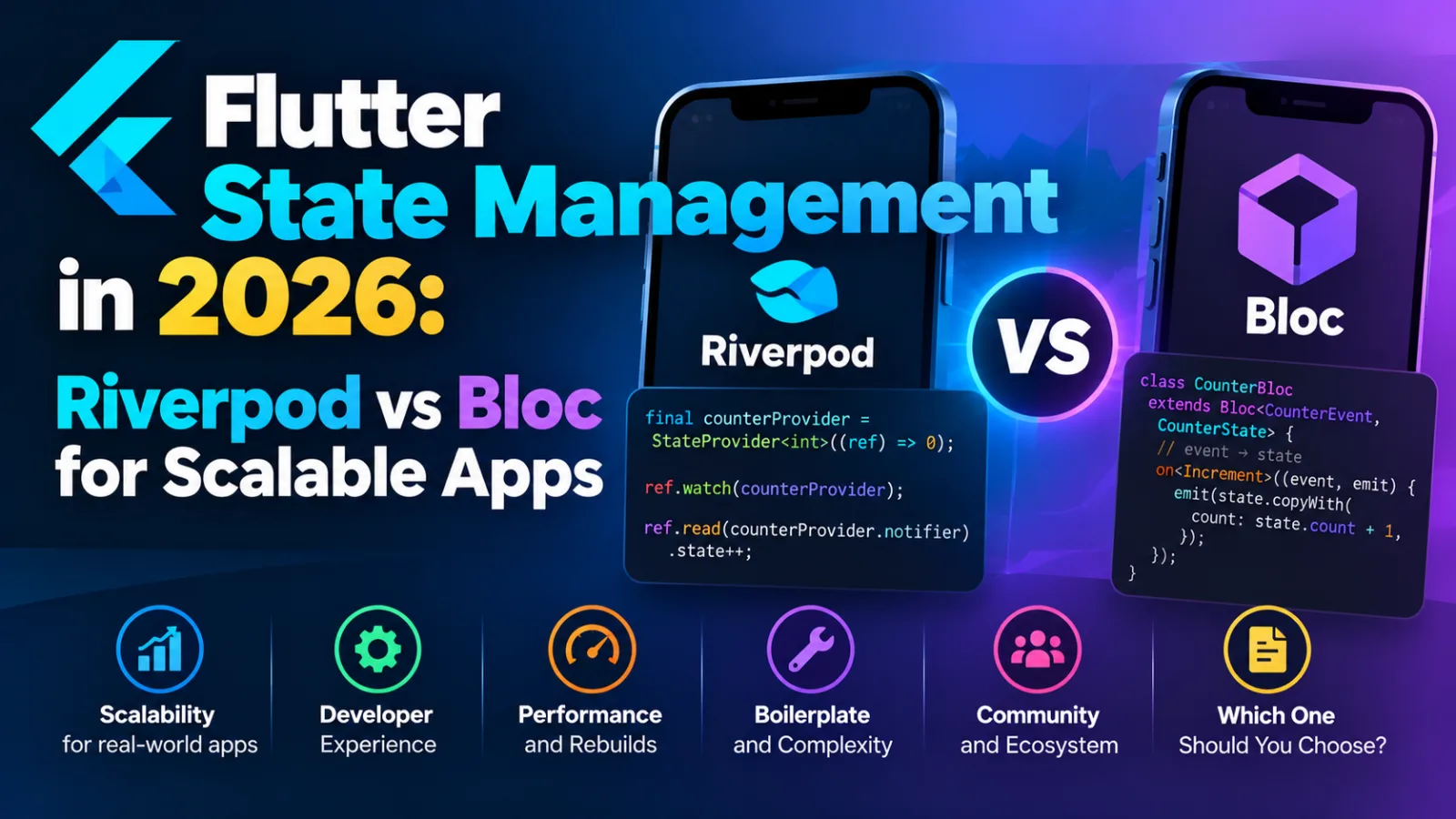
At its core, Flutter Bloc (Business Logic Component) enforces a strict, event-driven architecture rooted in reactive programming principles. Every user action, system notification, or background process is explicitly dispatched as an event. A Bloc intercepts these events, executes business logic, and emits an immutable state. This strict unidirectional data flow ensures that application state transitions remain predictable, reproducible, and easy to trace across complex enterprise applications.
Riverpod takes a declarative, compile-safe approach to dependency injection and reactive state management. Created as a complete rewrite of the original Provider package, Riverpod decouples state management entirely from the Flutter widget tree. Instead of relying on BuildContext to locate state nodes across inherited widgets, Riverpod treats state as globally declared, compile-time safe providers. Widgets subscribe directly to these providers using reactive refs, triggering granular widget rebuilds only when specific data slices change.
Comparing Developer Experience and Scalability
When evaluating developer experience across a team, project longevity, code readability, and onboarding efficiency play decisive roles.
Bloc: Governance, Rigor, and Standardisation
Bloc excels in large enterprise environments where strict architectural consistency is paramount across multiple independent engineering pods.
- Standardised Structure: Because Bloc mandates strict separation between events, states, and business logic, any developer can step into a codebase and immediately locate where data transformations occur.
- Predictable State History: Immutable state emissions make time-travel debugging and centralized logging straightforward across complex user journeys.
- Higher Initial Setup: Bloc requires writing distinct classes or unions for events and states, which introduces noticeable boilerplate for straightforward features.
Riverpod: Expressiveness, Safety, and Fast Iteration
Riverpod prioritizes developer velocity while offering exceptional compile-time safety and flexibility.
- No Context Dependency: Providers can be accessed anywhere inside your application, including non-UI services, background tasks, and utility classes.
- Built-In Async Handling: Riverpod's
AsyncValueconstruct elegantly wraps loading, data, and error states, eliminating defensive boilerplate during network calls. - Potential Architecture Drift: Because Riverpod allows flexible provider organization, teams must enforce strict code review guidelines to prevent business logic from leaking into UI components.
Code Comparison: Managing Shopping Cart State
To understand the practical difference in daily development, consider a digital marketplace shopping cart that handles item updates and network latency.
Here is how dependency imports are configured inside your configuration file:
name: commerce_app
description: Scalable e-commerce application

environment:
  sdk: ">=3.5.0 <4.0.0"

dependencies:
  flutter:
    sdk: flutter
  flutter_riverpod: ^2.6.0
  flutter_bloc: ^8.1.6
Here is how an expressive cart state manager is implemented using Riverpod:
// Expressive AsyncNotifier representation in TypeScript-style state logic
export interface CartItem {
  id: string;
  name: string;
  price: number;
}

export interface CartState {
  items: CartItem[];
  totalAmount: number;
}

export class CartNotifier {
  private state: CartState = { items: [], totalAmount: 0 };

  public getState(): CartState {
    return this.state;
  }

  async addItem(item: CartItem): Promise<void> {
    const updatedItems = [...this.state.items, item];
    const updatedTotal = updatedItems.reduce((sum, i) => sum + i.price, 0);
    this.state = { items: updatedItems, totalAmount: updatedTotal };
  }
}
And here is the equivalent event-driven architecture using Bloc's explicit event-state pattern:
// Strict Bloc Event and State contract
export type CartEvent =
  | { type: 'ADD_ITEM'; item: CartItem }
  | { type: 'REMOVE_ITEM'; id: string };

export type CartState =
  | { status: 'initial'; items: []; total: 0 }
  | { status: 'loading'; items: CartItem[]; total: number }
  | { status: 'success'; items: CartItem[]; total: number }
  | { status: 'error'; message: string; items: CartItem[]; total: number };

export class CartBloc {
  private state: CartState = { status: 'initial', items: [], total: 0 };

  public handleEvent(event: CartEvent): CartState {
    switch (event.type) {
      case 'ADD_ITEM':
        const newItems = [...this.state.items, event.item];
        const newTotal = newItems.reduce((sum, item) => sum + item.price, 0);
        return { status: 'success', items: newItems, total: newTotal };
      case 'REMOVE_ITEM':
        const filtered = this.state.items.filter(i => i.id !== event.id);
        return { status: 'success', items: filtered, total: filtered.reduce((s, i) => s + i.price, 0) };
      default:
        return this.state;
    }
  }
}
Notice how Bloc explicitly separates action triggers (CartEvent) from state outcomes (CartState), making it impossible to alter state without emitting an event. Riverpod, by contrast, exposes direct methods on the notifier, keeping code concise while maintaining immutability.
Performance and Memory Optimization
In high-volume applications targeting budget devices alongside flagship smartphones, memory consumption and frame rate consistency directly influence user retention and conversion rates.
Riverpod features automatic lifecycle management via auto-dispose providers. When a user exits a dynamic checkout screen, associated network streams, web sockets, and memory allocations are cleaned up automatically without manual lifecycle hooks.
Bloc relies on Flutter's widget tree scope via BlocProvider. While this guarantees that state exists as long as its corresponding widget subtree is mounted, developers must explicitly handle subscription teardowns and avoid redundant global providers.
select method or Bloc's buildWhen parameters to filter unnecessary widget rebuilds. Filtering out rebuilds when non-visible properties change keeps your app running smoothly at a steady 60fps or 120fps.Feature Comparison: Riverpod vs Bloc
The following table breaks down how both frameworks compare across core operational metrics:
| Operational Factor | Riverpod | Flutter Bloc |
|---|---|---|
| Core Architecture | Declarative Reactive Providers | Unidirectional Event-State Streams |
| Widget Tree Coupling | Fully Decoupled (No Context) | Tree-Dependent (BuildContext) |
| Boilerplate Overhead | Low to Moderate | Moderate to High |
| Async State Handling | Native AsyncValue |
Custom State Enums / Unions |
| Testing Ergonomics | Simple Provider Overrides | Dedicated bloc_test Framework |
| Recommended Context | Agile Teams & Rapid Scale | Large Enterprise & Multi-Team Projects |
Making the Decision for Your Team
Selecting between Riverpod and Bloc depends on team dynamics, organizational goals, and codebase architecture rather than raw library capabilities.
- Choose Riverpod if: You require fast development iterations, prefer minimal boilerplate code, rely heavily on asynchronous state processing, and want to keep business logic completely detached from widget contexts.
- Choose Bloc if: You manage large cross-functional engineering teams, require strict architectural enforcement across feature modules, demand complete auditability of state events, or maintain existing RxDart codebases.
Wrapping Up
Both Riverpod and Bloc are production-proven, highly scalable solutions capable of supporting complex cross-platform applications. Neither framework is inherently superior; rather, each solves state management problems through different architectural approaches.
To choose the right option for your team:
- Build a prototype of a core app feature using both approaches.
- Evaluate how comfortably your engineering team adopts reactive streams versus functional provider bindings.
- Establish consistent code patterns and linting rules early to ensure your architecture remains maintainable as your product scales.